Ch. R - Review of Basic Concepts
Lial - College Algebra 13th Edition
Lial13th EditionCollege AlgebraISBN: 9780136881063Not the one you use?Change textbook
Chapter 1, Problem 41

Determine whether each statement is true or false. 1 ∈ {11, 5, 4, 3, 1}

Verified step by step guidance
1
Understand the problem: We need to determine if the number 1 is an element of the set \{11, 5, 4, 3, 1\}.
Recall the definition of set membership: An element \(a\) is in a set \(S\) if \(a\) is listed as one of the elements of \(S\). This is denoted as \(a \in S\).
Look at the given set \(\{11, 5, 4, 3, 1\}\) and check if the number 1 appears among the elements listed.
Since 1 is explicitly listed as an element of the set, it means \(1 \in \{11, 5, 4, 3, 1\}\) is true.
Therefore, the statement \(1 \in \{11, 5, 4, 3, 1\}\) is true.

Verified video answer for a similar problem:

This video solution was recommended by our tutors as helpful for the problem above.
Video duration:
40s

Key Concepts

Here are the essential concepts you must grasp in order to answer the question correctly.

Set Membership

Set membership refers to whether an element belongs to a given set. If an element is listed within the curly braces defining the set, it is considered a member. For example, 1 ∈ {11, 5, 4, 3, 1} means checking if 1 is an element of that set.
Recommended video:
05:18
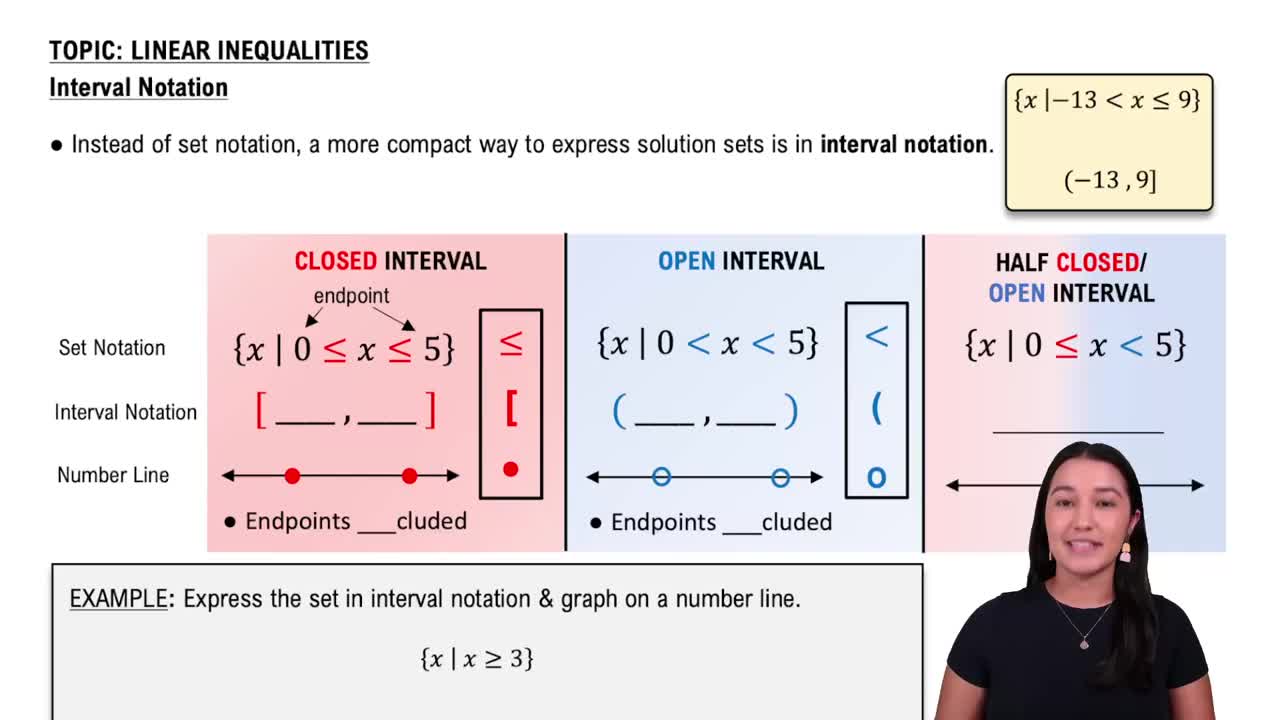
Interval Notation

Notation for Sets

Sets are typically denoted by curly braces {} containing distinct elements separated by commas. The symbol '∈' means 'is an element of,' and is used to express membership. Understanding this notation is essential for interpreting and answering questions about sets.
Recommended video:
05:18
Interval Notation

True or False Statements in Mathematics

Determining whether a statement is true or false involves verifying the claim based on definitions or properties. In this case, the statement '1 ∈ {11, 5, 4, 3, 1}' is true if 1 is found in the set, otherwise false. This skill is fundamental in logic and proofs.
Recommended video:
6:57
Classifying Systems of Linear Equations