Perform the indicated operations and/or simplify each expression. Assume all variables represent positive real numbers. ∛2/3
Ch. R - Review of Basic Concepts

Chapter 1, Problem 129
Complete the table of fraction, decimal and percent equivalents.

Verified step by step guidance1
Understand that percent means 'per hundred,' so to convert a decimal to a percent, you multiply the decimal by 100.
Take the given decimal value, which is \(0.01\), and multiply it by 100: \(0.01 \times 100\).
Write the result of the multiplication as the percent equivalent, followed by the percent symbol '%'.
Recognize that this process converts the decimal to a percentage, which is another way to express the same value.
Complete the table by filling in the percent column with the value obtained from the multiplication.

Verified video answer for a similar problem:
This video solution was recommended by our tutors as helpful for the problem above.
Video duration:
1mWas this helpful?
Key Concepts
Here are the essential concepts you must grasp in order to answer the question correctly.
Fraction to Decimal Conversion
Converting a fraction to a decimal involves dividing the numerator by the denominator. For example, 1/100 means 1 divided by 100, which equals 0.01. Understanding this process helps in comparing and converting between different numerical forms.
Recommended video:
Guided course
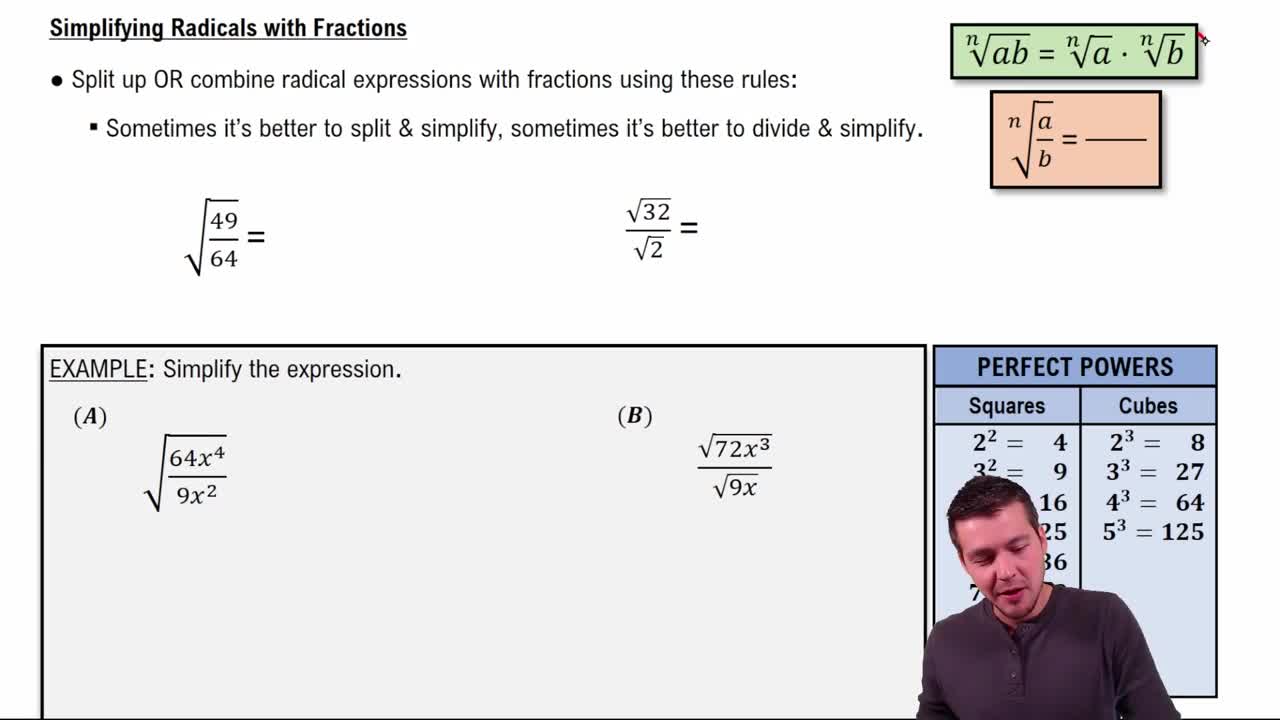
Radical Expressions with Fractions
Decimal to Percent Conversion
To convert a decimal to a percent, multiply the decimal by 100 and add the percent symbol (%). For instance, 0.01 multiplied by 100 equals 1%, showing how decimals represent parts of a hundred.
Recommended video:
The Number e
Simplifying Fractions
A fraction is in lowest terms when the numerator and denominator have no common factors other than 1. Simplifying fractions ensures clarity and consistency when converting between fractions, decimals, and percents.
Recommended video:
Guided course
Radical Expressions with Fractions
Related Practice
Textbook Question
3
views
Textbook Question
Simplify each expression. (3/4r)(-12)
6
views
Textbook Question
Factor out the least power of the variable or variable expression. Assume all variables represent positive real numbers. See Example 8.
Textbook Question
Factor out the least power of the variable or variable expression. Assume all variables represent positive real numbers. See Example 8. 2(3x+1)-3/2+4(3x+1)-1/2+6(3x+1)1/2
2
views
Textbook Question
Factor out the least power of the variable or variable expression. Assume all variables represent positive real numbers. See Example 8. 4x(2x+3)-5/9+6x2(2x+3)4/9-8x3(2x+3)13/9
Textbook Question
Factor out the least power of the variable or variable expression. Assume all variables represent positive real numbers. See Example 8.