Ch. R - Review of Basic Concepts
Lial - College Algebra 13th Edition
Lial13th EditionCollege AlgebraISBN: 9780136881063Not the one you use?Change textbook
Chapter 1, Problem 28

Add or subtract, as indicated. (8x3+x3)+(2x3+x2)(4x2+3x1)-(8x^3+x-3) + (2x^3+x^2) - (4x^2+3x-1)

Verified step by step guidance
1
First, rewrite the expression clearly, paying attention to the signs in front of each parenthesis: \(-(8x^3 + x - 3) + (2x^3 + x^2) - (4x^2 + 3x - 1)\).
Next, distribute the negative signs to each term inside the parentheses where applicable: change the signs of all terms inside the first and third parentheses because of the leading minus signs.
After distribution, write out all the terms without parentheses: \(-8x^3 - x + 3 + 2x^3 + x^2 - 4x^2 - 3x + 1\).
Now, group like terms together. Like terms are terms that have the same variable raised to the same power: group \(x^3\) terms, \(x^2\) terms, \(x\) terms, and constant terms separately.
Finally, combine the coefficients of the like terms by adding or subtracting them accordingly to simplify the expression.

Verified video answer for a similar problem:

This video solution was recommended by our tutors as helpful for the problem above.
Video duration:
3m
Was this helpful?

Key Concepts

Here are the essential concepts you must grasp in order to answer the question correctly.

Polynomial Addition and Subtraction

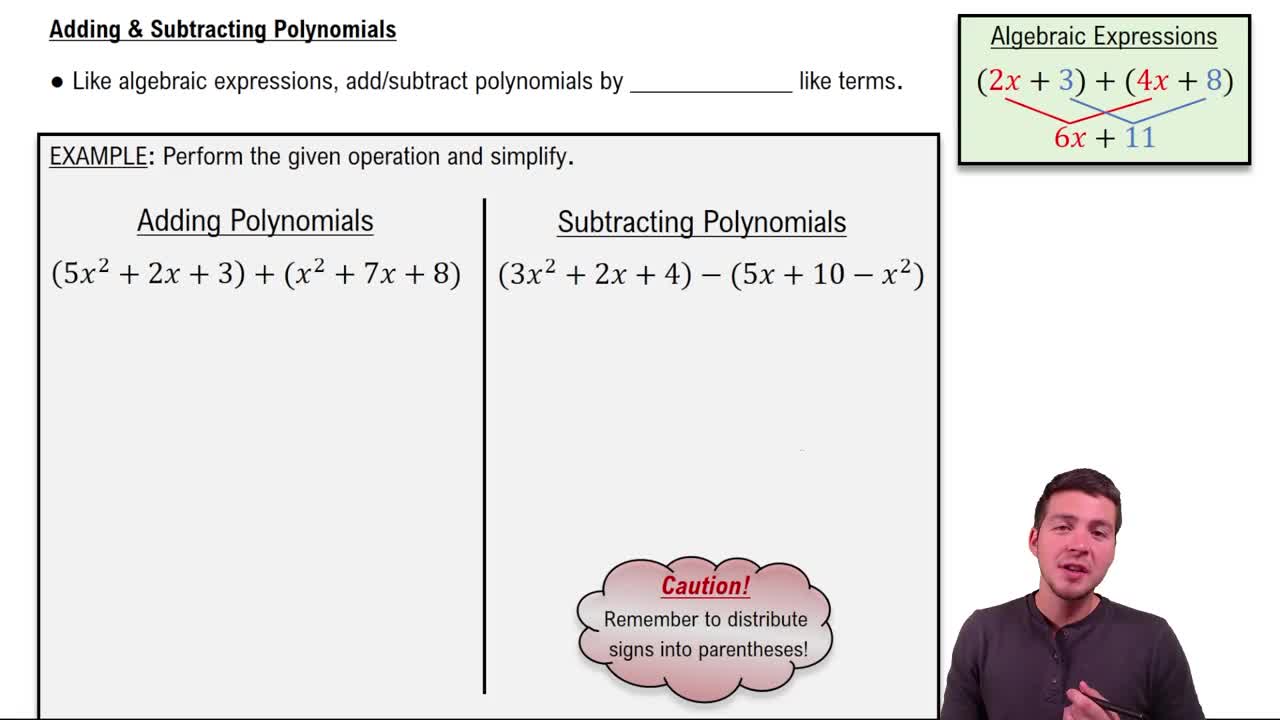
Adding or subtracting polynomials involves combining like terms, which are terms with the same variable raised to the same power. When subtracting, distribute the negative sign to each term inside the parentheses before combining. This ensures correct simplification of the expression.
Recommended video:
Guided course
03:34
Adding and Subtracting Polynomials

Like Terms

Like terms have identical variable parts and exponents, such as 8x^3 and 2x^3. Only like terms can be added or subtracted directly by combining their coefficients. Recognizing like terms is essential for simplifying polynomial expressions accurately.
Recommended video:
Guided course
03:50
Adding & Subtracting Like Radicals

Distributive Property

The distributive property allows you to multiply a single term outside the parentheses by each term inside. For subtraction, it means applying a negative sign to every term within the parentheses, changing their signs before combining. This step is crucial to avoid errors in polynomial operations.
Recommended video:
Guided course
04:15
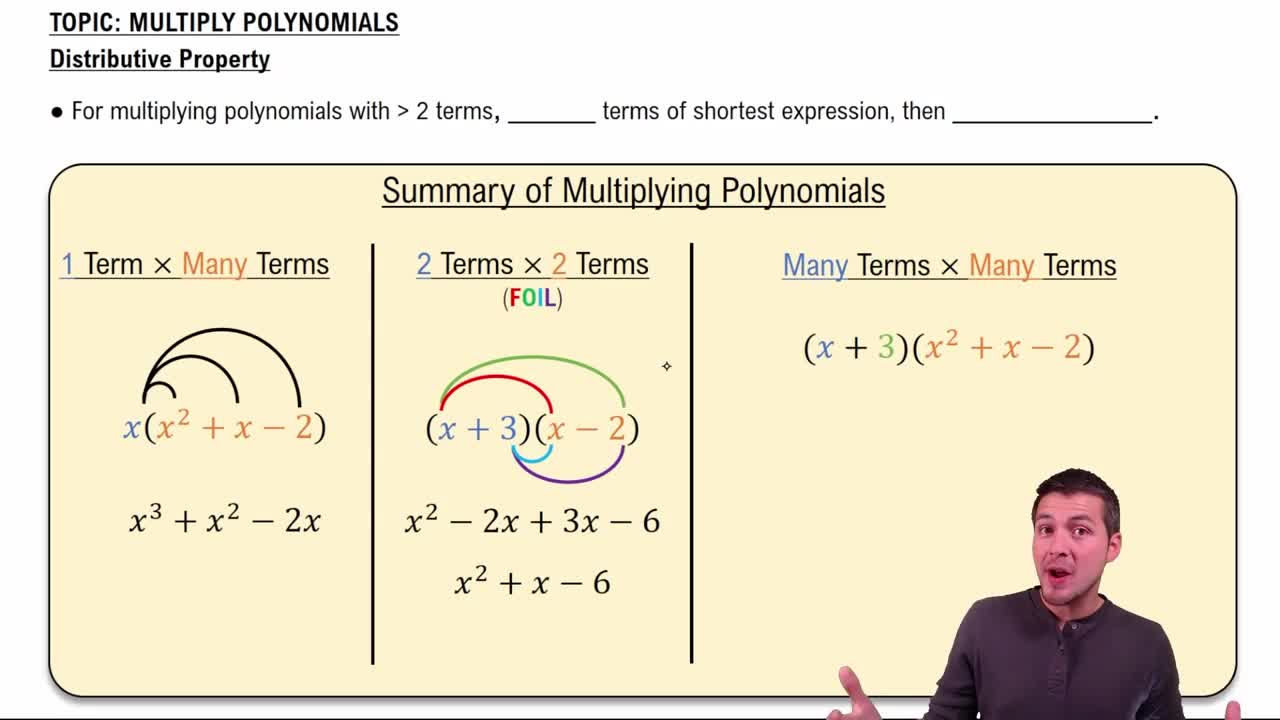
Multiply Polynomials Using the Distributive Property