Ch. 5 - Systems and Matrices
Lial - College Algebra 13th Edition
Lial13th EditionCollege AlgebraISBN: 9780136881063Not the one you use?Change textbook
Chapter 6, Problem 23

Use the Gauss-Jordan method to solve each system of equations. For systems in two variables with infinitely many solutions, write the solution with y arbitrary. For systems in three variables with infinitely many solutions, write the solution set with z arbitrary.
3x + 2y = -9
2x - 5y = -6

Verified step by step guidance
1
Write the system of equations as an augmented matrix: \[\left[\begin{array}{cc|c} 3 & 2 & -9 \\ 2 & -5 & -6 \end{array}\right]\]
Use row operations to get a leading 1 in the first row, first column. For example, divide the first row by 3: \[R_1 \to \frac{1}{3} R_1\]
Eliminate the x-term in the second row by replacing the second row with \( R_2 - 2 \times R_1 \): \[R_2 \to R_2 - 2R_1\]
Make the leading coefficient in the second row a 1 by dividing the second row by its current leading coefficient.
Use back substitution by eliminating the y-term in the first row using the second row, then write the solution for \(x\) and \(y\) from the resulting matrix.

Verified video answer for a similar problem:

This video solution was recommended by our tutors as helpful for the problem above.
Video duration:
7m
Was this helpful?

Key Concepts

Here are the essential concepts you must grasp in order to answer the question correctly.

Gauss-Jordan Elimination Method

Gauss-Jordan elimination is a systematic procedure to solve systems of linear equations by transforming the augmented matrix into reduced row-echelon form. This method uses row operations to simplify the system, making it easier to identify solutions or determine if there are infinitely many or no solutions.
Recommended video:
Guided course
6:04
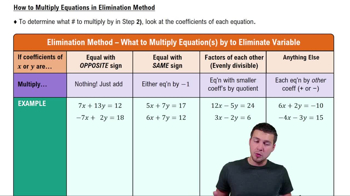
How to Multiply Equations in Elimination Method

Types of Solutions in Linear Systems

A system of linear equations can have a unique solution, infinitely many solutions, or no solution. Infinitely many solutions occur when equations are dependent, leading to free variables that can take arbitrary values, which must be expressed explicitly in the solution.
Recommended video:
Guided course
4:27
Introduction to Systems of Linear Equations

Expressing Solutions with Arbitrary Variables

When a system has infinitely many solutions, one or more variables are free and can be assigned arbitrary parameters (like y or z). Writing the solution set involves expressing dependent variables in terms of these arbitrary variables to describe all possible solutions clearly.
Recommended video:
Guided course
06:44
Radical Expressions with Variables