Find the maximum and minimum values of each objective function over the region of feasible solutions shown at the right. objective function = 3x + 5y
Ch. 5 - Systems and Matrices

Chapter 6, Problem 79
Use a system of equations to solve each problem. Find an equation of the parabola y = ax2 + bx + c that passes through the points (2, 3), (-1, 0), and (-2, 2).
Verified step by step guidance1
Start by substituting each given point into the general form of the parabola equation \(y = ax^2 + bx + c\). For the point \((2, 3)\), substitute \(x = 2\) and \(y = 3\) to get the equation \(3 = a(2)^2 + b(2) + c\).
Next, substitute the point \((-1, 0)\) into the equation by setting \(x = -1\) and \(y = 0\), which gives \(0 = a(-1)^2 + b(-1) + c\).
Then, substitute the point \((-2, 2)\) by setting \(x = -2\) and \(y = 2\), resulting in \(2 = a(-2)^2 + b(-2) + c\).
Now, simplify each equation to form a system of three linear equations in terms of \(a\), \(b\), and \(c\). This system will look like: \(4a + 2b + c = 3\), \(a - b + c = 0\), and \(4a - 2b + c = 2\).
Solve this system of equations using either substitution, elimination, or matrix methods to find the values of \(a\), \(b\), and \(c\). These values will give you the specific equation of the parabola.

Verified video answer for a similar problem:
This video solution was recommended by our tutors as helpful for the problem above.
Video duration:
6mWas this helpful?
Key Concepts
Here are the essential concepts you must grasp in order to answer the question correctly.
System of Equations
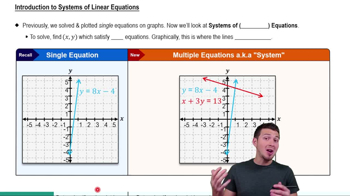
A system of equations consists of multiple equations with multiple variables that are solved together. In this problem, each point provides an equation when substituted into y = ax^2 + bx + c, creating a system to find a, b, and c.
Recommended video:
Guided course
Introduction to Systems of Linear Equations
Quadratic Function Form
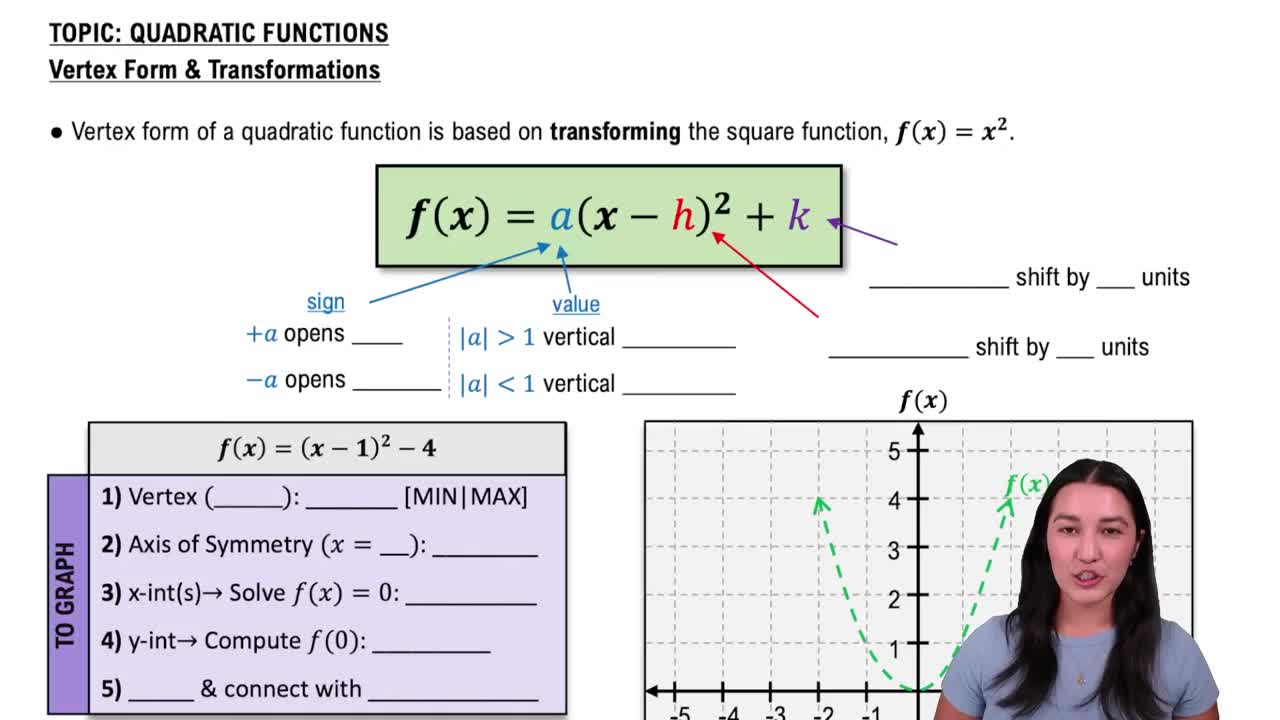
The quadratic function y = ax^2 + bx + c represents a parabola, where a, b, and c are constants. Understanding this form allows you to set up equations by plugging in x and y values from given points.
Recommended video:
Vertex Form
Substitution of Points into Equations
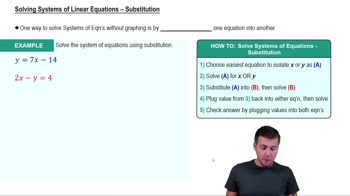
Substituting each point's coordinates into the quadratic equation generates specific equations. This step translates geometric information into algebraic form, enabling the creation of a solvable system.
Recommended video:
Guided course
Solving Systems of Equations - Substitution
Related Practice
Textbook Question
Textbook Question
For each pair of matrices A and B, find (a) AB and (b) BA. See Example 7.
Textbook Question
Use Cramer's rule to solve each system of equations. If D = 0, then use another method to determine the solution set. See Examples 5–7.
x + 2y + 3z = 4
4x + 3y + 2z = 1
-x - 2y - 3z = 0
Textbook Question
Use a system of equations to solve each problem. See Example 8. Find an equation of the line y = ax + b that passes through the points (-2, 1) and (-1, -2).
Textbook Question
Use Cramer's rule to solve each system of equations. If D = 0, then use another method to determine the solution set. See Examples 5–7.
-2x - 2y + 3z = 4
5x + 7y - z = 2
2x + 2y - 3z = -4
Textbook Question
Perform each operation, if possible.