Ch. 5 - Systems and Matrices
Lial - College Algebra 13th Edition
Lial13th EditionCollege AlgebraISBN: 9780136881063Not the one you use?Change textbook
Chapter 6, Problem 72

Solve each system. (Hint: In Exercises 69–72, let 1/x=t1/x = t and 1/y=u1/y = u.)
2x+3y=18\(\frac{2}{x}\)+\(\frac{3}{y}\)=18
4x5y=8\(\frac{4}{x}\)-\(\frac{5}{y}\)=-8

Verified step by step guidance
1
Start by using the hint given: let \( t = \frac{1}{x} \) and \( u = \frac{1}{y} \). This substitution will transform the system into a linear system in terms of \( t \) and \( u \).
Rewrite each equation by substituting \( \frac{1}{x} = t \) and \( \frac{1}{y} = u \). The system becomes: \[ 2t + 3u = 18 \] \[ 4t - 5u = -8 \]
Solve the new system of linear equations for \( t \) and \( u \) using either the substitution method or the elimination method. For example, you can multiply the first equation by 4 and the second by 2 to align coefficients for elimination.
Once you find the values of \( t \) and \( u \), recall that \( t = \frac{1}{x} \) and \( u = \frac{1}{y} \). Use these relationships to solve for \( x \) and \( y \) by taking the reciprocal of \( t \) and \( u \) respectively.
Check your solutions by substituting \( x \) and \( y \) back into the original equations to ensure they satisfy both equations.

Verified video answer for a similar problem:

This video solution was recommended by our tutors as helpful for the problem above.
Video duration:
6m

Key Concepts

Here are the essential concepts you must grasp in order to answer the question correctly.

Substitution Method

The substitution method involves replacing variables with new expressions to simplify a system of equations. In this problem, substituting 1/x = t and 1/y = u transforms the original system into a linear system in terms of t and u, making it easier to solve.
Recommended video:
04:03
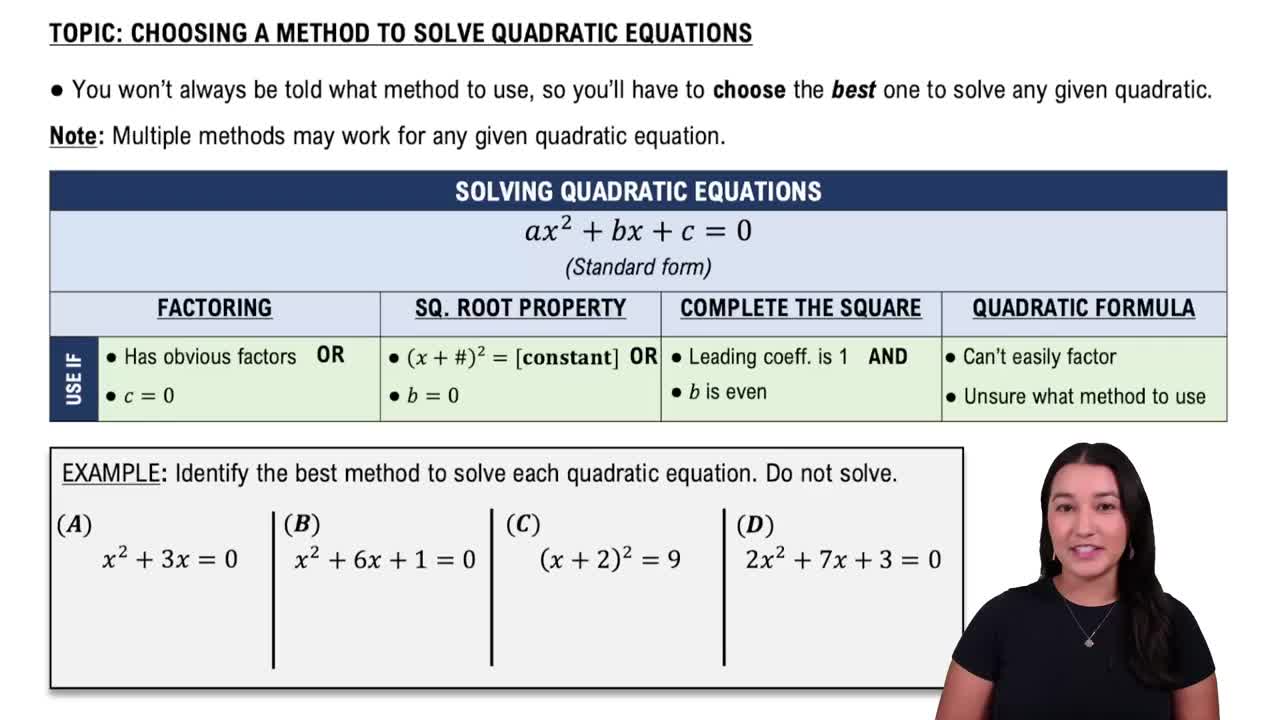
Choosing a Method to Solve Quadratics

Solving Systems of Linear Equations

Once the substitution is made, the system becomes linear in t and u. Solving systems of linear equations involves finding values for variables that satisfy all equations simultaneously, typically using methods like substitution, elimination, or matrix operations.
Recommended video:
4:27
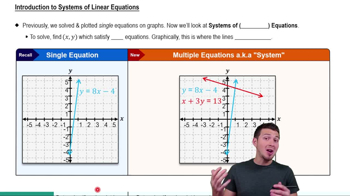
Introduction to Systems of Linear Equations

Back-Substitution

After finding the values of t and u, back-substitution is used to find the original variables x and y by reversing the substitution: x = 1/t and y = 1/u. This step is crucial to interpret the solution in terms of the original variables.
Recommended video:
5:48
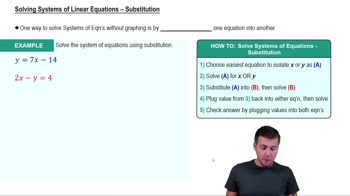
Solving Systems of Equations - Substitution
Related Practice
Textbook Question

Given A=[4231],B=[510237]A = \(\left\)[ \(\begin{matrix}\) 4 & -2 \\ 3 & 1 \(\end{matrix}\) \(\right\)], \(\quad\) B = \(\left\)[ \(\begin{matrix}\) 5 & 1 \\ 0 & -2 \\ 3 & 7 \(\end{matrix}\) \(\right\)] , and C=[541036]C = \(\left\)[ \(\begin{matrix}\) -5 & 4 & 1 \\ 0 & 3 & 6 \(\end{matrix}\) \(\right\)] , find each product, if possible. See Examples 5–7. AB

Textbook Question

Given A=[4231],B=[510237]A = \(\left\)[ \(\begin{matrix}\) 4 & -2 \\ 3 & 1 \(\end{matrix}\) \(\right\)], \(\quad\) B = \(\left\)[ \(\begin{matrix}\) 5 & 1 \\ 0 & -2 \\ 3 & 7 \(\end{matrix}\) \(\right\)] , and C=[541036]C = \(\left\)[ \(\begin{matrix}\) -5 & 4 & 1 \\ 0 & 3 & 6 \(\end{matrix}\) \(\right\)] , find each product, if possible. See Examples 5–7. BC

Textbook Question

Use Cramer's rule to solve each system of equations. If D = 0, then use another method to determine the solution set. See Examples 5–7.

(1/2)x + (1/3)y = 2

(3/2)x - (1/2)y = -12

Textbook Question

Solve each problem. The supply and demand equations for a certain commodity are given. supply: p = √(0.1q + 9) - 2 and demand: p = √(25 - 0.1q).

Find the equilibrium demand.

4
views
Textbook Question

Perform each operation, if possible.

[325][846]+[102]\(\left\)[\(\begin{matrix}\)3\\ 2\\ 5\(\end{matrix}\)\(\right\)]-\(\left\)[\(\begin{matrix}\)8\\ -4\\ 6\(\end{matrix}\[\right\)]+\(\left\)[\(\begin{matrix}\)1\\ 0\\ 2\(\end{matrix}\]\right\)]

Textbook Question

Solve each problem. The supply and demand equations for a certain commodity are given. supply: p = √(0.1q + 9) - 2 and demand: p = √(25 - 0.1q).

Find the equilibrium price (in dollars).