Find the partial fraction decomposition for each rational expression. See Examples 1–4. (3x - 2)/((x + 4)(3x2 + 1))
Ch. 5 - Systems and Matrices

Chapter 6, Problem 25
Graph each inequality. x2 + (y + 3)2 ≤ 16
Verified step by step guidance1
Identify the inequality as representing a circle with all points inside or on the boundary. The general form of a circle's equation is \( (x - h)^2 + (y - k)^2 = r^2 \), where \((h, k)\) is the center and \(r\) is the radius.
Rewrite the given inequality \( x^2 + (y + 3)^2 \leq 16 \) in the form \( (x - 0)^2 + (y - (-3))^2 \leq 4^2 \). This shows the center is at \((0, -3)\) and the radius is \(4\).
Draw the circle centered at \((0, -3)\) with radius \(4\) on the coordinate plane. This circle includes all points \((x, y)\) that satisfy the equation \( (x - 0)^2 + (y + 3)^2 = 16 \).
Since the inequality is \( \leq \), shade the entire region inside and on the circle to represent all points where \( x^2 + (y + 3)^2 \leq 16 \) holds true.
Label the center and radius on the graph for clarity, and ensure the boundary circle is solid (not dashed) because points on the circle satisfy the inequality.

Verified video answer for a similar problem:
This video solution was recommended by our tutors as helpful for the problem above.
Video duration:
9mKey Concepts
Here are the essential concepts you must grasp in order to answer the question correctly.
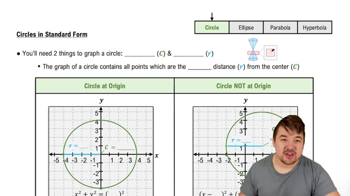
Graphing Circles
The inequality x² + (y + 3)² ≤ 16 represents all points inside or on the circle centered at (0, -3) with radius 4. Understanding how to graph circles involves identifying the center and radius from the equation and plotting the boundary circle accordingly.
Recommended video:
Circles in Standard Form
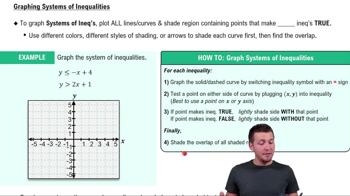
Inequalities and Regions
Inequalities like ≤ indicate that the solution includes all points inside the boundary curve, not just on it. For this problem, shading the region inside the circle shows all points (x, y) satisfying the inequality.
Recommended video:
Systems of Inequalities
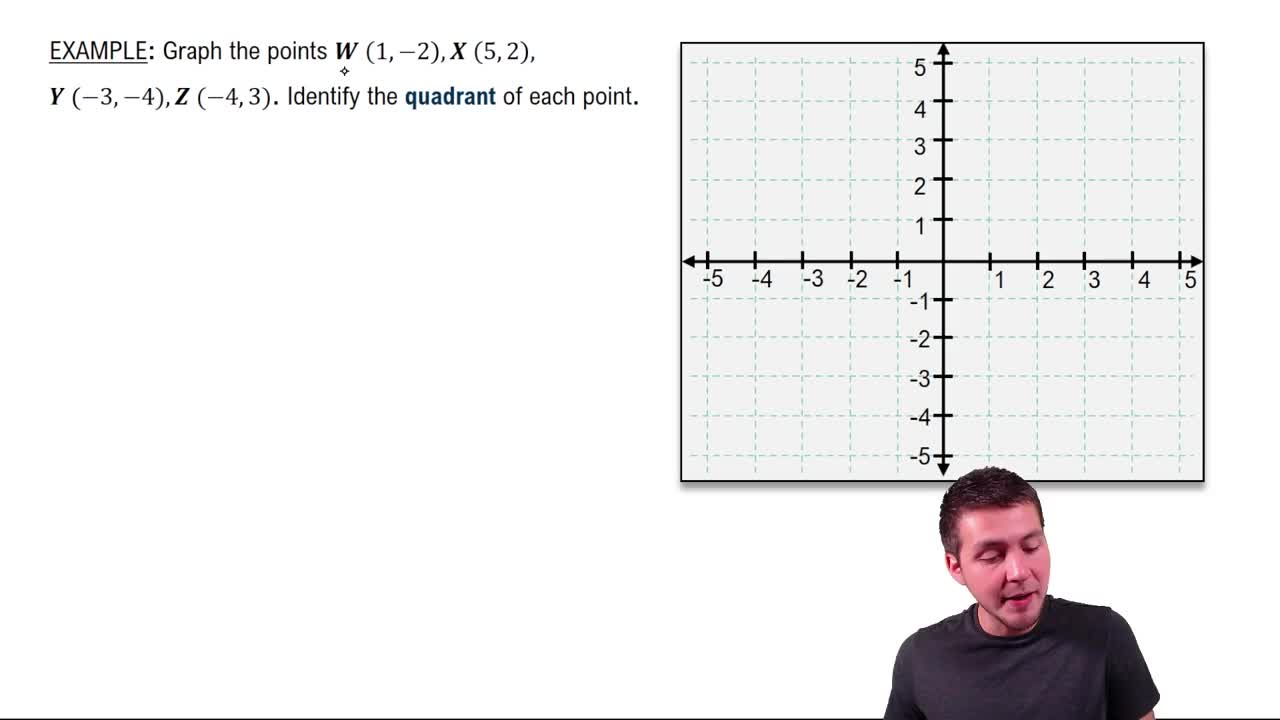
Coordinate Geometry and Transformations
Recognizing the shift in the circle’s center from the origin to (0, -3) involves understanding how adding or subtracting values inside the equation translates the graph vertically or horizontally in the coordinate plane.
Recommended video:
Graphs and Coordinates - Example
Related Practice
Textbook Question
Textbook Question
Solve each system, using the method indicated.
5x + 2y = -10
3x - 5y = -6 (Gauss-Jordan)
1
views
Textbook Question
Solve each system by elimination. In systems with fractions, first clear denominators.
6x + 7y + 2 = 0
7x - 6y - 26 = 0
2
views
Textbook Question
Use the Gauss-Jordan method to solve each system of equations. For systems in two variables with infinitely many solutions, write the solution with y arbitrary. For systems in three variables with infinitely many solutions, write the solution set with z arbitrary.
6x - 3y - 4 = 0
3x + 6y - 7= 0
1
views
Textbook Question
Graph each inequality. y > (x - 1)2 + 2
Textbook Question
Solve each nonlinear system of equations. Give all solutions, including those with nonreal complex components. See Examples 1–5.