Ch. 5 - Systems and Matrices
Lial - College Algebra 13th Edition
Lial13th EditionCollege AlgebraISBN: 9780136881063Not the one you use?Change textbook
Chapter 6, Problem 75

For what value(s) of k will the following system of linear equations have no solution? infinitely many solutions?
x - 2y = 3
-2x + 4y = k

Verified step by step guidance
1
Write down the system of equations clearly: \( x - 2y = 3 \) \( -2x + 4y = k \)
Recognize that for a system of two linear equations, the system will have: - No solution if the lines are parallel but not the same line. - Infinitely many solutions if the two equations represent the same line.
To analyze this, compare the ratios of the coefficients of \(x\), \(y\), and the constants. For the system: \( \frac{a_1}{a_2} = \frac{b_1}{b_2} \neq \frac{c_1}{c_2} \) means no solution, \( \frac{a_1}{a_2} = \frac{b_1}{b_2} = \frac{c_1}{c_2} \) means infinitely many solutions, where \(a_1\), \(b_1\), \(c_1\) are coefficients from the first equation and \(a_2\), \(b_2\), \(c_2\) from the second.
Identify the coefficients: First equation: \(a_1 = 1\), \(b_1 = -2\), \(c_1 = 3\) Second equation: \(a_2 = -2\), \(b_2 = 4\), \(c_2 = k\)
Set up the ratios and solve for \(k\): Calculate \(\frac{a_1}{a_2}\) and \(\frac{b_1}{b_2}\) and check if they are equal. Then, for infinitely many solutions, set \(\frac{c_1}{c_2}\) equal to these ratios and solve for \(k\). For no solution, \(\frac{a_1}{a_2} = \frac{b_1}{b_2} \neq \frac{c_1}{c_2}\), so find \(k\) values that do not satisfy the equality with \(c_1/c_2\).

Verified video answer for a similar problem:

This video solution was recommended by our tutors as helpful for the problem above.
Video duration:
2m
Was this helpful?

Key Concepts

Here are the essential concepts you must grasp in order to answer the question correctly.

Systems of Linear Equations

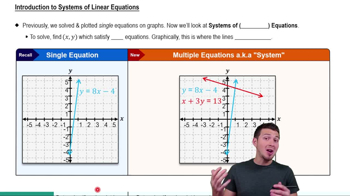
A system of linear equations consists of two or more linear equations with the same variables. The solution to the system is the set of values that satisfy all equations simultaneously. Systems can have one solution, infinitely many solutions, or no solution depending on the relationships between the equations.
Recommended video:
Guided course
4:27
Introduction to Systems of Linear Equations

Conditions for No Solution

A system has no solution when the equations represent parallel lines, meaning they have the same slope but different y-intercepts. This occurs when the ratios of the coefficients of the variables are equal, but the ratio of the constants is different, indicating inconsistency.
Recommended video:
06:00
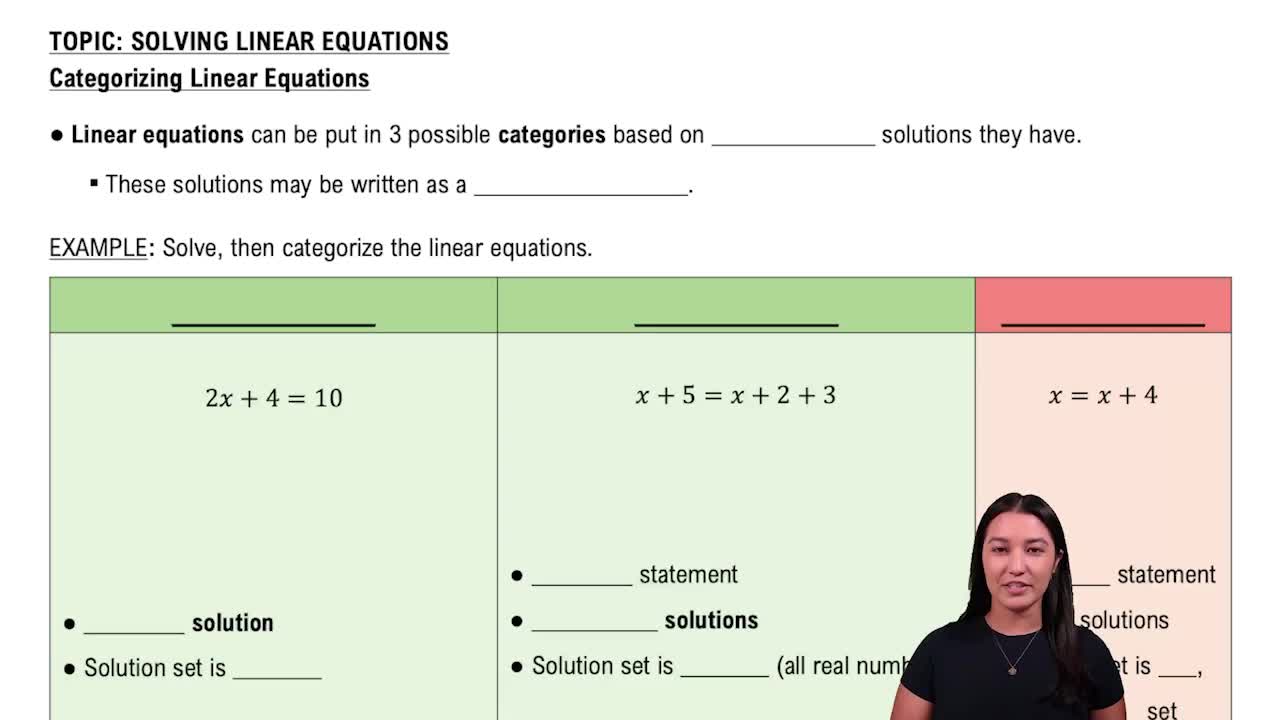
Categorizing Linear Equations

Conditions for Infinitely Many Solutions

A system has infinitely many solutions when the equations represent the same line, meaning they are multiples of each other. This happens when the ratios of the coefficients of the variables and the constants are all equal, indicating the equations are dependent and consistent.
Recommended video:
06:00
Categorizing Linear Equations