Ch. 4 - Inverse, Exponential, and Logarithmic Functions
Lial - College Algebra 13th Edition
Lial13th EditionCollege AlgebraISBN: 9780136881063Not the one you use?Change textbook
Chapter 5, Problem 45

Use the definition of inverses to determine whether ƒ and g are inverses. f(x) = x2+3, x≥0; g(x) = √x-3, x≥3

Verified step by step guidance
1
Recall that two functions \( f \) and \( g \) are inverses if and only if \( f(g(x)) = x \) for all \( x \) in the domain of \( g \), and \( g(f(x)) = x \) for all \( x \) in the domain of \( f \).
Start by finding \( f(g(x)) \). Substitute \( g(x) = \sqrt{x} - 3 \) into \( f(x) = x^2 + 3 \), so \( f(g(x)) = (\sqrt{x} - 3)^2 + 3 \).
Next, simplify \( f(g(x)) \) by expanding the square: \( (\sqrt{x} - 3)^2 = (\sqrt{x})^2 - 2 \cdot 3 \cdot \sqrt{x} + 3^2 = x - 6\sqrt{x} + 9 \). Then add 3 to get \( f(g(x)) = x - 6\sqrt{x} + 12 \).
Now, find \( g(f(x)) \). Substitute \( f(x) = x^2 + 3 \) into \( g(x) = \sqrt{x} - 3 \), so \( g(f(x)) = \sqrt{x^2 + 3} - 3 \).
Check if \( f(g(x)) = x \) and \( g(f(x)) = x \) hold true for all \( x \) in their respective domains. If both equalities hold, then \( f \) and \( g \) are inverses; otherwise, they are not.

Verified video answer for a similar problem:

This video solution was recommended by our tutors as helpful for the problem above.
Video duration:
2m
Was this helpful?

Key Concepts

Here are the essential concepts you must grasp in order to answer the question correctly.

Definition of Inverse Functions

Two functions f and g are inverses if applying one after the other returns the original input, meaning f(g(x)) = x and g(f(x)) = x for all x in their domains. This relationship shows that each function 'undoes' the effect of the other.
Recommended video:
4:30
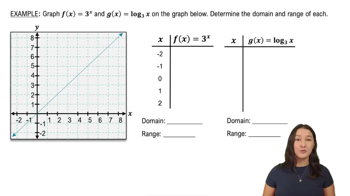
Graphing Logarithmic Functions

Domain and Range Restrictions

When determining inverses, it is crucial to consider the domain and range of each function. Restrictions like x ≥ 0 for f and x ≥ 3 for g ensure the functions are one-to-one and their inverses are well-defined, preventing ambiguity in outputs.
Recommended video:
4:22
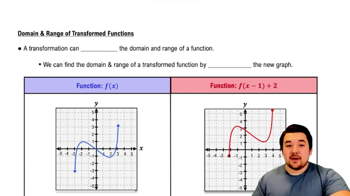
Domain & Range of Transformed Functions

Composition of Functions

Function composition involves substituting one function into another, such as f(g(x)) or g(f(x)). Checking if these compositions simplify to the identity function (x) confirms whether two functions are inverses, making composition a key tool in this verification.
Recommended video:
4:56
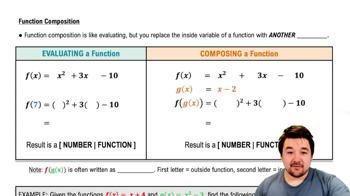
Function Composition