Ch. 4 - Inverse, Exponential, and Logarithmic Functions
Lial - College Algebra 13th Edition
Lial13th EditionCollege AlgebraISBN: 9780136881063Not the one you use?Change textbook
Chapter 5, Problem 88

Use the change-of-base theorem to find an approximation to four decimal places for each logarithm. log√19 5

Verified step by step guidance
1
Identify the logarithm you need to approximate: \(\log_{\sqrt{19}} 5\).
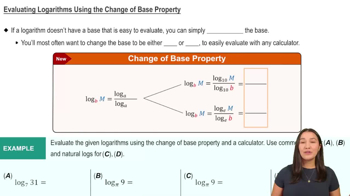
Recall the change-of-base formula: \(\log_a b = \frac{\log_c b}{\log_c a}\), where \(c\) is any positive number (commonly 10 or \(e\)).
Apply the change-of-base formula using base 10 (common logarithm): \(\log_{\sqrt{19}} 5 = \frac{\log_{10} 5}{\log_{10} \sqrt{19}}\).
Express \(\sqrt{19}\) as \(19^{1/2}\) to simplify the denominator: \(\log_{10} \sqrt{19} = \log_{10} 19^{1/2} = \frac{1}{2} \log_{10} 19\).
Calculate the values of \(\log_{10} 5\) and \(\log_{10} 19\), then substitute back into the fraction and simplify to find the approximate value to four decimal places.

Verified video answer for a similar problem:

This video solution was recommended by our tutors as helpful for the problem above.
Video duration:
2m
Was this helpful?

Key Concepts

Here are the essential concepts you must grasp in order to answer the question correctly.

Change-of-Base Theorem

The change-of-base theorem allows you to rewrite a logarithm with any base as a ratio of logarithms with a new base, typically base 10 or e. It states that log_b(a) = log_c(a) / log_c(b), where c is the new base. This is useful for calculating logarithms on calculators that only have log base 10 or natural log functions.
Recommended video:
5:36
Change of Base Property

Logarithms with Radical Bases

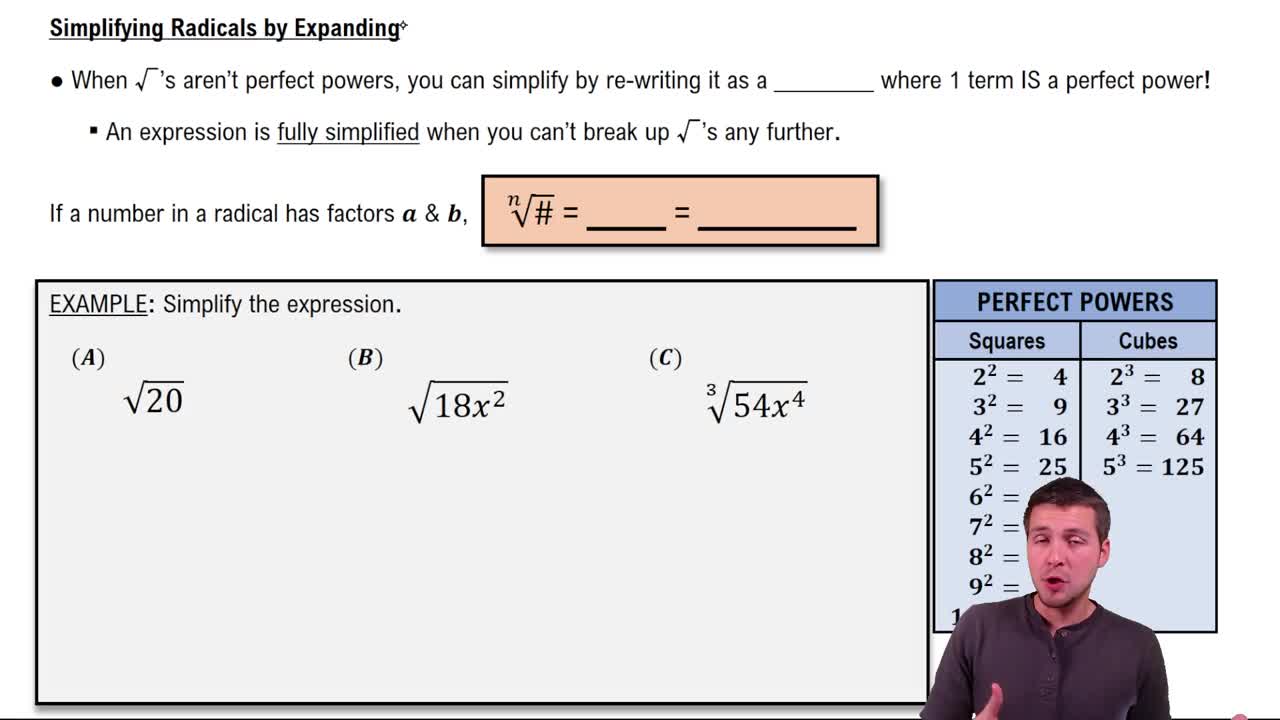
When the base of a logarithm is a radical, such as √19, it can be expressed as an exponent (19^(1/2)). This helps simplify the logarithm using exponent rules, making it easier to apply the change-of-base formula and calculate the value accurately.
Recommended video:
Guided course
05:20
Expanding Radicals

Rounding and Approximation

After calculating the logarithm using the change-of-base formula, the result should be rounded to the specified decimal places, here four decimal places. Proper rounding ensures the answer meets the precision requirements and is presented clearly.
Recommended video:
4:20
Graph Hyperbolas at the Origin