Ch. 4 - Inverse, Exponential, and Logarithmic Functions
Lial - College Algebra 13th Edition
Lial13th EditionCollege AlgebraISBN: 9780136881063Not the one you use?Change textbook
Chapter 5, Problem 83

Use the change-of-base theorem to find an approximation to four decimal places for each logarithm. log1/2 3

Verified step by step guidance
1
Identify the logarithm you need to approximate: \(\log_{\frac{1}{2}} 3\).
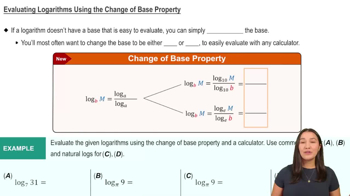
Recall the change-of-base formula: \(\log_a b = \frac{\log_c b}{\log_c a}\), where \(c\) is any positive number different from 1. Common choices for \(c\) are 10 (common logarithm) or \(e\) (natural logarithm).
Apply the change-of-base formula using base 10: \(\log_{\frac{1}{2}} 3 = \frac{\log_{10} 3}{\log_{10} \frac{1}{2}}\).
Use a calculator to find the values of \(\log_{10} 3\) and \(\log_{10} \frac{1}{2}\) separately, keeping several decimal places for accuracy.
Divide the value of \(\log_{10} 3\) by the value of \(\log_{10} \frac{1}{2}\) to get the approximate value of \(\log_{\frac{1}{2}} 3\), then round your answer to four decimal places.

Verified video answer for a similar problem:

This video solution was recommended by our tutors as helpful for the problem above.
Video duration:
2m
Was this helpful?

Key Concepts

Here are the essential concepts you must grasp in order to answer the question correctly.

Change-of-Base Theorem

The change-of-base theorem allows you to rewrite a logarithm with any base as a ratio of logarithms with a new base, typically base 10 or e. It states that log_b(a) = log_c(a) / log_c(b), where c is the new base. This is useful for calculating logarithms on calculators that only support common or natural logs.
Recommended video:
5:36
Change of Base Property

Properties of Logarithms

Understanding the properties of logarithms, such as how the base affects the value and the behavior of logarithmic functions, is essential. For example, logarithms with bases between 0 and 1 (like 1/2) decrease as the argument increases, which influences the sign and magnitude of the result.
Recommended video:
5:36
Change of Base Property

Decimal Approximation and Rounding

After computing the logarithm using the change-of-base formula, you must approximate the result to a specified number of decimal places. This involves using a calculator for precise values and rounding the final answer correctly to four decimal places to meet the problem's requirements.
Recommended video:
4:47
The Number e