Ch. 4 - Inverse, Exponential, and Logarithmic Functions
Lial - College Algebra 13th Edition
Lial13th EditionCollege AlgebraISBN: 9780136881063Not the one you use?Change textbook
Chapter 5, Problem 79

Use the change-of-base theorem to find an approximation to four decimal places for each logarithm. log2 5

Verified step by step guidance
1
Recall the change-of-base formula for logarithms: \(\log_a b = \frac{\log_c b}{\log_c a}\), where \(c\) is any positive number different from 1. Common choices for \(c\) are 10 (common logarithm) or \(e\) (natural logarithm).
Apply the change-of-base formula to \(\log_2 5\) by choosing base 10: \(\log_2 5 = \frac{\log_{10} 5}{\log_{10} 2}\).
Use a calculator to find the values of \(\log_{10} 5\) and \(\log_{10} 2\) separately. These are the common logarithms of 5 and 2, respectively.
Divide the value of \(\log_{10} 5\) by the value of \(\log_{10} 2\) to get the approximate value of \(\log_2 5\).
Round the result to four decimal places to complete the approximation.

Verified video answer for a similar problem:

This video solution was recommended by our tutors as helpful for the problem above.
Video duration:
2m
Was this helpful?

Key Concepts

Here are the essential concepts you must grasp in order to answer the question correctly.

Logarithms and Their Bases

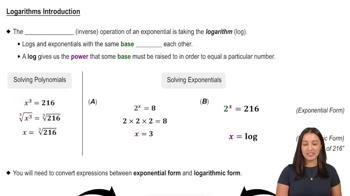
A logarithm answers the question: to what power must the base be raised to produce a given number? For example, log₂5 asks for the power to which 2 must be raised to get 5. Understanding the relationship between the base, exponent, and the logarithm value is fundamental.
Recommended video:
7:30
Logarithms Introduction

Change-of-Base Theorem

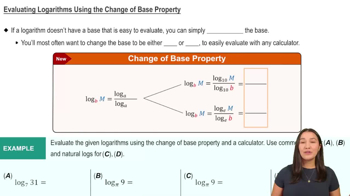
The change-of-base theorem allows you to rewrite a logarithm with any base into a ratio of logarithms with a new base, typically base 10 or e. It states log_b(a) = log_c(a) / log_c(b), which helps in calculating logarithms on calculators that only have log base 10 or natural log functions.
Recommended video:
5:36
Change of Base Property

Decimal Approximation of Logarithms

After applying the change-of-base formula, you use a calculator to find decimal values of the logarithms. Rounding the result to four decimal places means limiting the answer to four digits after the decimal point, ensuring a precise and standardized approximation.
Recommended video:
7:30
Logarithms Introduction