Ch. 4 - Inverse, Exponential, and Logarithmic Functions
Lial - College Algebra 13th Edition
Lial13th EditionCollege AlgebraISBN: 9780136881063Not the one you use?Change textbook
Chapter 5, Problem 35

Solve each equation. In Exercises 11–34, give irrational solutions as decimals correct to the nearest thousandth. In Exercises 35-40, give solutions in exact form. e2x - 6ex + 8 = 0

Verified step by step guidance
1
Recognize that the equation involves exponential expressions with the same base \(e\). To simplify, let \(y = e^{x}\). Then, \(e^{2x} = (e^{x})^2 = y^2\).
Rewrite the original equation \(e^{2x} - 6e^{x} + 8 = 0\) in terms of \(y\) as \(y^2 - 6y + 8 = 0\).
Solve the quadratic equation \(y^2 - 6y + 8 = 0\) using factoring or the quadratic formula. This will give you the possible values for \(y\).
Recall that \(y = e^{x}\), so for each solution \(y_i\), solve the equation \(e^{x} = y_i\) by taking the natural logarithm of both sides: \(x = \ln(y_i)\).
Evaluate the logarithms to find the values of \(x\). Since the problem asks for decimal answers correct to the nearest thousandth, approximate the logarithms accordingly.

Verified video answer for a similar problem:

This video solution was recommended by our tutors as helpful for the problem above.
Video duration:
6m

Key Concepts

Here are the essential concepts you must grasp in order to answer the question correctly.

Exponential Equations

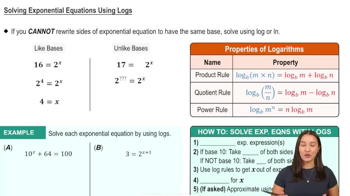
Exponential equations involve variables in the exponent, such as e^x. Solving these requires understanding how to manipulate and isolate the exponential expression, often by substitution or applying logarithms.
Recommended video:
5:47
Solving Exponential Equations Using Logs

Substitution Method for Quadratic Form

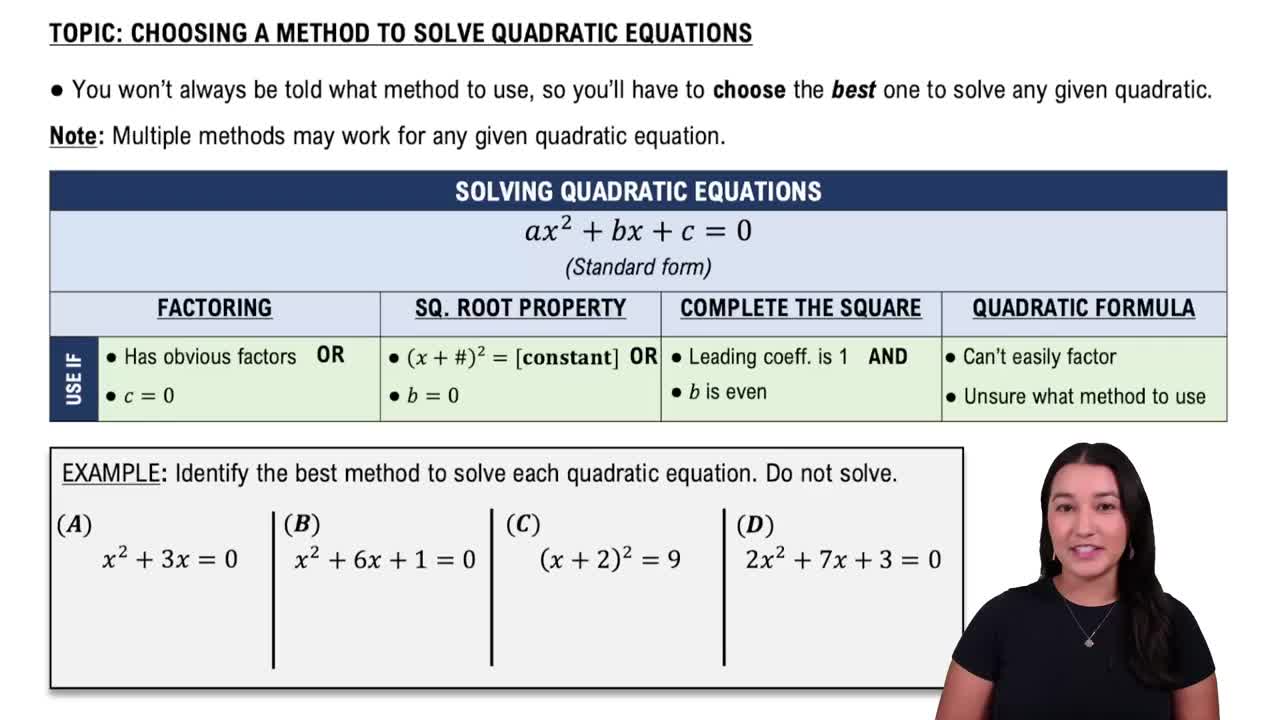
When an equation contains terms like e^{2x} and e^x, it can be treated as a quadratic by substituting u = e^x. This transforms the equation into a quadratic form, which can be solved using factoring or the quadratic formula.
Recommended video:
04:03
Choosing a Method to Solve Quadratics

Exact vs. Approximate Solutions

Exact solutions are expressed in terms of constants and variables without rounding, while approximate solutions are numerical values rounded to a specified decimal place. Understanding when to use each is important for interpreting answers correctly.
Recommended video:
3:18
Permutations vs. Combinations