Ch. 4 - Inverse, Exponential, and Logarithmic Functions
Lial - College Algebra 13th Edition
Lial13th EditionCollege AlgebraISBN: 9780136881063Not the one you use?Change textbook
Chapter 5, Problem 67

Solve each equation. Give solutions in exact form. See Examples 5–9. log2 (x2 - 100) - log2 (x + 10) = 1

Verified step by step guidance
1
Recall the logarithmic property that states \( \log_b A - \log_b B = \log_b \left( \frac{A}{B} \right) \). Apply this to combine the left side: \( \log_2 \left( \frac{x^2 - 100}{x + 10} \right) = 1 \).
Simplify the expression inside the logarithm. Notice that \( x^2 - 100 \) is a difference of squares and can be factored as \( (x - 10)(x + 10) \). Substitute this to get \( \log_2 \left( \frac{(x - 10)(x + 10)}{x + 10} \right) = 1 \).
Cancel the common factor \( x + 10 \) in the numerator and denominator, assuming \( x + 10 \neq 0 \), to simplify the logarithm to \( \log_2 (x - 10) = 1 \).
Rewrite the logarithmic equation in its equivalent exponential form: \( 2^1 = x - 10 \). This means \( 2 = x - 10 \).
Solve the resulting linear equation for \( x \) by adding 10 to both sides: \( x = 2 + 10 \). Also, check the domain restrictions to ensure the solution makes the original logarithmic expressions defined (arguments must be positive).

Verified video answer for a similar problem:

This video solution was recommended by our tutors as helpful for the problem above.
Video duration:
5m

Key Concepts

Here are the essential concepts you must grasp in order to answer the question correctly.

Properties of Logarithms

Understanding the properties of logarithms, especially the subtraction rule log_b(A) - log_b(B) = log_b(A/B), is essential. This allows combining or simplifying logarithmic expressions, which is crucial for solving equations involving multiple logs with the same base.
Recommended video:
5:36
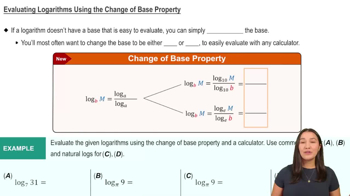
Change of Base Property

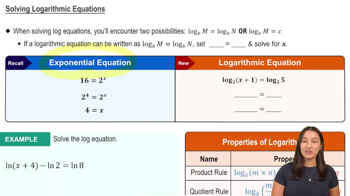
Solving Logarithmic Equations

Solving logarithmic equations involves rewriting the equation in exponential form to isolate the variable. After simplifying the logarithmic expression, convert log_b(y) = c into y = b^c to find the exact solutions.
Recommended video:
5:02
Solving Logarithmic Equations

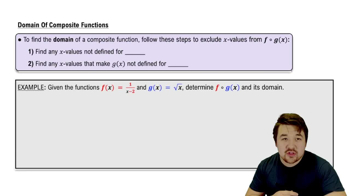
Domain Restrictions in Logarithms

Logarithmic functions are only defined for positive arguments. When solving equations like log_2(x^2 - 100), ensure that expressions inside the logs are greater than zero to find valid solutions and exclude extraneous roots.
Recommended video:
3:51
Domain Restrictions of Composed Functions