Ch. 4 - Inverse, Exponential, and Logarithmic Functions
Lial - College Algebra 13th Edition
Lial13th EditionCollege AlgebraISBN: 9780136881063Not the one you use?Change textbook
Chapter 5, Problem 20

For ƒ(x) = 3x and g(x)= (1/4)x find each of the following. Round answers to the nearest thousandth as needed. ƒ(-5/2)

Verified step by step guidance
1
Identify the function given: \( f(x) = 3^x \). We need to find \( f\left(-\frac{5}{2}\right) \).
Substitute \( x = -\frac{5}{2} \) into the function: \( f\left(-\frac{5}{2}\right) = 3^{-\frac{5}{2}} \).
Recall the property of exponents for negative powers: \( a^{-b} = \frac{1}{a^b} \). So rewrite the expression as \( \frac{1}{3^{\frac{5}{2}}} \).
Express the fractional exponent \( \frac{5}{2} \) as a root and power: \( 3^{\frac{5}{2}} = \left(3^{\frac{1}{2}}\right)^5 = (\sqrt{3})^5 \).
Evaluate or approximate \( (\sqrt{3})^5 \) and then take the reciprocal to find \( f\left(-\frac{5}{2}\right) \), rounding the final answer to the nearest thousandth.

Verified video answer for a similar problem:

This video solution was recommended by our tutors as helpful for the problem above.
Video duration:
1m
Was this helpful?

Key Concepts

Here are the essential concepts you must grasp in order to answer the question correctly.

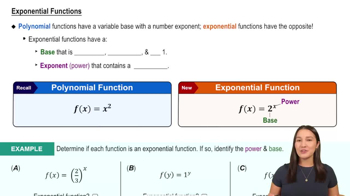
Exponential Functions

Exponential functions have the form f(x) = a^x, where the base a is a positive constant. They model growth or decay processes and are evaluated by raising the base to the power of the input x. Understanding how to compute values for negative and fractional exponents is essential.
Recommended video:
6:13
Exponential Functions

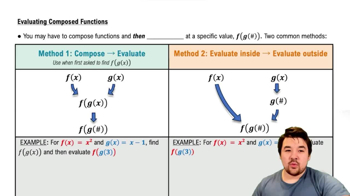
Evaluating Functions at Specific Inputs

Evaluating a function means substituting a given input value into the function's formula and simplifying. For example, to find f(-5/2), replace x with -5/2 and calculate the result carefully, especially when dealing with fractional or negative exponents.
Recommended video:
4:26
Evaluating Composed Functions

Rounding Decimal Values

After calculating a function value, rounding to a specified decimal place ensures clarity and precision. Rounding to the nearest thousandth means keeping three digits after the decimal point and adjusting the last digit based on the next digit's value.
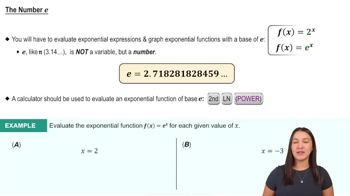
Recommended video:
4:47
The Number e