Ch. 4 - Inverse, Exponential, and Logarithmic Functions
Lial - College Algebra 13th Edition
Lial13th EditionCollege AlgebraISBN: 9780136881063Not the one you use?Change textbook
Chapter 5, Problem 30

For each substance, find the pH from the given hydronium ion concentration to the nearest tenth. limes, 1.6×\(\times\)10-2

Verified step by step guidance
1
Recall the formula to find pH from the hydronium ion concentration \([\mathrm{H_3O^+}]\): \(pH = -\log_{10}([\mathrm{H_3O^+}])\)
Identify the given hydronium ion concentration: \([\mathrm{H_3O^+}] = 1.6 \times 10^{-2}\)
Substitute the given concentration into the pH formula: \(pH = -\log_{10}(1.6 \times 10^{-2})\)
Use the logarithm property for products: \(\log_{10}(a \times b) = \log_{10}(a) + \log_{10}(b)\), so \(pH = - (\log_{10}(1.6) + \log_{10}(10^{-2}))\)
Calculate each logarithm separately (without final numeric evaluation here): \(\log_{10}(1.6)\) and \(\log_{10}(10^{-2}) = -2\), then combine them to find the pH.

Verified video answer for a similar problem:

This video solution was recommended by our tutors as helpful for the problem above.
Video duration:
4m
Was this helpful?

Key Concepts

Here are the essential concepts you must grasp in order to answer the question correctly.

pH and Hydronium Ion Concentration

pH is a measure of the acidity of a solution and is calculated as the negative logarithm (base 10) of the hydronium ion concentration, [H₃O⁺]. The formula is pH = -log[H₃O⁺]. This relationship allows us to convert between ion concentration and pH values.

Logarithms in pH Calculations

Logarithms are used to simplify the calculation of pH from very small hydronium ion concentrations. Understanding how to apply the log function and interpret its output is essential for accurately determining pH values from given concentrations.
Recommended video:
7:30
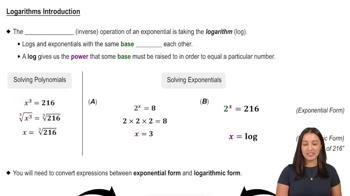
Logarithms Introduction

Rounding and Significant Figures

When reporting pH values, it is important to round the result to the specified precision, here to the nearest tenth. Proper rounding ensures clarity and consistency in scientific communication, reflecting the accuracy of the given data.
Recommended video:
2:57
Probability of Non-Mutually Exclusive Events Example