Ch. 4 - Inverse, Exponential, and Logarithmic Functions
Lial - College Algebra 13th Edition
Lial13th EditionCollege AlgebraISBN: 9780136881063Not the one you use?Change textbook
Chapter 5, Problem 115

Find ƒ-1(x), and give the domain and range. ƒ(x) = ex+1 - 4

Verified step by step guidance
1
Start with the function given: \(f(x) = e^{x+1} - 4\). To find the inverse function \(f^{-1}(x)\), first replace \(f(x)\) with \(y\): \(y = e^{x+1} - 4\).
Swap the variables \(x\) and \(y\) to begin solving for the inverse: \(x = e^{y+1} - 4\).
Isolate the exponential term by adding 4 to both sides: \(x + 4 = e^{y+1}\).
Take the natural logarithm (ln) of both sides to undo the exponential: \(\ln(x + 4) = y + 1\).
Solve for \(y\) by subtracting 1 from both sides: \(y = \ln(x + 4) - 1\). This expression represents the inverse function \(f^{-1}(x) = \ln(x + 4) - 1\). To find the domain and range, recall that the domain of \(f^{-1}\) is the range of \(f\), and the range of \(f^{-1}\) is the domain of \(f\).

Verified video answer for a similar problem:

This video solution was recommended by our tutors as helpful for the problem above.
Video duration:
5m
Was this helpful?

Key Concepts

Here are the essential concepts you must grasp in order to answer the question correctly.

Inverse Functions

An inverse function reverses the effect of the original function, swapping inputs and outputs. To find ƒ⁻¹(x), you solve the equation y = ƒ(x) for x in terms of y, then interchange x and y. This process helps determine the function that 'undoes' ƒ(x).
Recommended video:
4:30
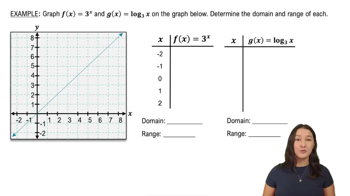
Graphing Logarithmic Functions

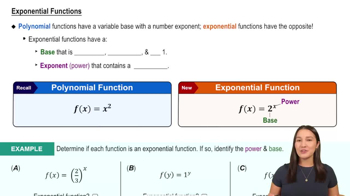
Exponential Functions and Their Properties

Exponential functions have the form f(x) = a^(x), where the variable is in the exponent. They are one-to-one and always positive, which ensures the existence of an inverse. Understanding how to manipulate and solve equations involving exponentials is essential for finding the inverse.
Recommended video:
6:13
Exponential Functions

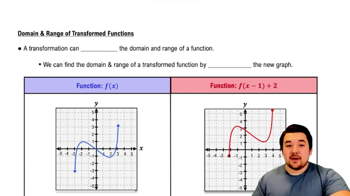
Domain and Range of Functions and Their Inverses

The domain is the set of all possible inputs, and the range is the set of all possible outputs of a function. For inverse functions, the domain and range swap roles compared to the original function. Identifying these sets is crucial for correctly defining the inverse function.
Recommended video:
4:22
Domain & Range of Transformed Functions