Ch. 3 - Polynomial and Rational Functions
Lial - College Algebra 13th Edition
Lial13th EditionCollege AlgebraISBN: 9780136881063Not the one you use?Change textbook
Chapter 4, Problem 26

Use an end behavior diagram, as shown below, to describe the end behavior of the graph of each polynomial function. ƒ(x)=10x6-x5+2x-2

Verified step by step guidance
1
Identify the leading term of the polynomial function. For the given function \(f(x) = 10x^6 - x^5 + 2x - 2\), the leading term is \$10x^6\( because it has the highest power of \)x$.
Determine the degree of the polynomial, which is the exponent of the leading term. Here, the degree is 6, an even number.
Look at the leading coefficient, which is the coefficient of the leading term. In this case, it is 10, a positive number.
Use the degree and leading coefficient to describe the end behavior: For an even degree and positive leading coefficient, as \(x \to \infty\), \(f(x) \to \infty\), and as \(x \to -\infty\), \(f(x) \to \infty\).
Summarize the end behavior using an end behavior diagram or notation: both ends of the graph rise upwards, which can be represented as \(\uparrow \quad \quad \uparrow\).

Verified video answer for a similar problem:

This video solution was recommended by our tutors as helpful for the problem above.
Video duration:
3m
Was this helpful?

Key Concepts

Here are the essential concepts you must grasp in order to answer the question correctly.

End Behavior of Polynomial Functions

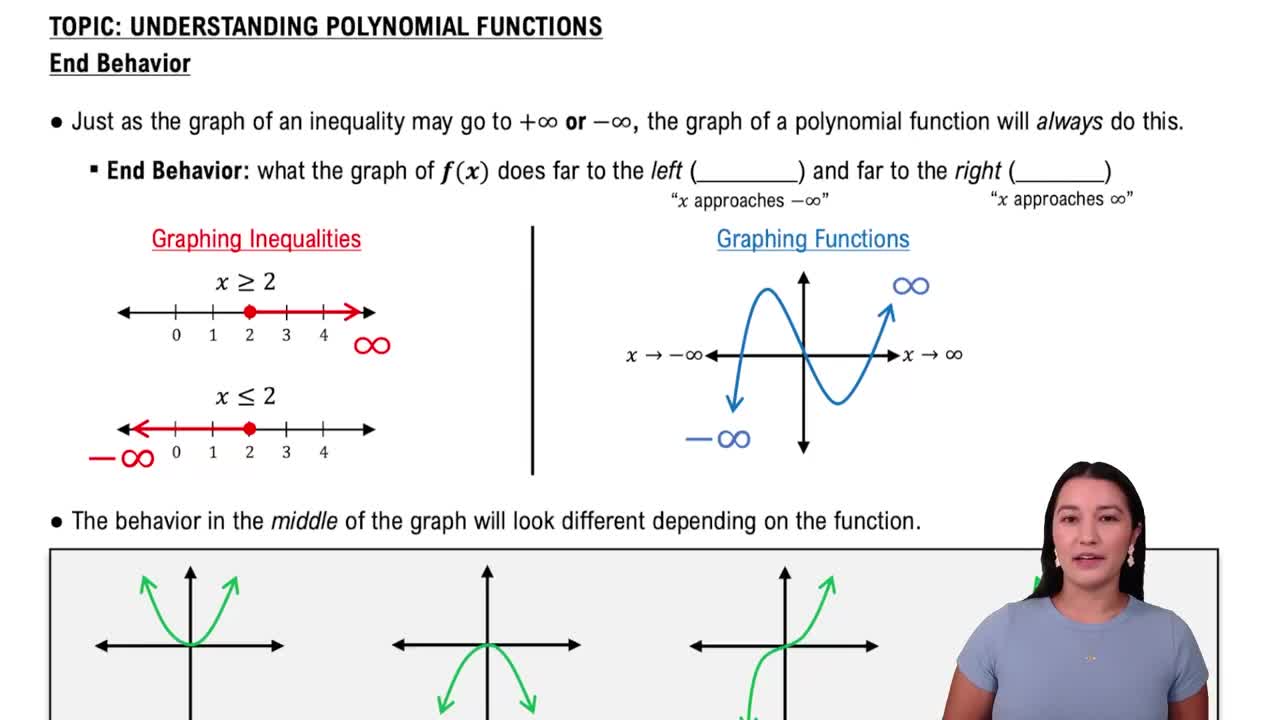
End behavior describes how the values of a polynomial function behave as x approaches positive or negative infinity. It is determined mainly by the leading term, which dominates the function for very large or very small x-values.
Recommended video:
06:08
End Behavior of Polynomial Functions

Leading Term and Degree of a Polynomial

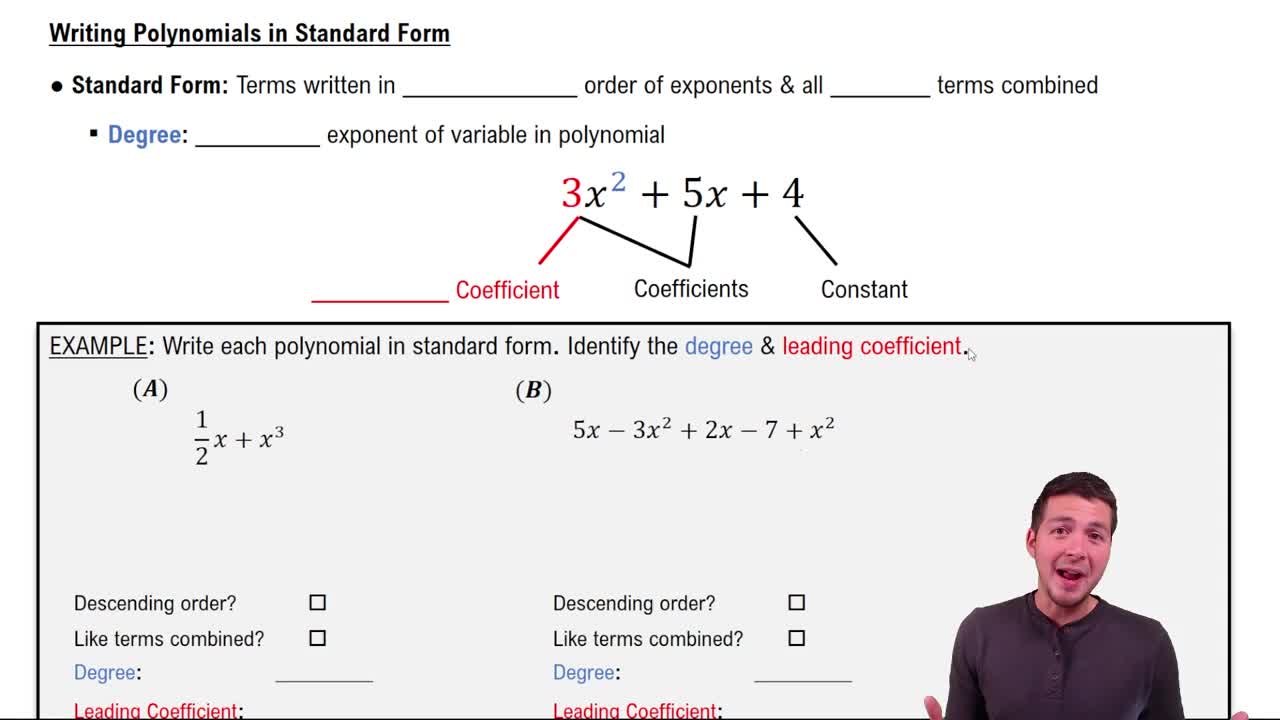
The leading term is the term with the highest power of x in a polynomial. The degree (the exponent of this term) and the leading coefficient (its coefficient) dictate the shape and direction of the graph's ends.
Recommended video:
Guided course
05:16
Standard Form of Polynomials

End Behavior Diagrams

End behavior diagrams use arrows or symbols to visually represent the direction of the graph as x approaches ±∞. They help summarize whether the graph rises or falls on each end based on the polynomial's degree and leading coefficient.
Recommended video:
06:08
End Behavior of Polynomial Functions