Ch. 3 - Polynomial and Rational Functions
Lial - College Algebra 13th Edition
Lial13th EditionCollege AlgebraISBN: 9780136881063Not the one you use?Change textbook
Chapter 4, Problem 69

The remainder theorem indicates that when a polynomial ƒ(x) is divided by x-k, the remainder is equal to ƒ(k). Consider the polynomial function ƒ(x) = x3 - 2x2 - x+2. Use the remainder theorem to find each of the following. Then determine the coordinates of the corresponding point on the graph of ƒ(x). ƒ (1)

Verified step by step guidance
1
Identify the polynomial function given: \(f(x) = x^3 - 2x^2 - x + 2\).
Recall the Remainder Theorem: When a polynomial \(f(x)\) is divided by \(x - k\), the remainder is \(f(k)\).
To find \(f(1)\), substitute \(x = 1\) into the polynomial: \(f(1) = (1)^3 - 2(1)^2 - (1) + 2\).
Simplify the expression step-by-step: calculate each term and combine them to find the value of \(f(1)\).
The coordinates of the corresponding point on the graph of \(f(x)\) are \((1, f(1))\), where \(f(1)\) is the value found in the previous step.

Verified video answer for a similar problem:

This video solution was recommended by our tutors as helpful for the problem above.
Video duration:
6m
Was this helpful?

Key Concepts

Here are the essential concepts you must grasp in order to answer the question correctly.

Remainder Theorem

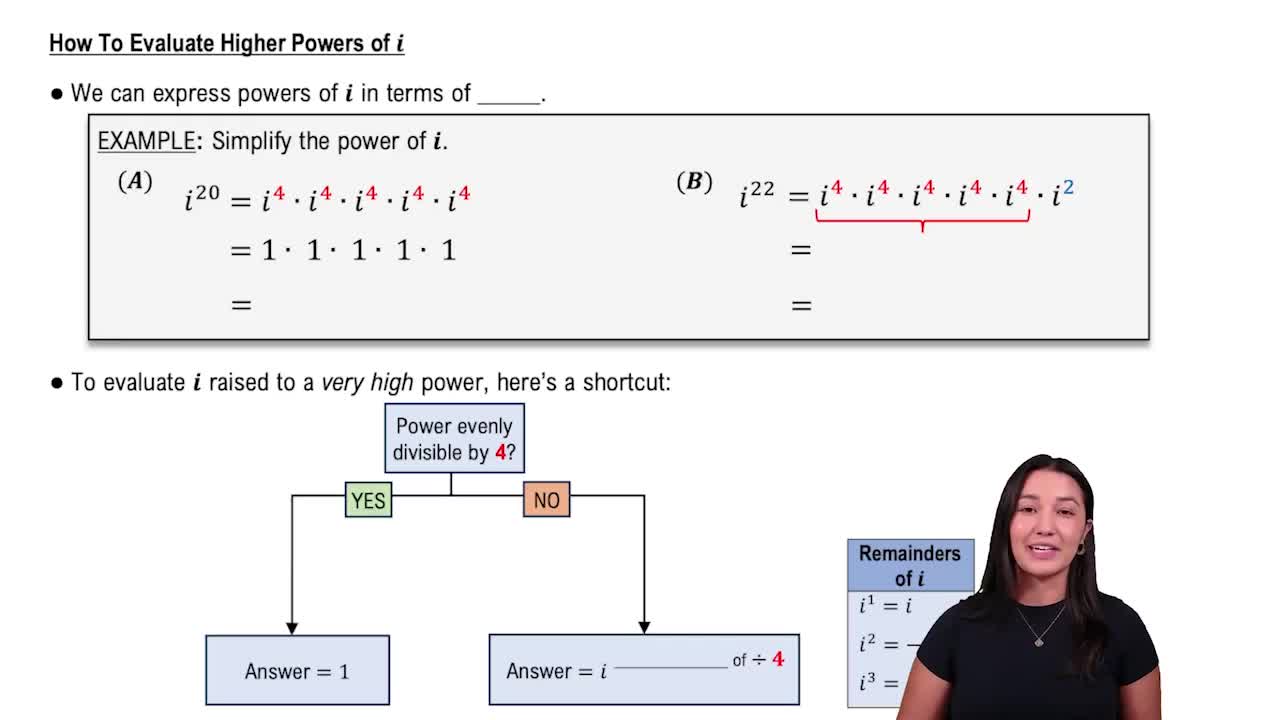
The Remainder Theorem states that when a polynomial ƒ(x) is divided by a linear divisor of the form x - k, the remainder of this division is equal to the value of the polynomial evaluated at k, or ƒ(k). This allows for quick calculation of remainders without performing full polynomial division.
Recommended video:
05:10
Higher Powers of i

Evaluating Polynomials

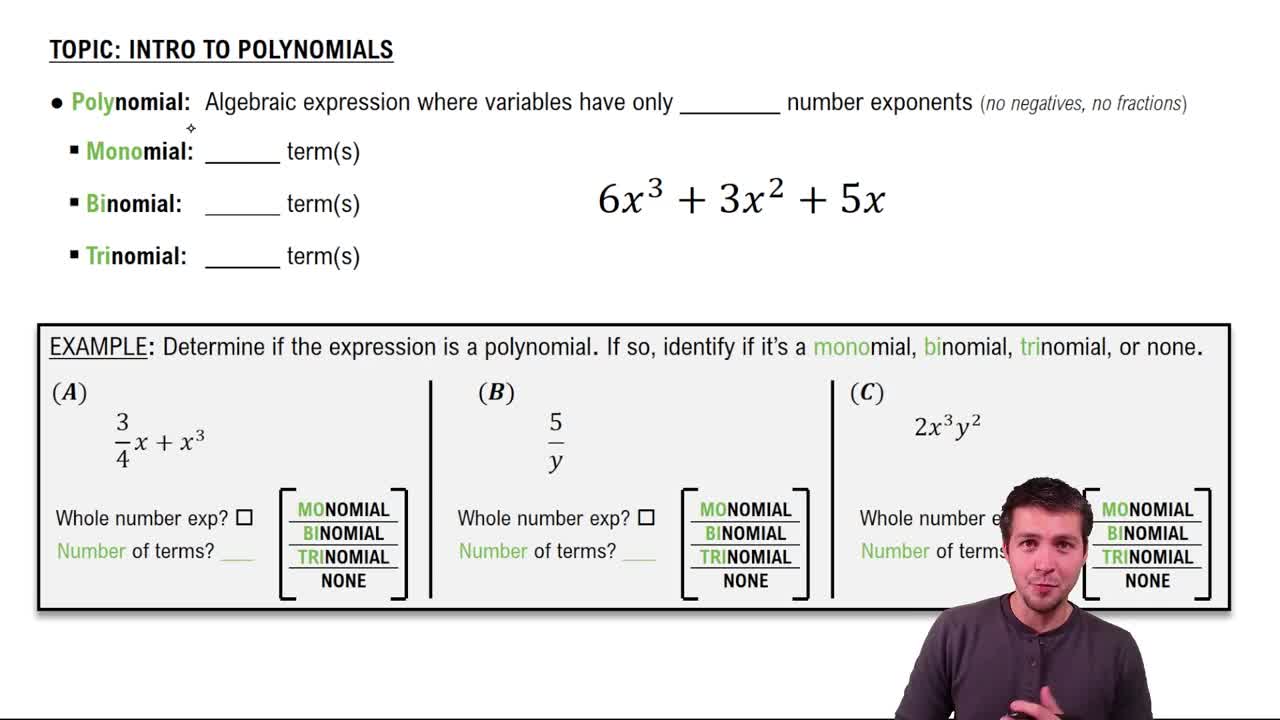
Evaluating a polynomial involves substituting a specific value for the variable x and simplifying the expression to find the corresponding output. For example, to find ƒ(1), substitute x = 1 into the polynomial and compute the result.
Recommended video:
Guided course
05:13
Introduction to Polynomials

Coordinates of Points on a Graph

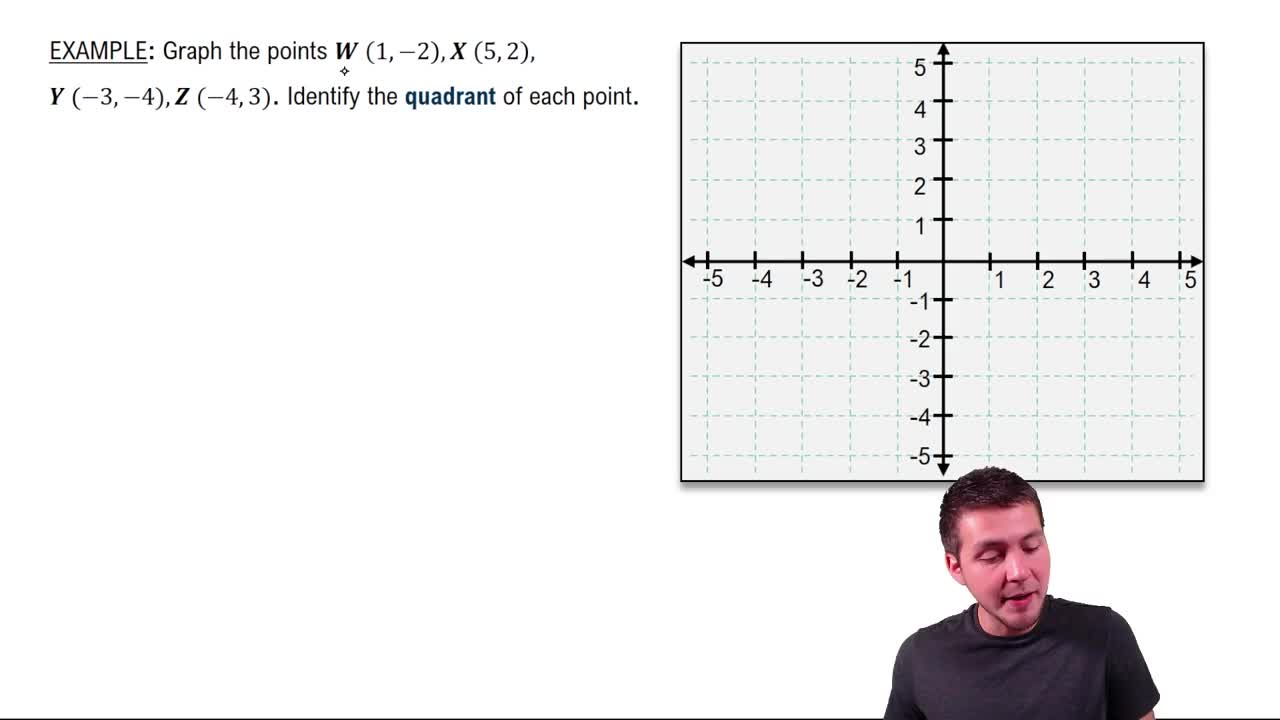
The coordinates of a point on the graph of a function ƒ(x) are given by (x, ƒ(x)). After finding ƒ(k) using the Remainder Theorem, the point (k, ƒ(k)) represents a point on the polynomial's graph, linking algebraic evaluation to geometric interpretation.
Recommended video:
Guided course
02:16
Graphs and Coordinates - Example