Ch. 3 - Polynomial and Rational Functions
Lial - College Algebra 13th Edition
Lial13th EditionCollege AlgebraISBN: 9780136881063Not the one you use?Change textbook
Chapter 4, Problem 96a

The following exercises are geometric in nature and lead to polynomial models. Solve each problem. A standard piece of notebook paper measuring 8.5 in. by 11 in. is to be made into a box with an open top by cutting equal-size squares from each cor-ner and folding up the sides. Let x represent the length of a side of each such square in inches. Use the table feature of a graphing calculator to do the following. Round to the nearest hundredth.
a. Find the maximum volume of the box.

Verified step by step guidance
1
Identify the dimensions of the original piece of paper: length = 11 inches and width = 8.5 inches.
Define the variable \(x\) as the side length of the square cut from each corner. After cutting and folding, the new dimensions of the box's base will be \((11 - 2x)\) by \((8.5 - 2x)\), and the height will be \(x\).
Write the volume function \(V(x)\) of the box as the product of the length, width, and height: \(V(x) = x \times (11 - 2x) \times (8.5 - 2x)\).
Use the graphing calculator's table feature to evaluate \(V(x)\) for various values of \(x\) within the domain \(0 < x < 4.25\) (since \(x\) must be less than half of the smaller side to form a box).
Identify the value of \(x\) that gives the maximum volume from the table, then calculate the corresponding maximum volume \(V(x)\) and round it to the nearest hundredth.

Verified video answer for a similar problem:

This video solution was recommended by our tutors as helpful for the problem above.
Video duration:
2m
Was this helpful?

Key Concepts

Here are the essential concepts you must grasp in order to answer the question correctly.

Formulating Polynomial Volume Functions

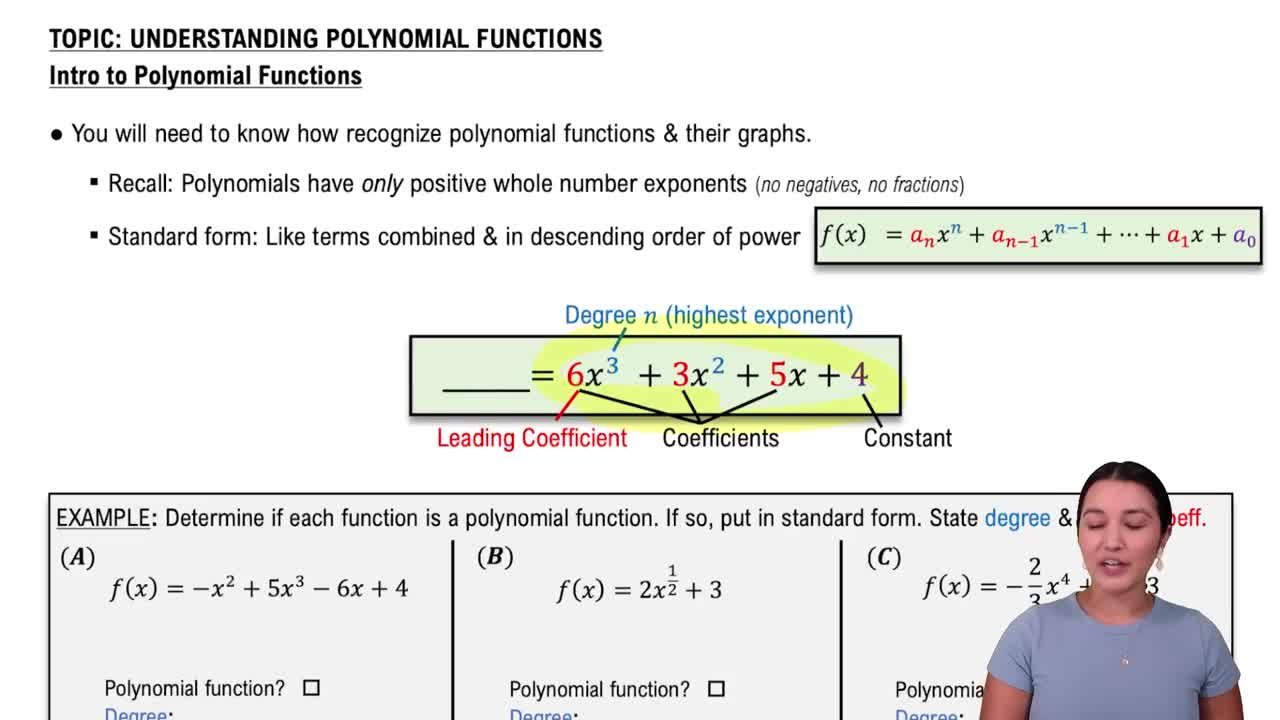
To model the volume of the box, express the volume as a polynomial function of x, the side length of the squares cut from each corner. The length and width of the base become (8.5 - 2x) and (11 - 2x), and the height is x, so volume V(x) = x(8.5 - 2x)(11 - 2x). Understanding this setup is essential for solving the problem.
Recommended video:
06:04
Introduction to Polynomial Functions

Domain Restrictions for Realistic Solutions

Since x represents the side length of the squares cut from the corners, it must be positive and less than half the smaller side of the paper (less than 4.25 inches). Recognizing these domain restrictions ensures that the volume function is evaluated only for physically meaningful values of x.
Recommended video:
3:51
Domain Restrictions of Composed Functions

Using a Graphing Calculator Table to Find Maximum Values

A graphing calculator's table feature helps evaluate the volume function at various x-values to approximate the maximum volume. By examining the table values and rounding to the nearest hundredth, one can identify the x that yields the maximum volume, which is crucial for solving optimization problems without calculus.
Recommended video:
5:10
Finding the Domain and Range of a Graph