For each polynomial function, one zero is given. Find all other zeros.
Ch. 3 - Polynomial and Rational Functions

Chapter 4, Problem 35
Solve each problem. Is x+1 a factor of ƒ(x)=x3+2x2+3x+2?
Verified step by step guidance1
Recall the Factor Theorem, which states that if \(x - c\) is a factor of a polynomial \(f(x)\), then \(f(c) = 0\). In this problem, since the factor is \(x + 1\), rewrite it as \(x - (-1)\), so \(c = -1\).
Evaluate the polynomial \(f(x) = x^3 + 2x^2 + 3x + 2\) at \(x = -1\) by substituting \(-1\) into the polynomial: calculate \(f(-1) = (-1)^3 + 2(-1)^2 + 3(-1) + 2\).
Simplify each term in the expression: \((-1)^3 = -1\), \(2(-1)^2 = 2(1) = 2\), \(3(-1) = -3\), and the constant term is \(2\).
Add the simplified terms together: \(-1 + 2 - 3 + 2\) to find the value of \(f(-1)\).
If the result of \(f(-1)\) is zero, then \(x + 1\) is a factor of \(f(x)\). If it is not zero, then \(x + 1\) is not a factor.

Verified video answer for a similar problem:
This video solution was recommended by our tutors as helpful for the problem above.
Video duration:
2mWas this helpful?
Key Concepts
Here are the essential concepts you must grasp in order to answer the question correctly.
Polynomial Functions
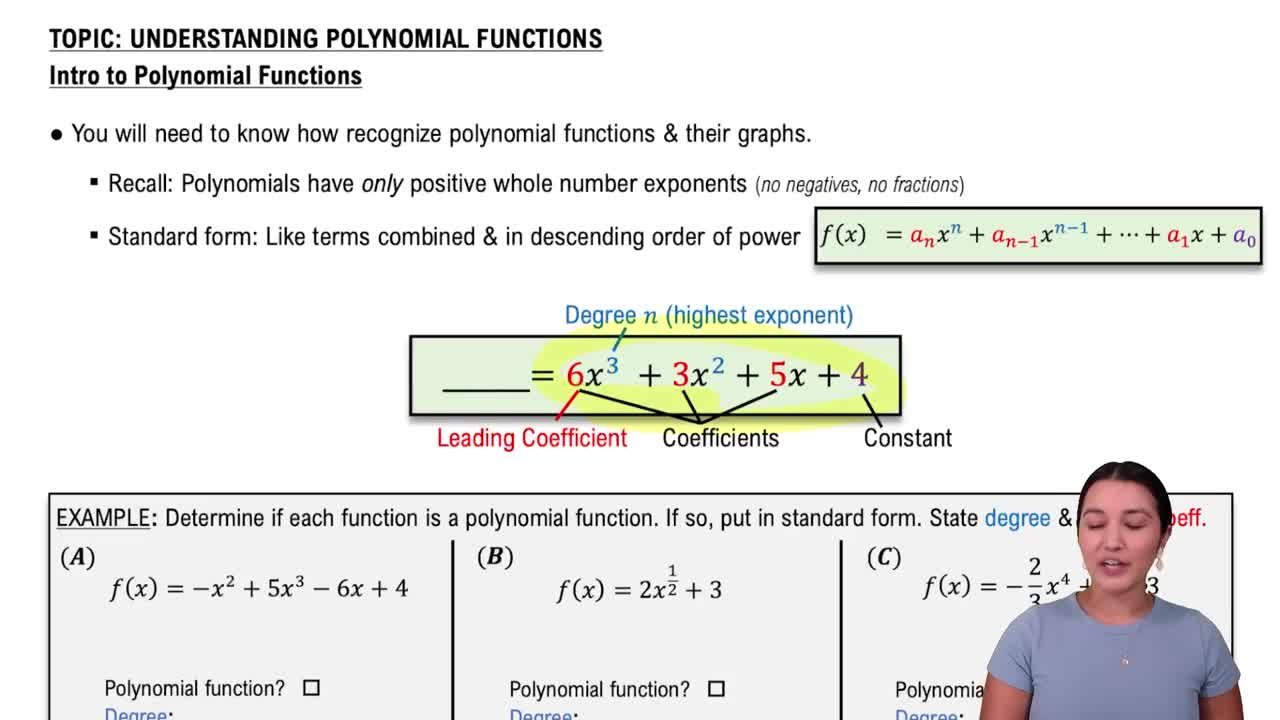
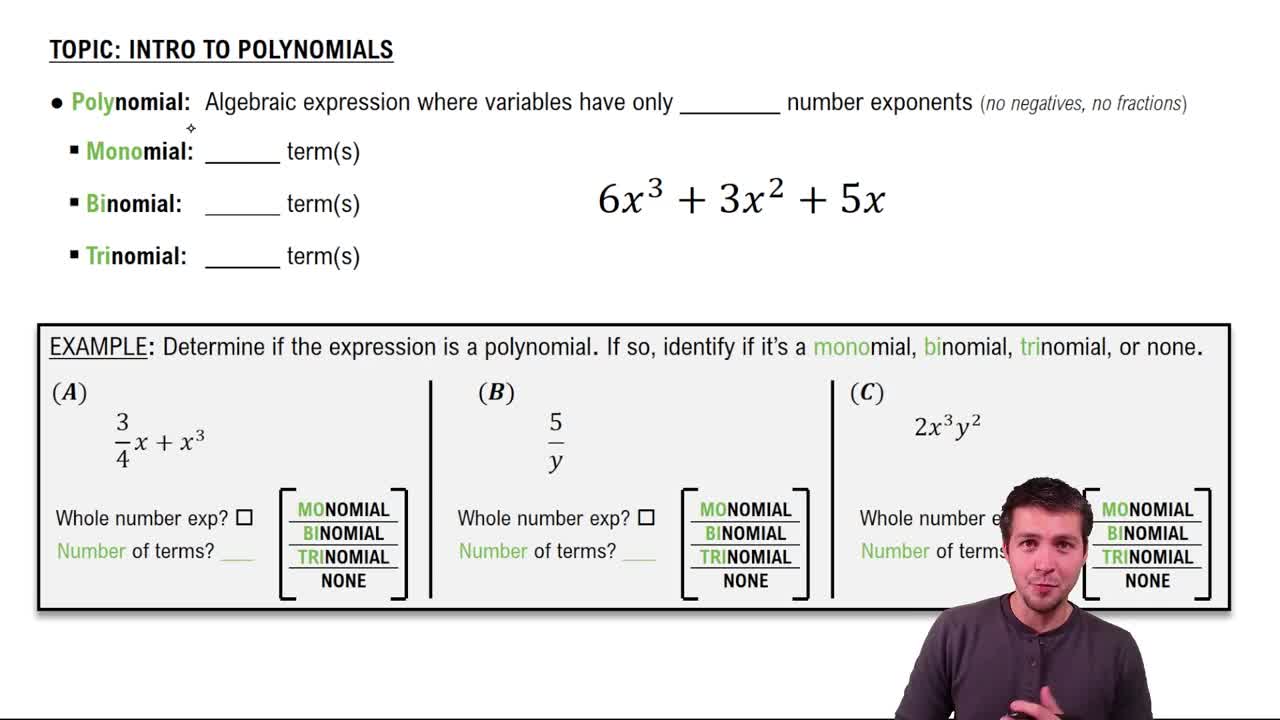
A polynomial function is an expression consisting of variables and coefficients combined using addition, subtraction, multiplication, and non-negative integer exponents. Understanding the structure of polynomials helps in analyzing their factors and roots.
Recommended video:
Introduction to Polynomial Functions
Factor Theorem
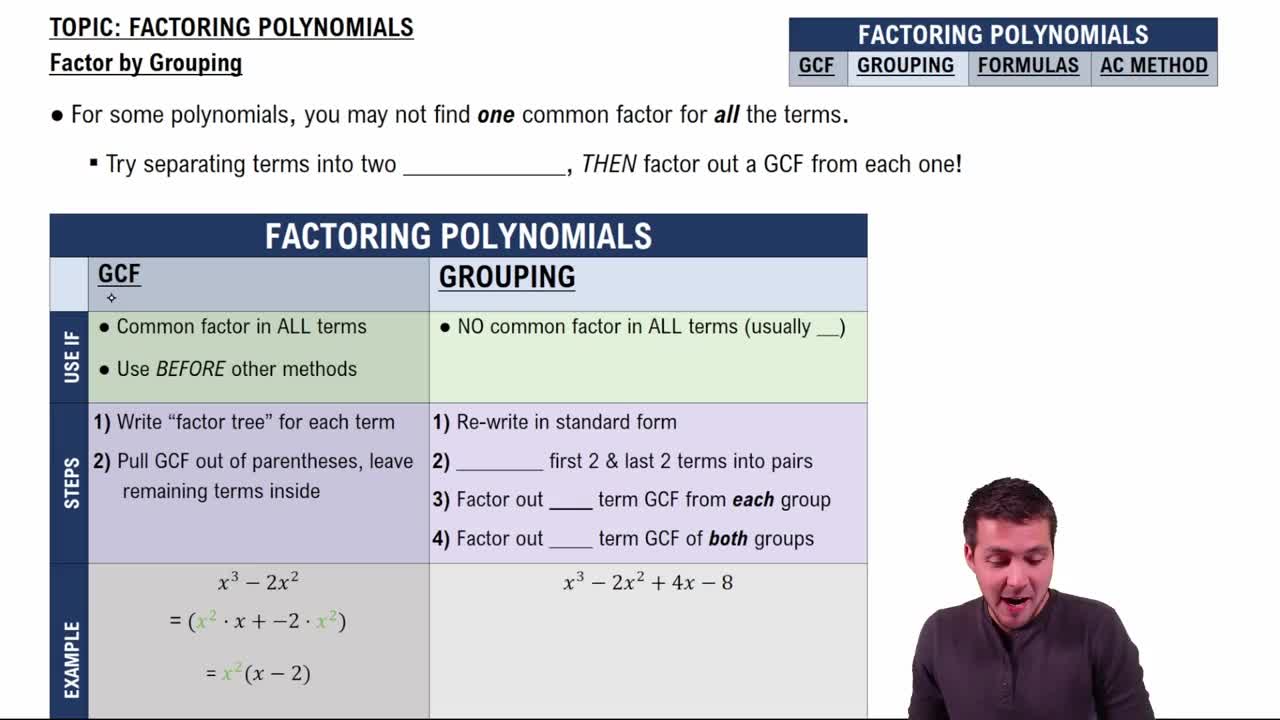
The Factor Theorem states that (x - c) is a factor of a polynomial ƒ(x) if and only if ƒ(c) = 0. This theorem is used to test whether a given binomial is a factor by substituting the root into the polynomial.
Recommended video:
Guided course
Factor by Grouping
Evaluating Polynomials
Evaluating a polynomial involves substituting a specific value for the variable and simplifying to find the result. This process is essential for applying the Factor Theorem to determine if a binomial is a factor.
Recommended video:
Guided course
Introduction to Polynomials
Related Practice
Textbook Question
Textbook Question
Solve each problem. The speed of a pulley varies inversely as its diameter. One kind of pulley, with diameter 3 in., turns at 150 revolutions per minute. Find the speed of a similar pulley with diameter 5 in.
2
views
Textbook Question
Solve each problem. Use Descartes' rule of signs to determine the different possibilities for the numbers of positive, negative, and nonreal complex zeros of .
Textbook Question
Graph each polynomial function. Factor first if the polynomial is not in factored form. ƒ(x)=(3x-1)(x+2)2
Textbook Question
Match the rational function in Column I with the appropriate description in Column II. Choices in Column II can be used only once. ƒ(x)=(x2+3x+4)/(x-5)
Textbook Question
For each polynomial function, use the remainder theorem to find ƒ(k). ƒ(x) = 2x2 - 3x-3; k = 2
2
views