Ch. 3 - Polynomial and Rational Functions
Lial - College Algebra 13th Edition
Lial13th EditionCollege AlgebraISBN: 9780136881063Not the one you use?Change textbook
Chapter 4, Problem 7

Solve each problem. If y varies directly as x, and y=20 when x=4, find y when x = -6.

Verified step by step guidance
1
Understand the concept of direct variation: If y varies directly as x, it means that y is equal to a constant k multiplied by x. This can be written as the equation \(y = k \times x\).
Use the given values to find the constant of variation k. Substitute \(y = 20\) and \(x = 4\) into the equation \(y = kx\) to get \(20 = k \times 4\).
Solve for k by dividing both sides of the equation by 4: \(k = \frac{20}{4}\).
Now that you have the value of k, use it to find y when \(x = -6\). Substitute \(k\) and \(x = -6\) into the equation \(y = kx\) to get \(y = k \times (-6)\).
Simplify the expression to find the value of y when \(x = -6\).

Verified video answer for a similar problem:

This video solution was recommended by our tutors as helpful for the problem above.
Video duration:
3m
Was this helpful?

Key Concepts

Here are the essential concepts you must grasp in order to answer the question correctly.

Direct Variation

Direct variation describes a relationship where one variable is a constant multiple of another, expressed as y = kx. If y varies directly as x, increasing x results in a proportional increase or decrease in y, depending on the constant k.
Recommended video:
02:44
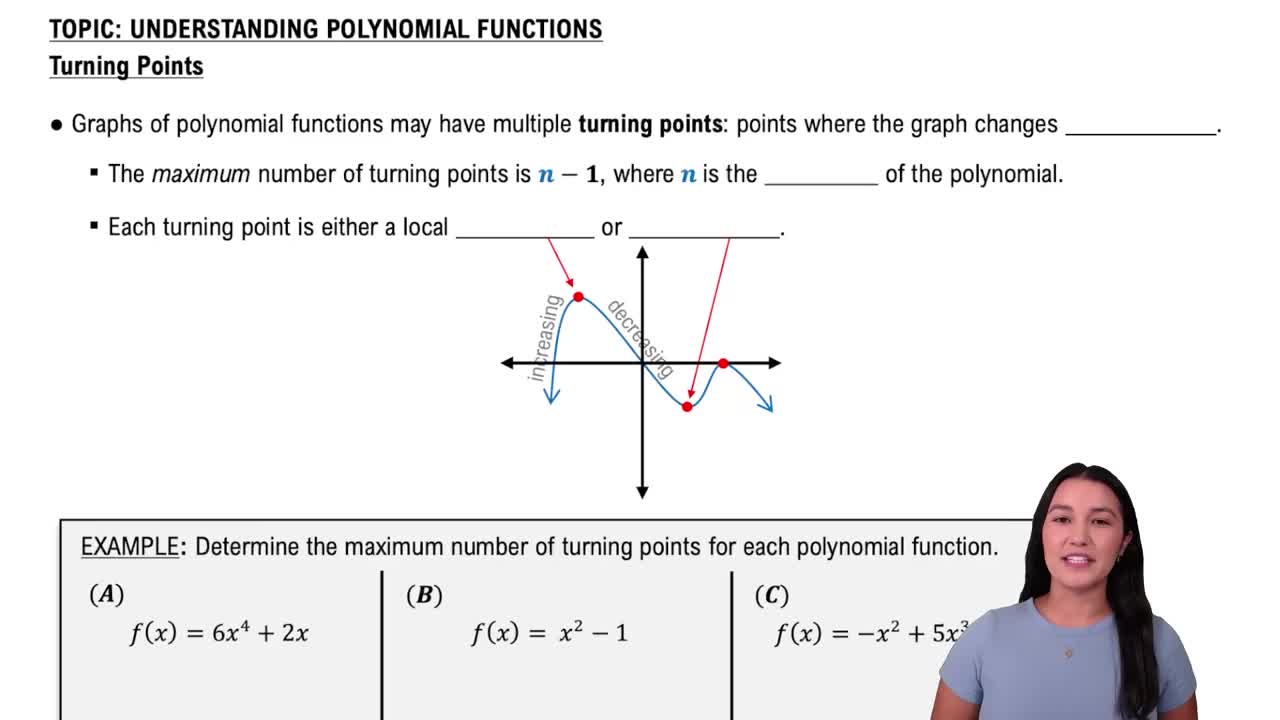
Maximum Turning Points of a Polynomial Function

Constant of Variation

The constant of variation (k) is the fixed multiplier in a direct variation equation y = kx. It can be found by substituting known values of x and y into the equation, allowing you to determine k and use it to find unknown values.
Recommended video:
6:02
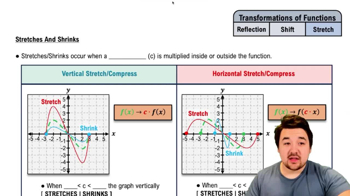
Stretches & Shrinks of Functions

Solving for Unknowns in Variation Problems

Once the constant of variation is known, you can solve for unknown variables by substituting given values into the direct variation formula. This process involves algebraic manipulation to find the missing value, such as y when x is given.
Recommended video:
Guided course
6:54
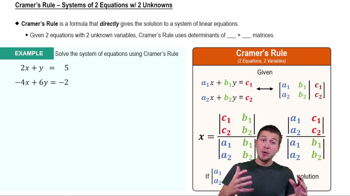
Cramer's Rule - 2 Equations with 2 Unknowns
Related Practice
Textbook Question

Use synthetic division to perform each division. (x3 + 3x2 +11x + 9) / x+1

4
views
Textbook Question

Solve each problem. During the course of ayear, the number of volunteers available to run a food bank each month is modeled by V(x),V(x), where V(x)=2x232x+150V(x)=2x^2-32x+150 between the months of January and August. Here x is time in months, with x=1 representing January. From August to December, V(x)V(x) is modeled by V(x)=31x226V(x)=31x-226. Find the number of volunteers in each of the following months.

August

1
views
Textbook Question

Solve each problem. During the course of a year, the number of volunteers available to run a food bank each month is modeled by V(x)V(x), where V(x)=2x232x+150V(x)=2x^2-32x+150 between the months of January and August. Here x is time in months, with x=1 representing January. From August to December, V(x)V(x) is modeled by V(x)=31x226V(x)=31x-226. Find the number of volunteers in each of the following months.

May

1
views
Textbook Question

Provide a short answer to each question. Is ƒ(x)=1/x2 an even or an odd function? What symmetry does its graph exhibit?

6
views
Textbook Question

Use the graph to solve each equation or inequality. Use interval notation where appropriate. 2(x-2) / {(x-1)(x-3)} = 0

Textbook Question

Solve each problem. During the course of a year, the number of volunteers available to run a food bank each month is modeled by V(x)V(x), where V(x)=2x232x+150V(x)=2x^2-32x+150 between the months of January and August. Here x is time in months, with x=1 representing January. From August to December, V(x) is modeled by V(x)=31x226V(x)=31x-226. Find the number of volunteers in each of the following months.

January

1
views