Solve each rational inequality. Give the solution set in interval notation. 1 /(x - 1) < 1 /(x + 1)
Ch. 3 - Polynomial and Rational Functions

Chapter 4, Problem 63
Show that the real zeros of each polynomial function satisfy the given conditions. ƒ(x)=x5-3x3+x+2; no real zero greater than 2
Verified step by step guidance1
First, understand the problem: we need to show that the real zeros of the polynomial function \(f(x) = x^5 - 3x^3 + x + 2\) have no real zero greater than 2. This means if \(r\) is a real root, then \(r \leq 2\).
Evaluate the polynomial at \(x = 2\) to check the sign of \(f(2)\). Substitute \(x = 2\) into the polynomial: \(f(2) = 2^5 - 3 \cdot 2^3 + 2 + 2\).
Analyze the behavior of \(f(x)\) for values greater than 2. Consider the leading term \(x^5\), which dominates for large \(x\). Since the leading coefficient is positive, \(f(x)\) tends to \(+\infty\) as \(x \to +\infty\).
Use the Intermediate Value Theorem: if \(f(2)\) is positive and \(f(x)\) tends to \(+\infty\) for \(x > 2\), then there is no root greater than 2 because the function does not cross the x-axis beyond 2.
Optionally, check \(f(3)\) or another value greater than 2 to confirm the function remains positive, reinforcing that no real zeros exist greater than 2.

Verified video answer for a similar problem:
This video solution was recommended by our tutors as helpful for the problem above.
Video duration:
6mWas this helpful?
Key Concepts
Here are the essential concepts you must grasp in order to answer the question correctly.
Real Zeros of Polynomial Functions
Real zeros of a polynomial are the values of x for which the polynomial equals zero. These zeros correspond to the x-intercepts of the graph. Understanding how to find and interpret real zeros is essential for analyzing the behavior of polynomial functions.
Recommended video:
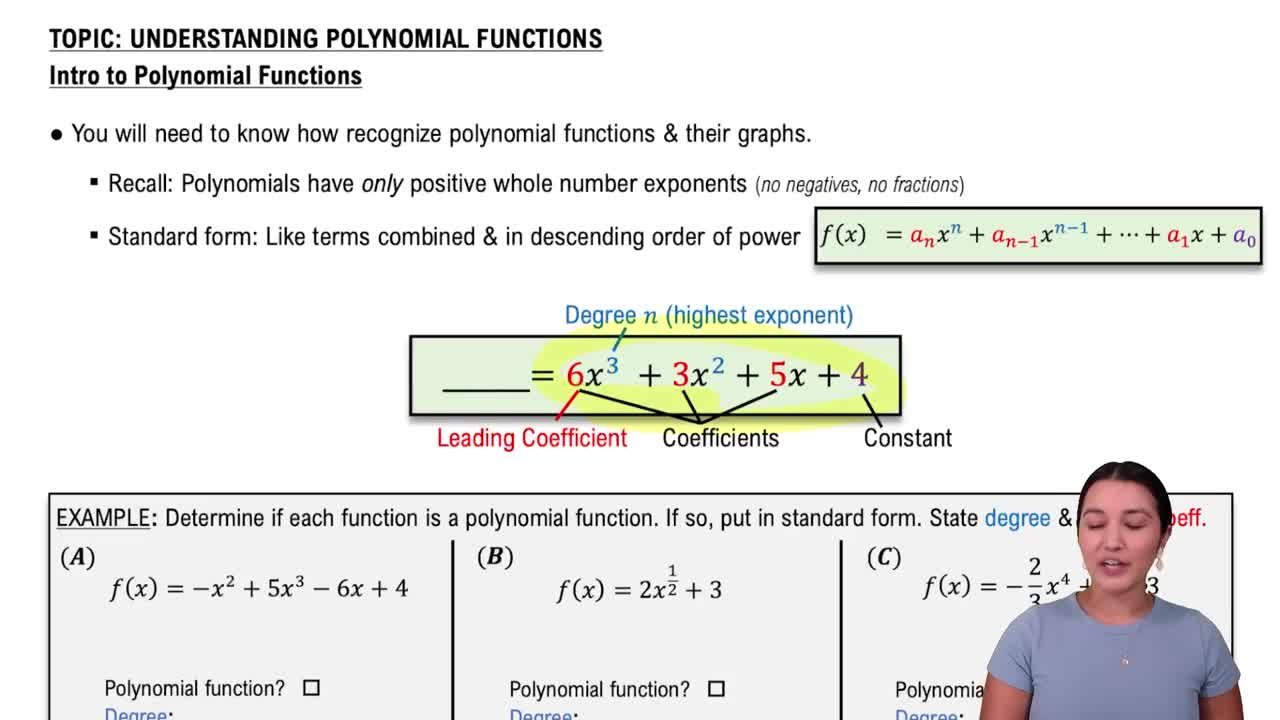
Introduction to Polynomial Functions
Evaluating Polynomial Values to Bound Zeros
To show that no real zero exceeds a certain value, evaluate the polynomial at that value and analyze the sign of the result. If the polynomial is positive (or negative) at that point and the function’s behavior indicates no sign changes beyond it, this helps establish bounds on the zeros.
Recommended video:
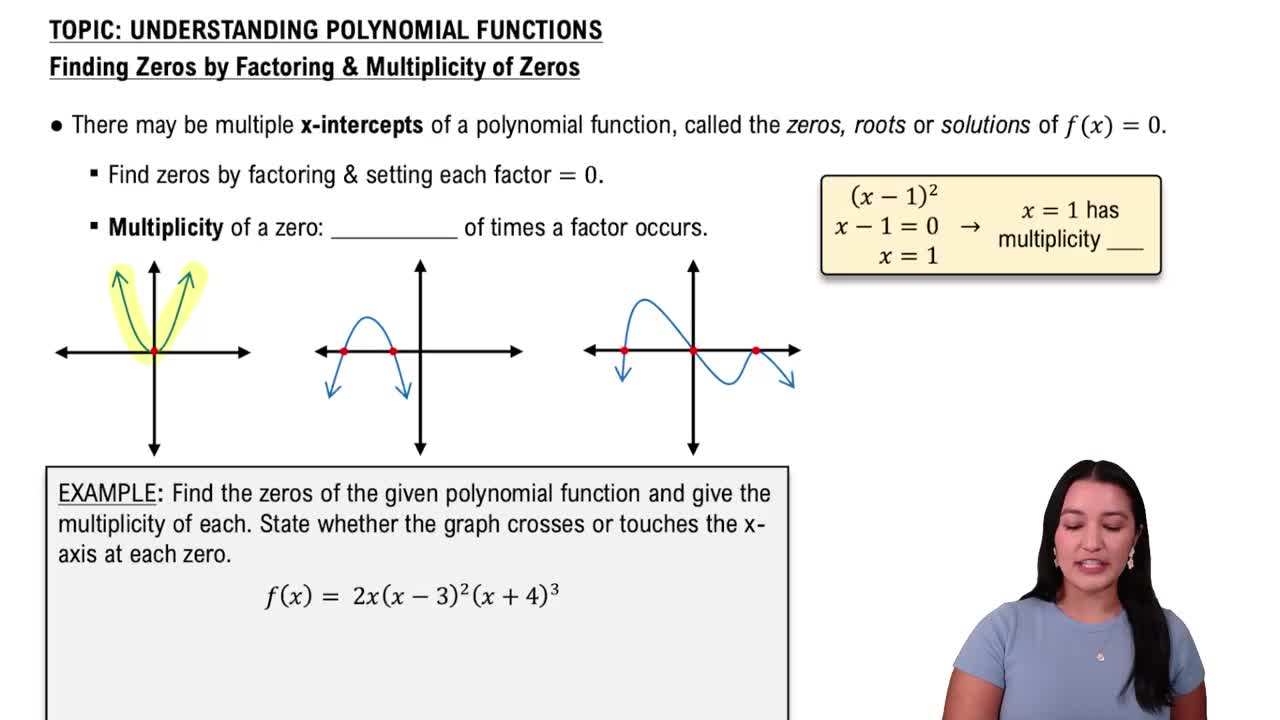
Finding Zeros & Their Multiplicity
Intermediate Value Theorem
The Intermediate Value Theorem states that if a continuous function changes sign over an interval, it must have a zero within that interval. This theorem is useful for locating zeros and proving that no zeros exist beyond a certain point by checking sign consistency.
Recommended video:
Introduction to Hyperbolas
Related Practice
Textbook Question
Textbook Question
Show that the real zeros of each polynomial function satisfy the given conditions. See Example 6.
; no real zero less than -3
Textbook Question
The remainder theorem indicates that when a polynomial ƒ(x) is divided by x-k, the remainder is equal to ƒ(k). Consider the polynomial function ƒ(x) = x3 - 2x2 - x+2. Use the remainder theorem to find each of the following. Then determine the coordinates of the corresponding point on the graph of ƒ(x). ƒ (-2)
3
views
Textbook Question
Graph each rational function. ƒ(x)=(x+2)/(x-3)
Textbook Question
Use synthetic division to determine whether the given number k is a zero of the polynomial function. If it is not, give the value of ƒ(k). ƒ(x) = x3 + 3x2 -x + 1; k = 1+i
Textbook Question
Solve each rational inequality. Give the solution set in interval notation. 1 /(x+ 2) > 1 /(x -3)