
Textbook Question
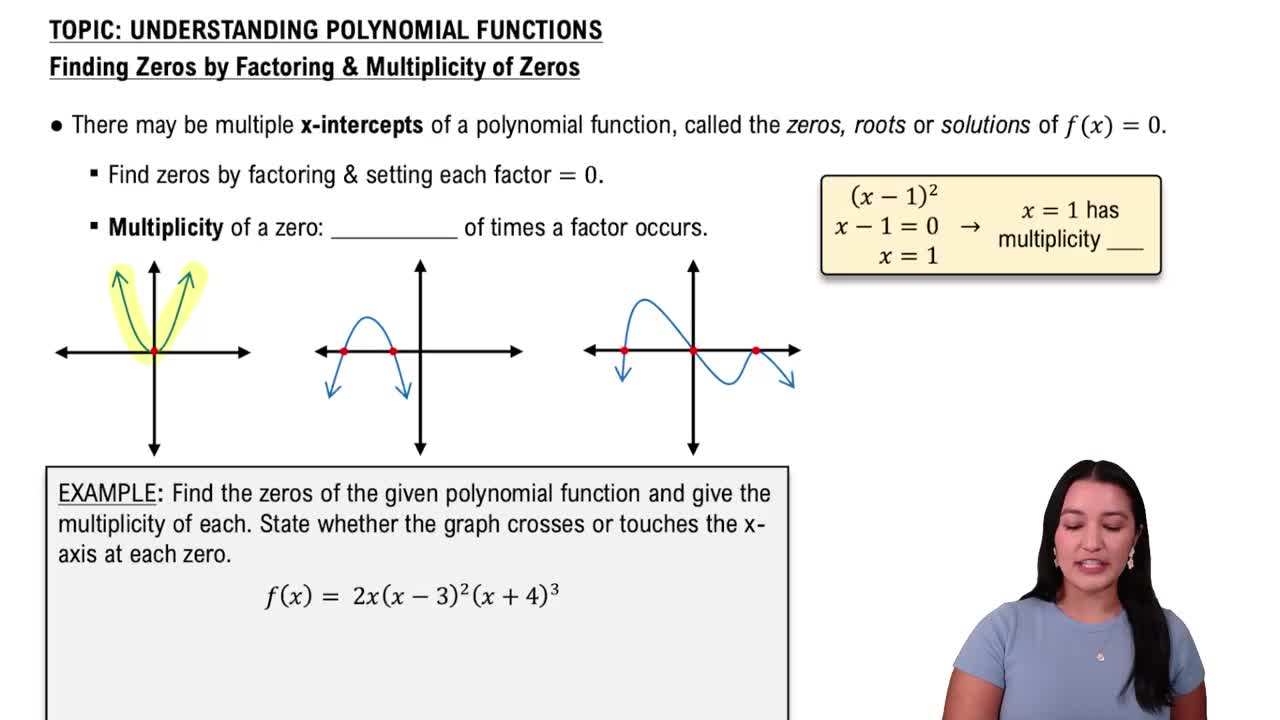
For each polynomial function, one zero is given. Find all other zeros.

 Verified step by step guidance
 03:42
03:42
 6:15
6:15 04:03
04:03For each polynomial function, one zero is given. Find all other zeros.
Show that each polynomial function has a real zero as described in parts (a) and (b). In Exercises 31 and 32, also work part (c). ƒ(x)=4x3-37x2+50x+60 between 7 and 8
Graph each polynomial function. Factor first if the polynomial is not in factored form. ƒ(x)=-x(x+1)(x-1)
Hooke's Law for a Spring Hooke's law for an elastic spring states that the distance a spring stretches varies directly as the force applied. If a force of 15 lb stretches a certain spring 8 in., how much will a force of 30 lb stretch the spring?
Solve each polynomial inequality. Give the solution set in interval notation. (x + 3)3(2x - 1)(x + 4) ≥ 0
Show that each polynomial function has a real zero as described in parts (a) and (b). In Exercises 31 and 32, also work part (c). ƒ(x)=4x3-37x2+50x+60 between 2 and 3