Ch. 3 - Polynomial and Rational Functions
Lial - College Algebra 13th Edition
Lial13th EditionCollege AlgebraISBN: 9780136881063Not the one you use?Change textbook
Chapter 4, Problem 59

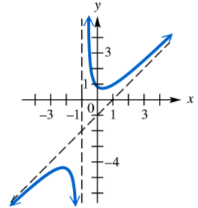
Identify any vertical, horizontal, or oblique asymptotes in the graph of y=ƒ(x). State the domain of ƒ.

Verified step by step guidance
1
Step 1: Identify the vertical asymptote by looking for the vertical line where the graph approaches infinity or negative infinity. In the graph, the red curve approaches a vertical dashed line at \(x = -2\), indicating a vertical asymptote there.
Step 2: Identify the horizontal asymptote by checking if the graph approaches a constant value as \(x\) goes to positive or negative infinity. In this graph, there is no horizontal line that the curve approaches, so there is no horizontal asymptote.
Step 3: Identify the oblique (slant) asymptote by observing if the graph approaches a non-horizontal, non-vertical line as \(x\) goes to infinity or negative infinity. The green dashed line with positive slope is the oblique asymptote, which appears to be \(y = x - 2\).
Step 4: State the domain of the function \(f\). Since there is a vertical asymptote at \(x = -2\), the function is undefined there. Therefore, the domain is all real numbers except \(x = -2\), which can be written as \((-\infty, -2) \cup (-2, \infty)\).
Step 5: Summarize the asymptotes and domain: Vertical asymptote at \(x = -2\), oblique asymptote at \(y = x - 2\), no horizontal asymptote, and domain \((-\infty, -2) \cup (-2, \infty)\).

Verified video answer for a similar problem:

This video solution was recommended by our tutors as helpful for the problem above.
Video duration:
7m
Was this helpful?

Key Concepts

Here are the essential concepts you must grasp in order to answer the question correctly.

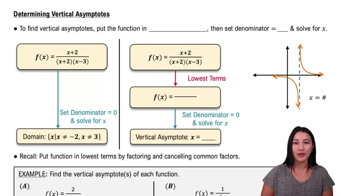
Vertical Asymptotes

Vertical asymptotes occur where the function approaches infinity or negative infinity as the input approaches a specific value. These are typically found where the denominator of a rational function is zero, causing the function to be undefined. In the graph, the vertical asymptote is shown as a dotted vertical line where the function spikes up or down.
Recommended video:
3:12
Determining Vertical Asymptotes

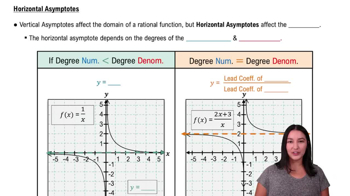
Horizontal and Oblique Asymptotes

Horizontal asymptotes describe the behavior of a function as the input approaches positive or negative infinity, indicating a constant value the function approaches. Oblique (slant) asymptotes occur when the function approaches a linear expression rather than a constant. In the graph, the dashed green line represents an oblique asymptote, showing the function's end behavior.
Recommended video:
4:48
Determining Horizontal Asymptotes

Domain of a Function

The domain of a function is the set of all input values for which the function is defined. Vertical asymptotes indicate values excluded from the domain because the function is undefined there. Identifying these asymptotes helps determine the domain by excluding points where the function does not exist.
Recommended video:
3:51
Domain Restrictions of Composed Functions