Solve each problem. Find a polynomial function ƒ of degree 3 with -2, 1, and 4 as zeros, and ƒ(2)=16.
Ch. 3 - Polynomial and Rational Functions

Chapter 4, Problem 38
Graph each polynomial function. Factor first if the polynomial is not in factored form. See Examples 3 and 4.
Verified step by step guidance1
Start by writing down the polynomial function: \(f(x) = x^3 + x^2 - 36x - 36\).
Look for common factors or use factoring by grouping. Group the terms as \((x^3 + x^2) + (-36x - 36)\).
Factor out the greatest common factor (GCF) from each group: \(x^2(x + 1) - 36(x + 1)\).
Notice that \((x + 1)\) is a common binomial factor, so factor it out: \((x + 1)(x^2 - 36)\).
Recognize that \(x^2 - 36\) is a difference of squares, which factors as \((x - 6)(x + 6)\), so the fully factored form is \((x + 1)(x - 6)(x + 6)\).

Verified video answer for a similar problem:
This video solution was recommended by our tutors as helpful for the problem above.
Video duration:
8mWas this helpful?
Key Concepts
Here are the essential concepts you must grasp in order to answer the question correctly.
Polynomial Functions
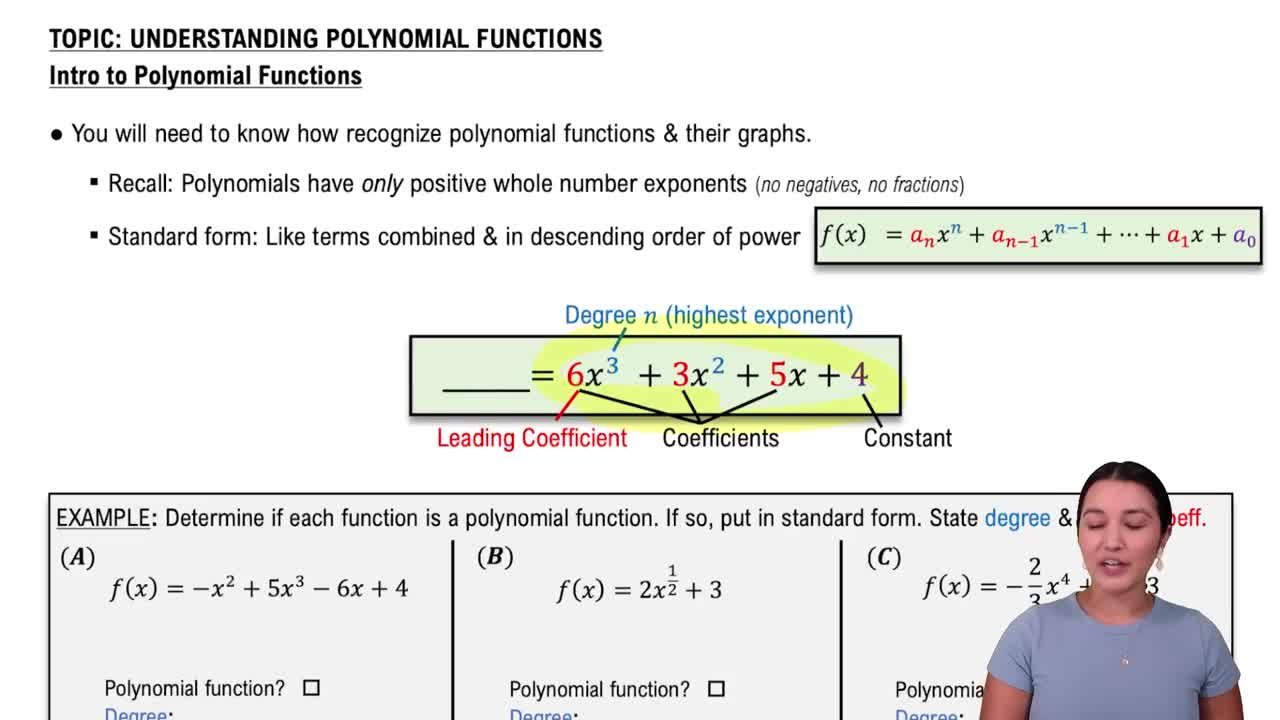
A polynomial function is an expression consisting of variables and coefficients combined using addition, subtraction, and multiplication, with non-negative integer exponents. Understanding the degree and leading coefficient helps predict the graph's general shape and end behavior.
Recommended video:
Introduction to Polynomial Functions
Factoring Polynomials
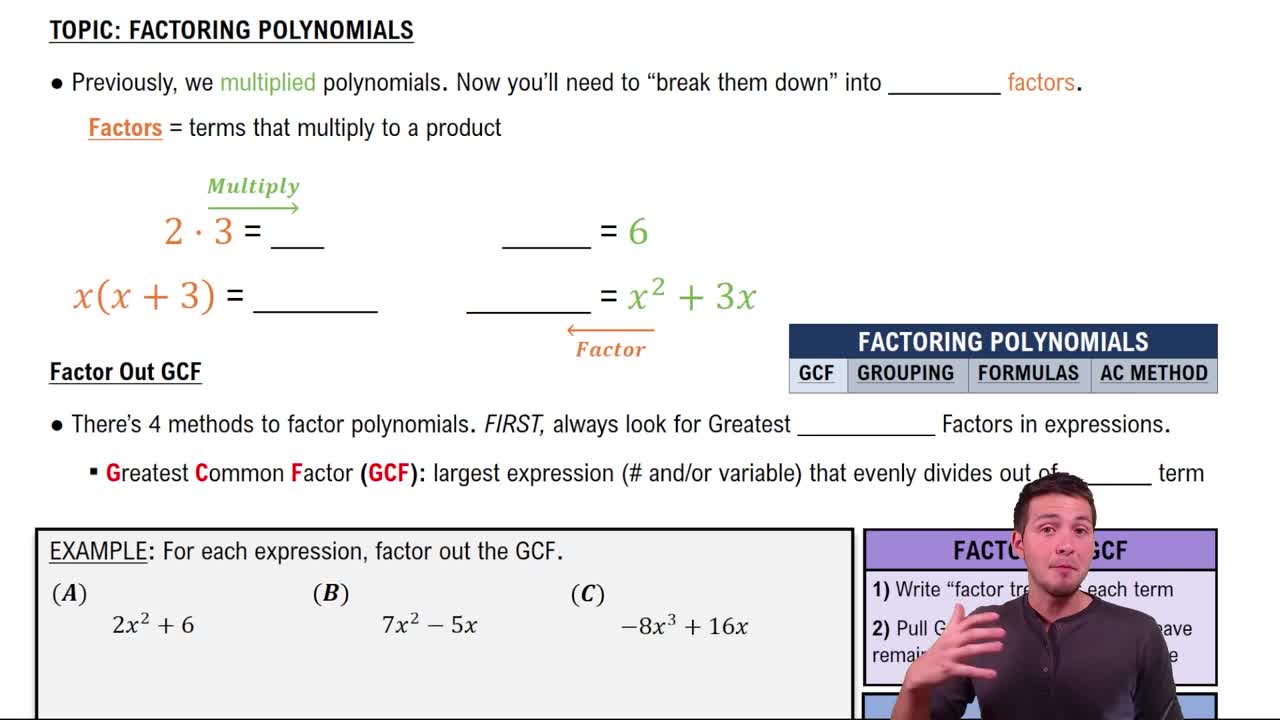
Factoring involves rewriting a polynomial as a product of simpler polynomials or factors. This process helps identify the roots or zeros of the function, which are critical points where the graph intersects the x-axis.
Recommended video:
Guided course
Introduction to Factoring Polynomials
Graphing Polynomial Functions
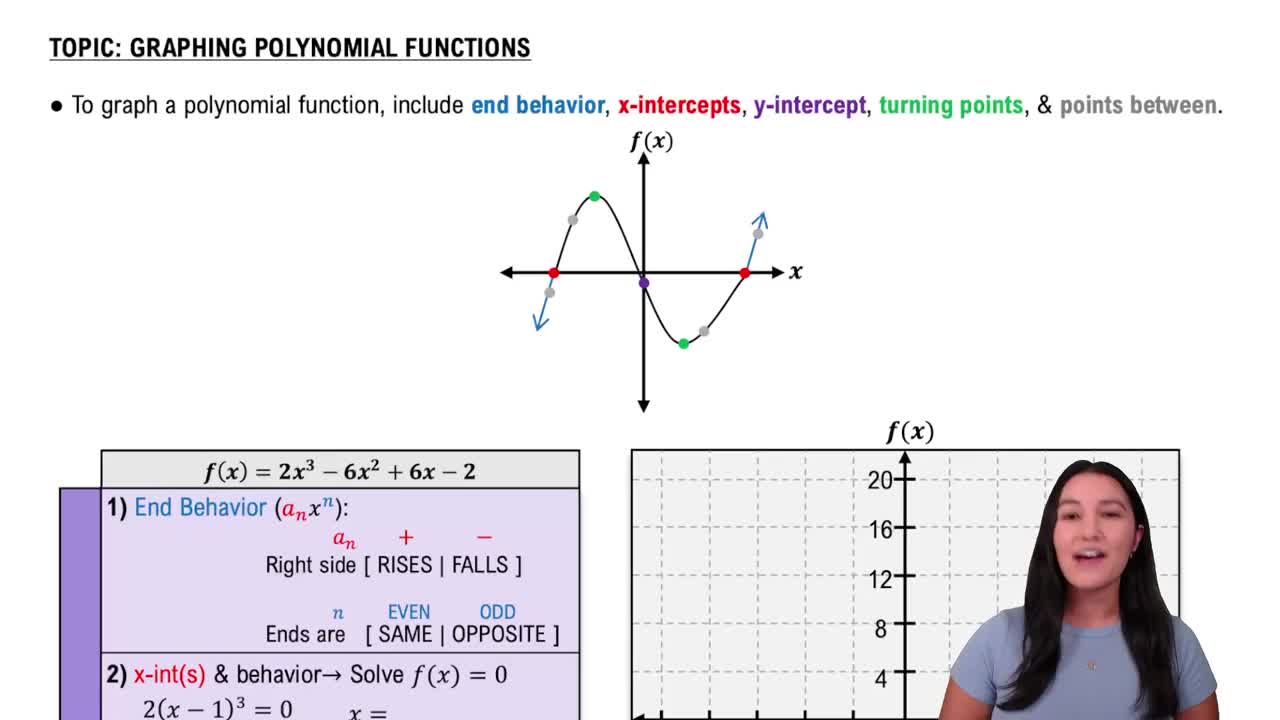
Graphing a polynomial requires plotting its zeros, analyzing end behavior, and identifying turning points. Factoring first simplifies finding zeros, and understanding multiplicity of roots helps determine whether the graph crosses or touches the x-axis at those points.
Recommended video:
Graphing Polynomial Functions
Related Practice
Textbook Question
Textbook Question
For each polynomial function, one zero is given. Find all other zeros.
3
views
Textbook Question
Solve each polynomial inequality. Give the solution set in interval notation. 2x3 - 7x2 ≥ 3 - 8x
Textbook Question
Current Flow In electric current flow, it is found that the resistance offered by a fixed length of wire of a given material varies inversely as the square of the diameter of the wire. If a wire 0.01 in. in diameter has a resistance of 0.4 ohm, what is the resistance of a wire of the same length and material with diameter 0.03 in., to the nearest ten-thousandth of an ohm?
Textbook Question
For each polynomial function, use the remainder theorem to find ƒ(k). ƒ(x) = x2 - 5x+1; k = 2+i
1
views
Textbook Question
Graph each polynomial function. Factor first if the polynomial is not in factored form. ƒ(x)=-x3+x2+2x