Ch. 3 - Polynomial and Rational Functions
Lial - College Algebra 13th Edition
Lial13th EditionCollege AlgebraISBN: 9780136881063Not the one you use?Change textbook
Chapter 4, Problem 82

For what values of a does y = ax2 - 8x + 4 have no x-intercepts?

Verified step by step guidance
1
Recall that the x-intercepts of a quadratic function \(y = ax^2 + bx + c\) occur where \(y = 0\). So, set the equation equal to zero: \(ax^2 - 8x + 4 = 0\).
To determine the number of x-intercepts, analyze the discriminant of the quadratic equation, which is given by \(\Delta = b^2 - 4ac\).
Identify the coefficients: here, \(a = a\) (the parameter we want to find), \(b = -8\), and \(c = 4\). Substitute these into the discriminant formula: \(\Delta = (-8)^2 - 4 \cdot a \cdot 4\).
Simplify the discriminant expression: \(\Delta = 64 - 16a\).
For the quadratic to have no x-intercepts, the discriminant must be less than zero: \(64 - 16a < 0\). Solve this inequality for \(a\) to find the values of \(a\) that make the parabola not cross the x-axis.

Verified video answer for a similar problem:

This video solution was recommended by our tutors as helpful for the problem above.
Video duration:
5m
Was this helpful?

Key Concepts

Here are the essential concepts you must grasp in order to answer the question correctly.

Quadratic Functions and Their Graphs

A quadratic function is a polynomial of degree two, typically written as y = ax^2 + bx + c. Its graph is a parabola that opens upward if a > 0 and downward if a < 0. Understanding the shape and position of the parabola helps analyze its intercepts and other properties.
Recommended video:
5:26
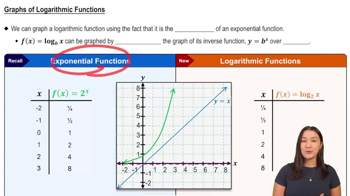
Graphs of Logarithmic Functions

X-Intercepts of a Quadratic Function

X-intercepts are points where the graph crosses the x-axis, found by setting y = 0 and solving the quadratic equation ax^2 + bx + c = 0. The number of x-intercepts depends on the nature of the roots of this equation, which can be two, one, or none.
Recommended video:
06:36
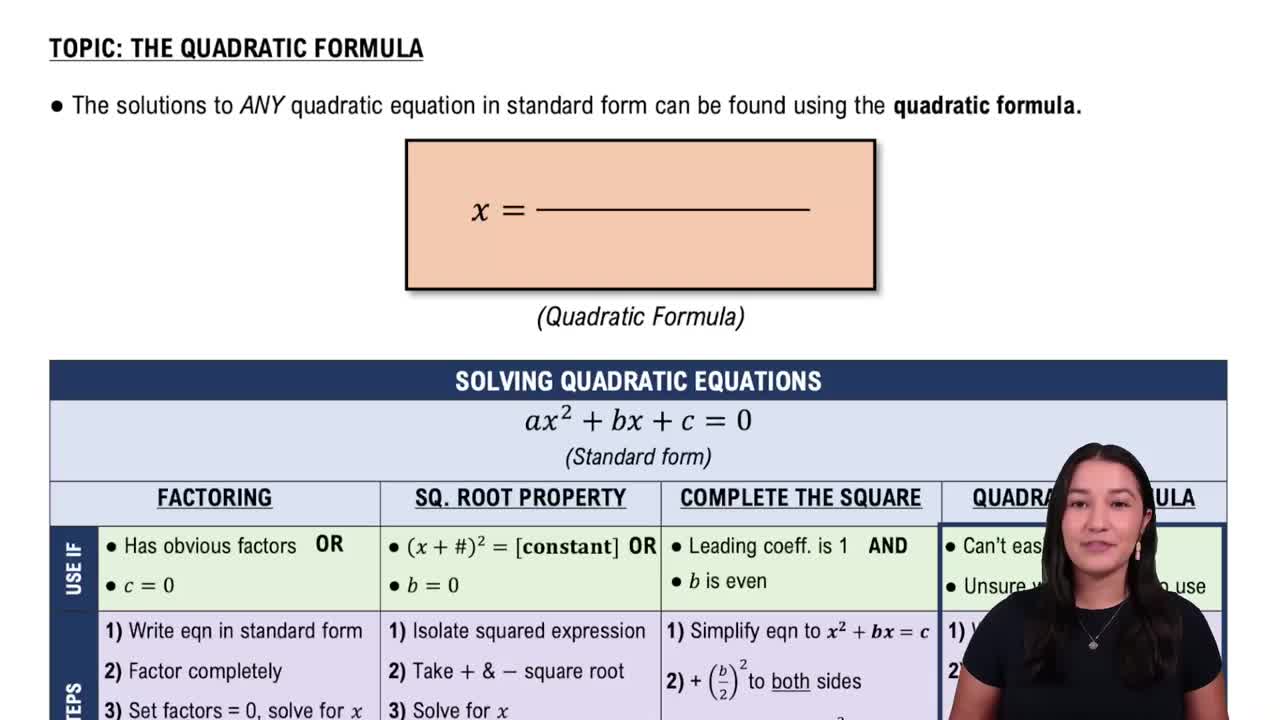
Solving Quadratic Equations Using The Quadratic Formula

Discriminant and Nature of Roots

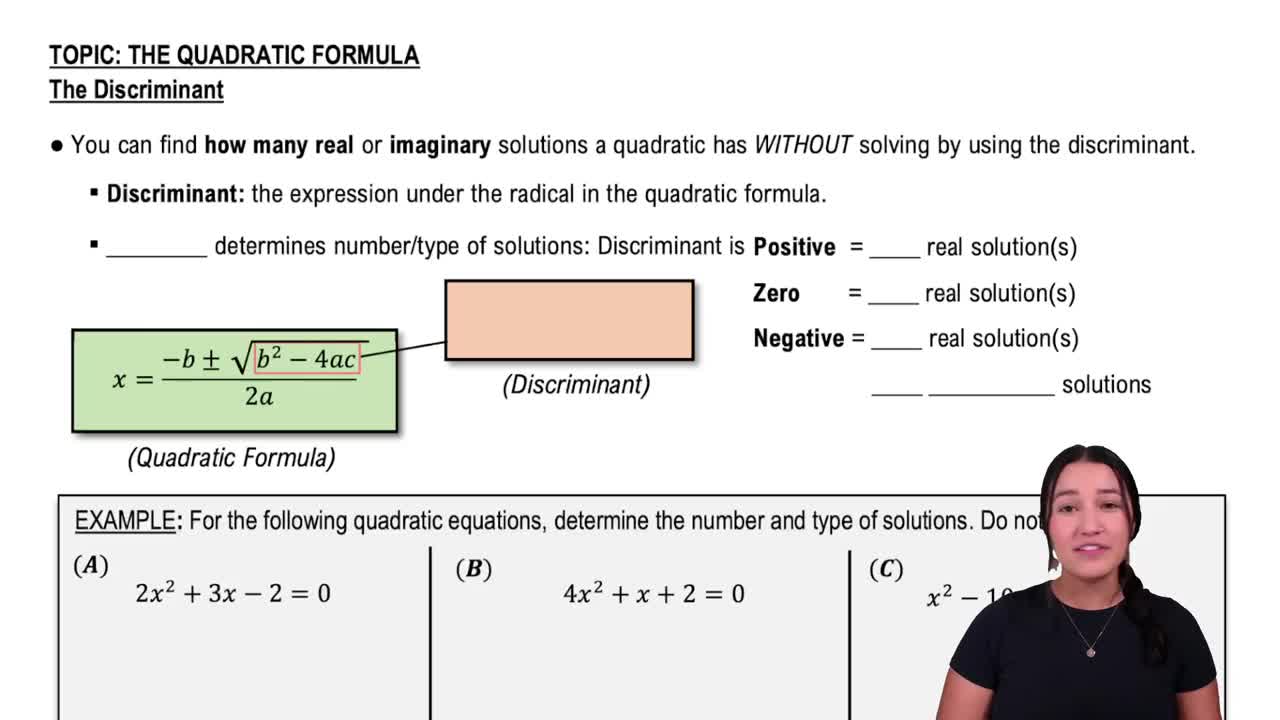
The discriminant, given by Δ = b^2 - 4ac, determines the number and type of roots of a quadratic equation. If Δ > 0, there are two distinct real roots; if Δ = 0, one real root; and if Δ < 0, no real roots, meaning the parabola does not cross the x-axis.
Recommended video:
04:11
The Discriminant