Ch. 3 - Polynomial and Rational Functions
Lial - College Algebra 13th Edition
Lial13th EditionCollege AlgebraISBN: 9780136881063Not the one you use?Change textbook
Chapter 4, Problem 73

Find a polynomial function ƒ(x) of least degree having only real coefficients and zeros as given. Assume multiplicity 1 unless otherwise stated. 2-i and 6-3i

Verified step by step guidance
1
Identify the given zeros: \(2 - i\) and \(6 - 3i\). Since the polynomial must have real coefficients, include their complex conjugates as zeros as well: \(2 + i\) and \(6 + 3i\).
Write the factors corresponding to each zero. For zero \(a\), the factor is \((x - a)\). So the factors are: \((x - (2 - i))\), \((x - (2 + i))\), \((x - (6 - 3i))\), and \((x - (6 + 3i))\).
Group the conjugate pairs and multiply each pair to get quadratic factors with real coefficients: multiply \((x - (2 - i))\) and \((x - (2 + i))\) to get one quadratic factor, and multiply \((x - (6 - 3i))\) and \((x - (6 + 3i))\) to get the other quadratic factor.
Use the formula for multiplying conjugate binomials: \((x - (a - bi))(x - (a + bi)) = (x - a)^2 + b^2\). Apply this to each pair to simplify the quadratic factors.
Multiply the two quadratic factors obtained in the previous step to get the polynomial function \(f(x)\) of least degree with real coefficients and the given zeros.

Verified video answer for a similar problem:

This video solution was recommended by our tutors as helpful for the problem above.
Video duration:
8m
Was this helpful?

Key Concepts

Here are the essential concepts you must grasp in order to answer the question correctly.

Complex Conjugate Root Theorem

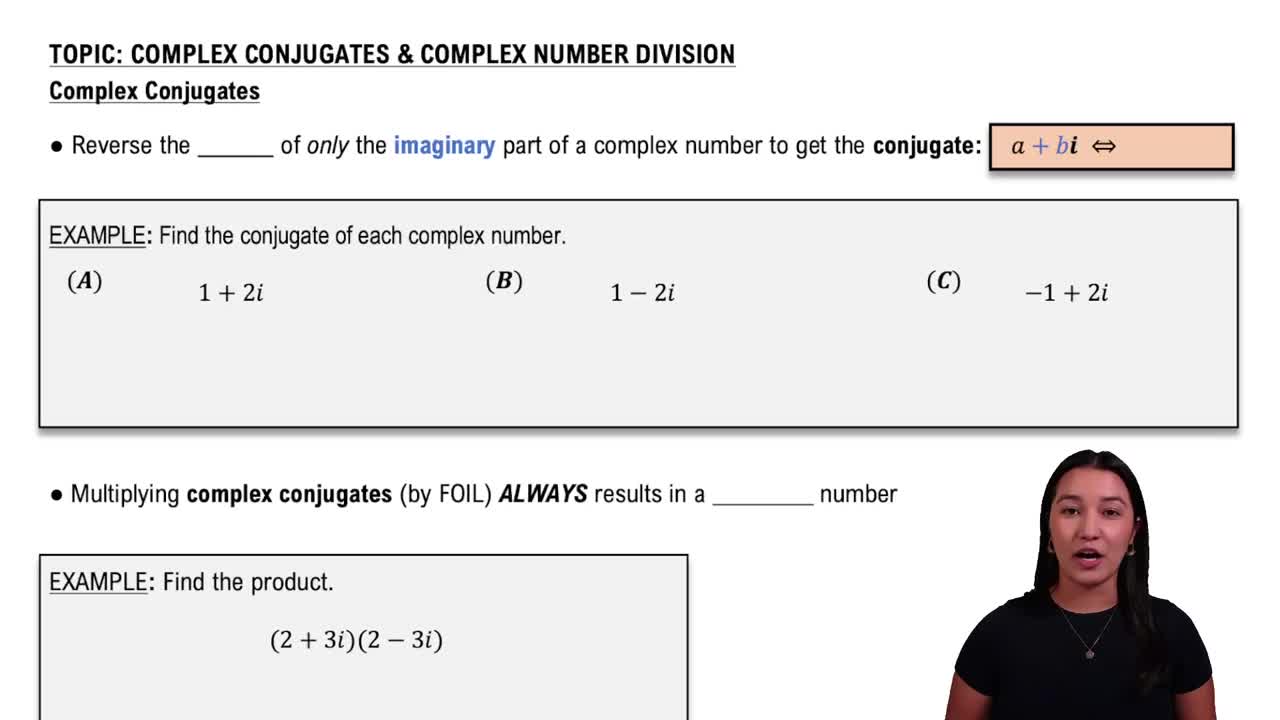
For polynomials with real coefficients, any non-real complex roots must occur in conjugate pairs. This means if 2 - i is a root, then its conjugate 2 + i must also be a root to ensure the polynomial has real coefficients.
Recommended video:
05:33
Complex Conjugates

Forming Polynomial from Roots

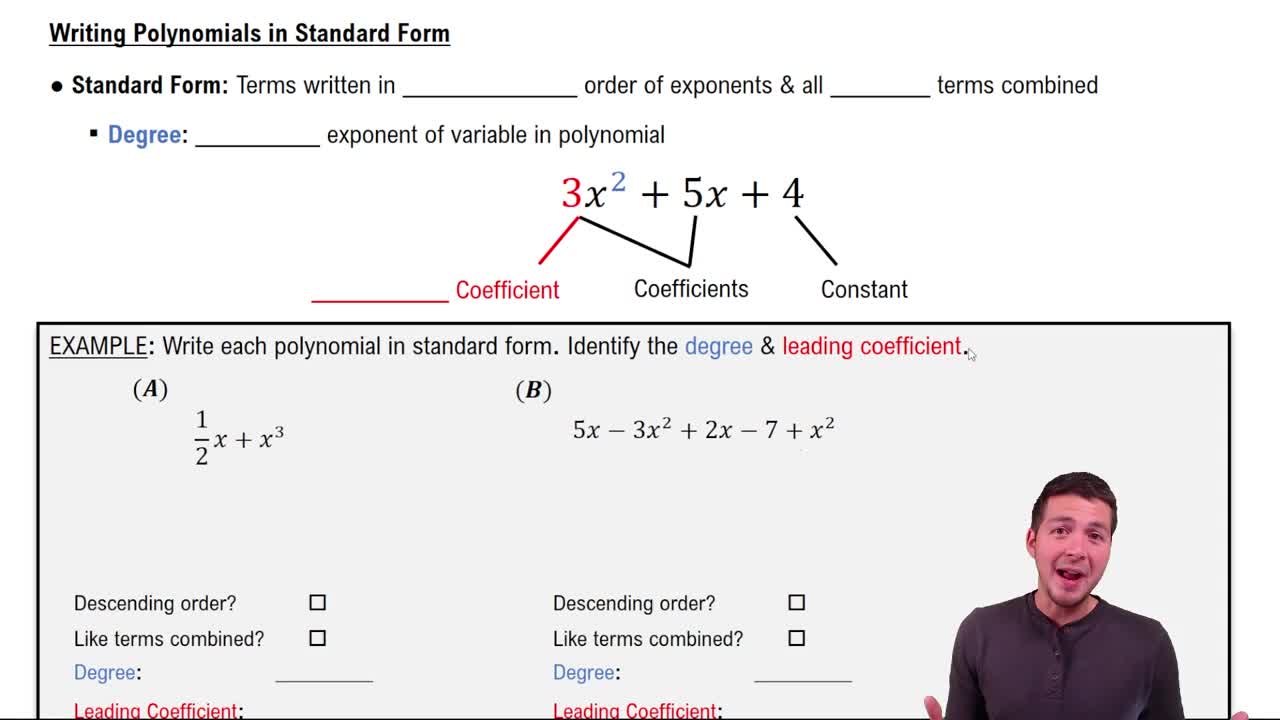
A polynomial can be constructed by creating factors from each root in the form (x - root). Multiplying these factors together yields a polynomial with the given roots. For example, roots r1 and r2 give factors (x - r1)(x - r2).
Recommended video:
Guided course
05:16
Standard Form of Polynomials

Simplifying Polynomial with Complex Roots

When multiplying factors involving complex conjugates, the product results in a quadratic with real coefficients. For instance, (x - (2 - i))(x - (2 + i)) simplifies to a quadratic with real coefficients, eliminating imaginary parts.
Recommended video:
05:33
Complex Conjugates