Ch. 3 - Polynomial and Rational Functions
Lial - College Algebra 13th Edition
Lial13th EditionCollege AlgebraISBN: 9780136881063Not the one you use?Change textbook
Chapter 4, Problem 57

Find a polynomial function ƒ(x) of degree 3 with real coefficients that satisfies the given conditions. Zero of -3 having multiplicity 3; ƒ(3)=36

Verified step by step guidance
1
Understand that the polynomial function ƒ(x) has a zero at x = -3 with multiplicity 3. This means the factor corresponding to this zero is \( (x + 3)^3 \). So, the general form of the polynomial is \( f(x) = a(x + 3)^3 \), where \( a \) is a real number coefficient to be determined.
Use the given condition \( f(3) = 36 \) to find the value of \( a \). Substitute \( x = 3 \) into the polynomial: \( f(3) = a(3 + 3)^3 = a(6)^3 = 216a \).
Set the expression equal to 36, as given: \( 216a = 36 \).
Solve for \( a \) by dividing both sides of the equation by 216: \( a = \frac{36}{216} \).
Write the final polynomial function by substituting the value of \( a \) back into the general form: \( f(x) = a(x + 3)^3 \).

Verified video answer for a similar problem:

This video solution was recommended by our tutors as helpful for the problem above.
Video duration:
4m
Was this helpful?

Key Concepts

Here are the essential concepts you must grasp in order to answer the question correctly.

Polynomial Functions and Degree

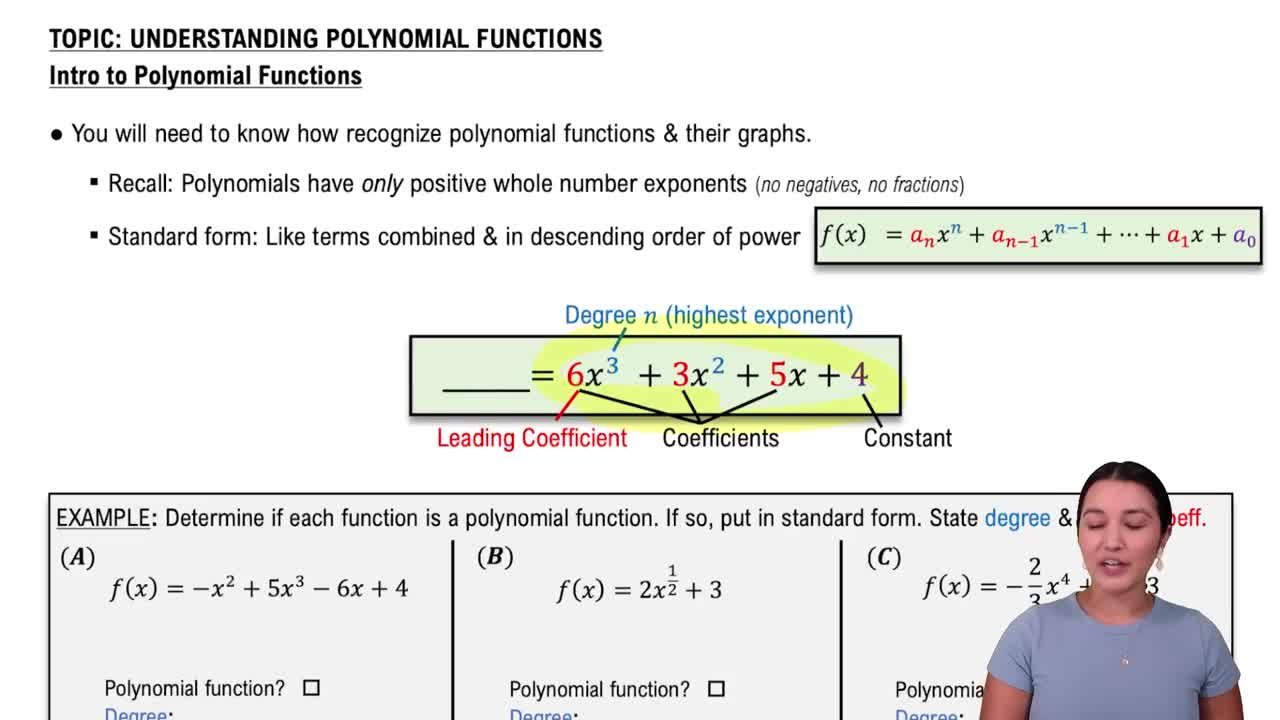
A polynomial function is an expression consisting of variables and coefficients combined using addition, subtraction, and multiplication, with non-negative integer exponents. The degree of a polynomial is the highest exponent of the variable, which determines the general shape and number of roots of the function. For this problem, the polynomial must be cubic (degree 3).
Recommended video:
06:04
Introduction to Polynomial Functions

Multiplicity of Roots

Multiplicity refers to the number of times a particular root appears in a polynomial. If a root has multiplicity 3, it means the factor corresponding to that root is repeated three times in the polynomial. For example, a root at x = -3 with multiplicity 3 implies the factor (x + 3)³.
Recommended video:
02:20
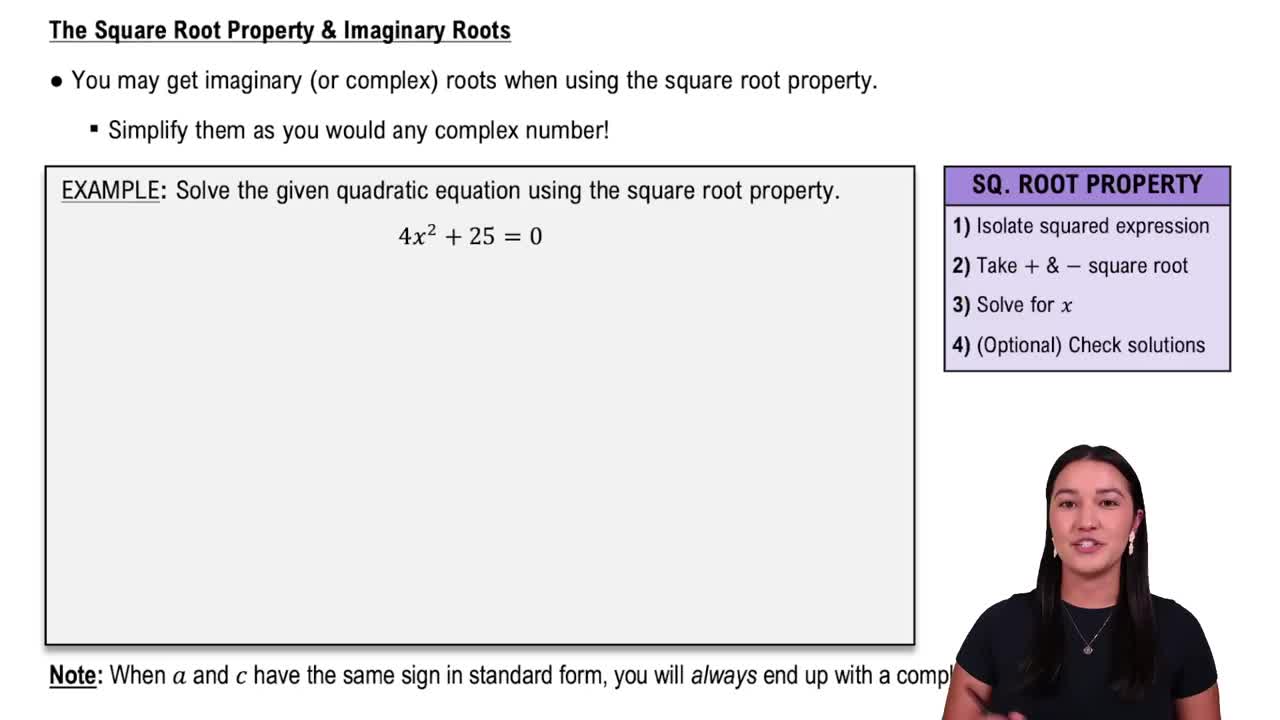
Imaginary Roots with the Square Root Property

Evaluating Polynomial Functions

Evaluating a polynomial function at a specific value means substituting that value into the function and calculating the result. This is used to find unknown coefficients by setting the function equal to a given output, such as ƒ(3) = 36, which helps determine the constant multiplier in the polynomial.
Recommended video:
06:04
Introduction to Polynomial Functions