Ch. 3 - Polynomial and Rational Functions
Lial - College Algebra 13th Edition
Lial13th EditionCollege AlgebraISBN: 9780136881063Not the one you use?Change textbook
Chapter 4, Problem 65

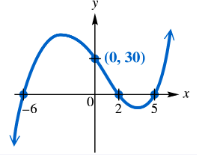
Find a polynomial function f of least degree having the graph shown. (Hint: See the NOTE following Example 4.)

Verified step by step guidance
1
Step 1: Identify the x-intercepts (roots) of the polynomial from the graph. The graph crosses the x-axis at approximately x = -5, x = 1, and x = 4. These are the zeros of the polynomial.
Step 2: Determine the multiplicity of each root by observing the behavior of the graph at each x-intercept. Since the graph crosses the x-axis at each root (not just touches), each root has an odd multiplicity, most likely 1 for the least degree polynomial.
Step 3: Write the general form of the polynomial using the roots. Since the roots are -5, 1, and 4, the polynomial can be expressed as \(f(x) = a(x + 5)(x - 1)(x - 4)\), where \(a\) is a constant coefficient to be determined.
Step 4: Use the given point on the graph, which is the y-intercept at (0, 20), to find the value of \(a\). Substitute \(x = 0\) and \(f(0) = 20\) into the polynomial: \(20 = a(0 + 5)(0 - 1)(0 - 4)\).
Step 5: Solve the equation from Step 4 for \(a\) to find the leading coefficient. Then write the final polynomial function \(f(x)\) by substituting \(a\) back into the general form.

Verified video answer for a similar problem:

This video solution was recommended by our tutors as helpful for the problem above.
Video duration:
4m
Was this helpful?

Key Concepts

Here are the essential concepts you must grasp in order to answer the question correctly.

Polynomial Function and Degree

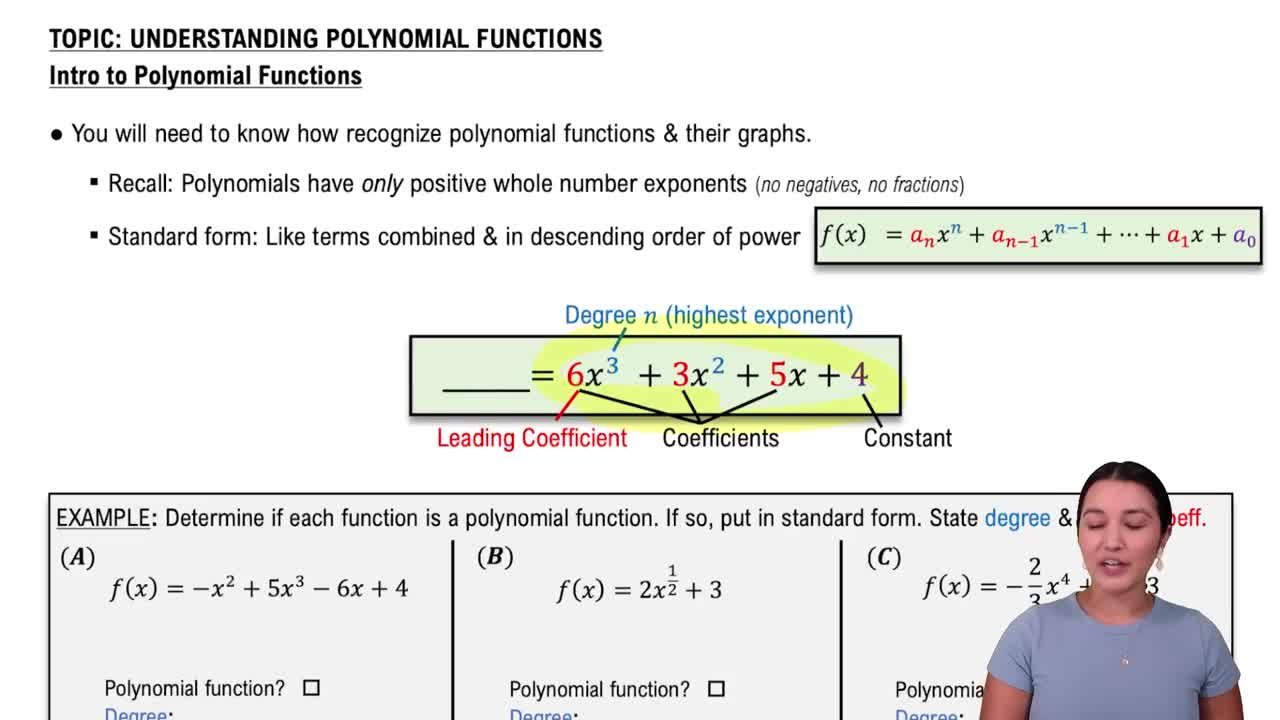
A polynomial function is an expression consisting of variables and coefficients combined using addition, subtraction, and multiplication, with non-negative integer exponents. The degree of the polynomial is the highest exponent of the variable, which determines the general shape and number of turning points of the graph.
Recommended video:
06:04
Introduction to Polynomial Functions

Zeros and Multiplicity

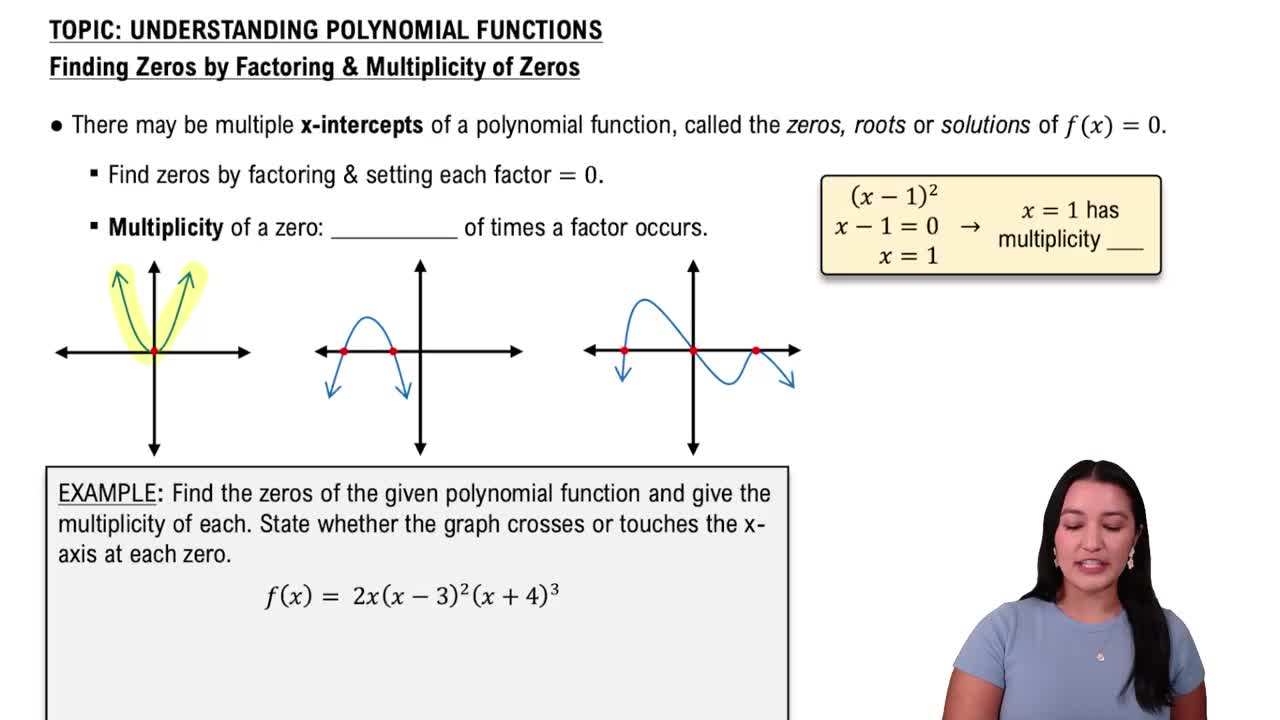
Zeros of a polynomial are the x-values where the function equals zero, corresponding to x-intercepts on the graph. The multiplicity of a zero affects the graph's behavior at that point: odd multiplicities cross the x-axis, while even multiplicities touch and turn around without crossing.
Recommended video:
03:42
Finding Zeros & Their Multiplicity

Using Points to Determine Coefficients

Known points on the graph, such as the y-intercept, help determine the coefficients of the polynomial. Substituting these points into the polynomial equation allows solving for unknown constants, ensuring the polynomial fits the given graph accurately.
Recommended video:
Guided course
4:36
Determinants of 2×2 Matrices