Ch. 2 - Graphs and Functions
Lial - College Algebra 13th Edition
Lial13th EditionCollege AlgebraISBN: 9780136881063Not the one you use?Change textbook
Chapter 3, Problem 25

Write an equation for each line described. Give answers in standard form for Exercises 11–20 and in slope-intercept form (if possible) for Exercises 21–32. horizontal, through (-7,4)

Verified step by step guidance
1
Identify the type of line described: a horizontal line has a slope of 0, meaning it does not rise or fall as it moves along the x-axis.
Recall that the equation of a horizontal line is always of the form \(y = k\), where \(k\) is the constant y-value for all points on the line.
Since the line passes through the point \((-7, 4)\), the y-value for every point on the line is 4.
Write the equation of the line as \(y = 4\).
Note that this equation is already in slope-intercept form \(y = mx + b\) with \(m = 0\) and \(b = 4\), and it can also be considered in standard form as \(0x + y = 4\).

Verified video answer for a similar problem:

This video solution was recommended by our tutors as helpful for the problem above.
Video duration:
3m
Was this helpful?

Key Concepts

Here are the essential concepts you must grasp in order to answer the question correctly.

Equation of a Horizontal Line

A horizontal line has a constant y-value for all x-values, meaning its slope is zero. The equation of a horizontal line is written as y = k, where k is the y-coordinate of any point on the line. For example, a horizontal line through (-7, 4) is y = 4.
Recommended video:
Guided course
05:39
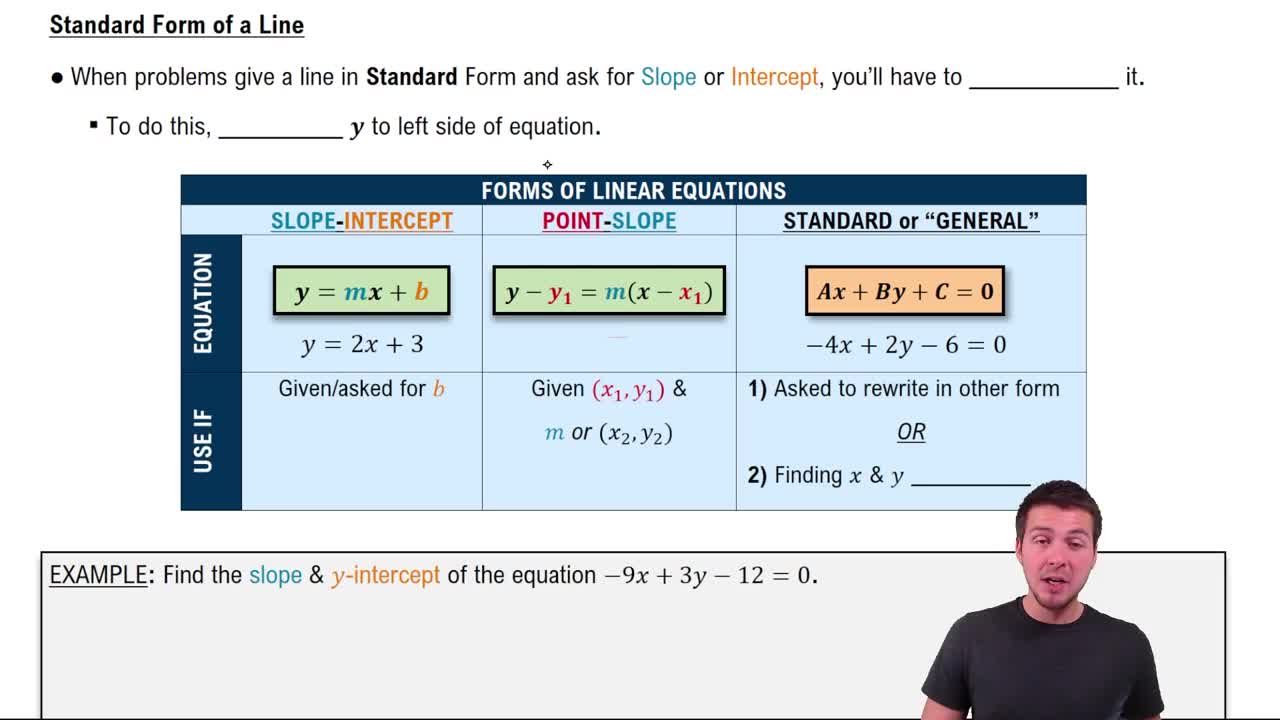
Standard Form of Line Equations

Standard Form of a Linear Equation

The standard form of a linear equation is Ax + By = C, where A, B, and C are integers, and A ≥ 0. This form is useful for quickly identifying intercepts and is often required for certain exercises. For horizontal lines, the standard form is typically y = constant, which can be rewritten as 0x + 1y = constant.
Recommended video:
Guided course
05:39
Standard Form of Line Equations

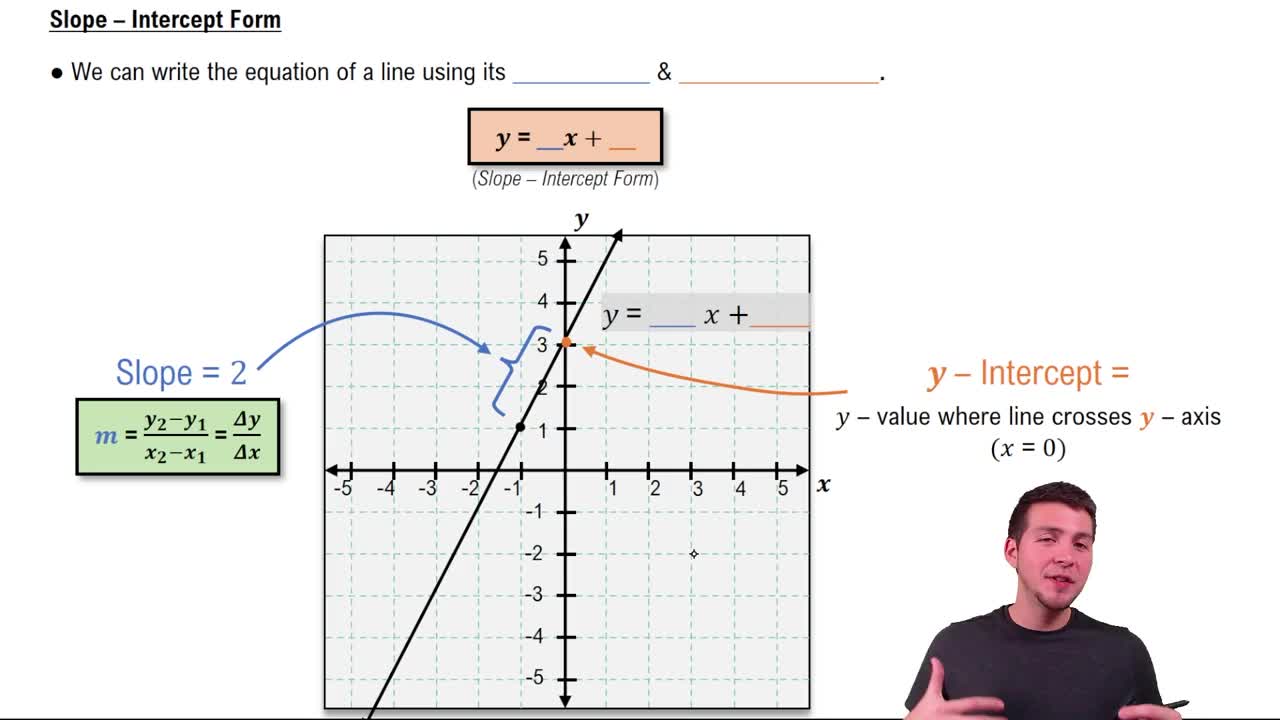
Slope-Intercept Form of a Linear Equation

The slope-intercept form is y = mx + b, where m is the slope and b is the y-intercept. It clearly shows the slope and where the line crosses the y-axis. For horizontal lines, the slope m = 0, so the equation simplifies to y = b, making it easy to write and interpret.
Recommended video:
Guided course
03:56
Slope-Intercept Form