Ch. 2 - Graphs and Functions
Lial - College Algebra 13th Edition
Lial13th EditionCollege AlgebraISBN: 9780136881063Not the one you use?Change textbook
Chapter 3, Problem 53

Write an equation (a) in standard form and (b) in slope-intercept form for each line described. through (1, 6), perpendicular to 3x+5y=1

Verified step by step guidance
1
Identify the slope of the given line by rewriting the equation \(3x + 5y = 1\) in slope-intercept form \(y = mx + b\). To do this, solve for \(y\): \(\n\[\n\)\(5y = -3x + 1\) \(\n\]\n\)\(y = -\frac{3}{5}x + \frac{1}{5}\). \(\n\)\(\nSo\), the slope \(m\) of the given line is \(-\frac{3}{5}\).
Find the slope of the line perpendicular to the given line. Recall that perpendicular slopes are negative reciprocals of each other. So, if the original slope is \(m = -\frac{3}{5}\), the perpendicular slope \(m_{\perp}\) is \(\frac{5}{3}\).
Use the point-slope form of a line equation with the point \((1, 6)\) and the perpendicular slope \(\frac{5}{3}\): \(\n\[\n\)\(y - y_1 = m(x - x_1)\) \(\n\]\nSubstitute\) \(x_1 = 1\), \(y_1 = 6\), and \(m = \frac{5}{3}\): \(\n\)\(\n\)\(y - 6 = \frac{5}{3}(x - 1)\).
Convert the point-slope form to slope-intercept form \(y = mx + b\) by distributing and isolating \(y\): \(\n\[\n\)\(y - 6 = \frac{5}{3}x - \frac{5}{3}\) \(\n\]\n\)\(y = \frac{5}{3}x - \frac{5}{3} + 6\).
Rewrite the equation in standard form \(Ax + By = C\) by eliminating fractions and moving all terms to one side: \(\n\[\nMultiply\) both sides by 3 to clear denominators: \(\n\]\n\)\(3y = 5x - 5 + 18\) \(\n\)\(\nSimplify\) and rearrange terms to get \(Ax + By = C\) with integer coefficients.

Verified video answer for a similar problem:

This video solution was recommended by our tutors as helpful for the problem above.
Video duration:
4m
Was this helpful?

Key Concepts

Here are the essential concepts you must grasp in order to answer the question correctly.

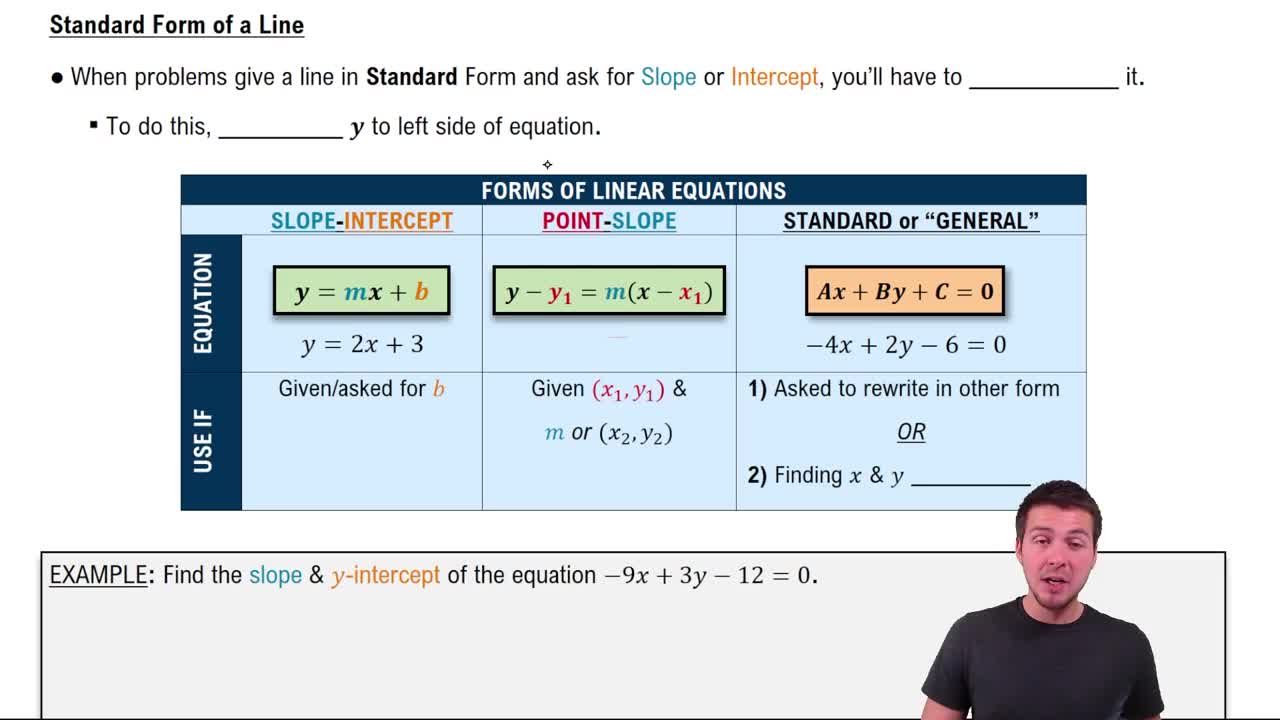
Standard Form of a Linear Equation

The standard form of a linear equation is written as Ax + By = C, where A, B, and C are integers, and A should be non-negative. This form is useful for identifying intercepts and for certain algebraic manipulations. Converting an equation to this form often involves rearranging terms and clearing fractions.
Recommended video:
Guided course
05:39
Standard Form of Line Equations

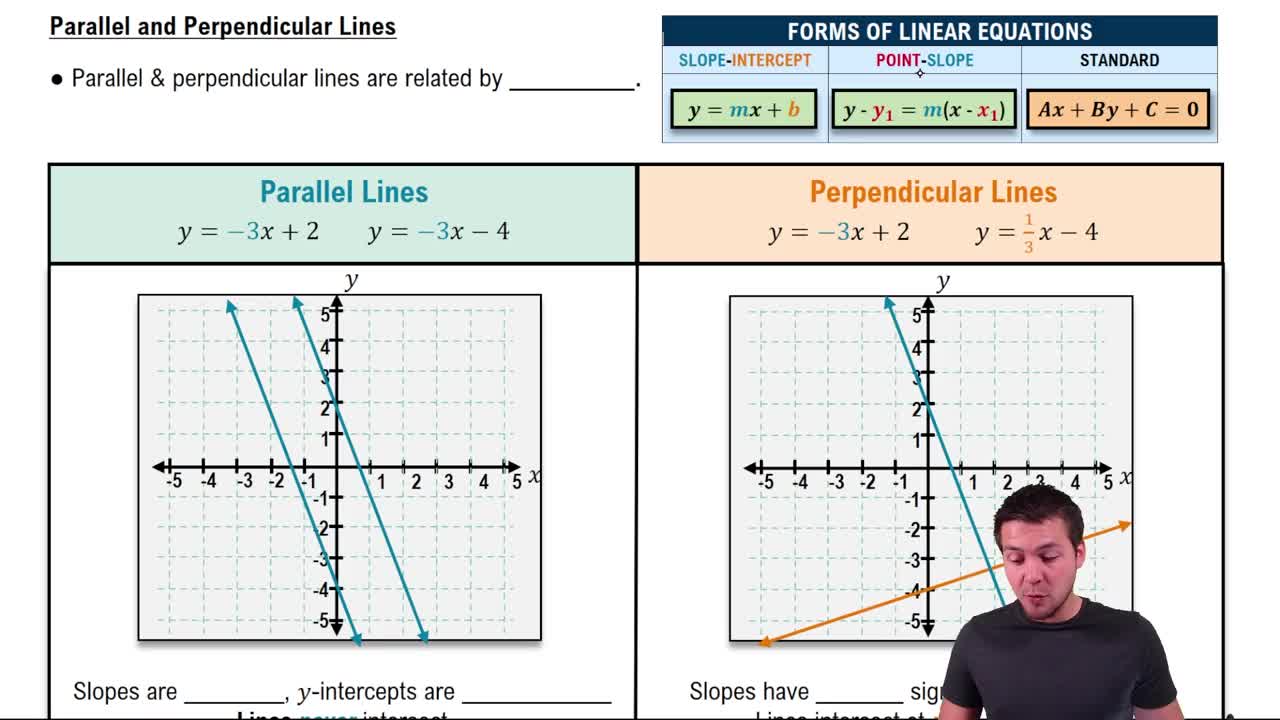
Slope of a Line and Perpendicular Lines

The slope of a line measures its steepness and is calculated as the ratio of the change in y to the change in x. For two lines to be perpendicular, their slopes must be negative reciprocals of each other. If one line has slope m, the perpendicular line's slope is -1/m.
Recommended video:
Guided course
07:52
Parallel & Perpendicular Lines

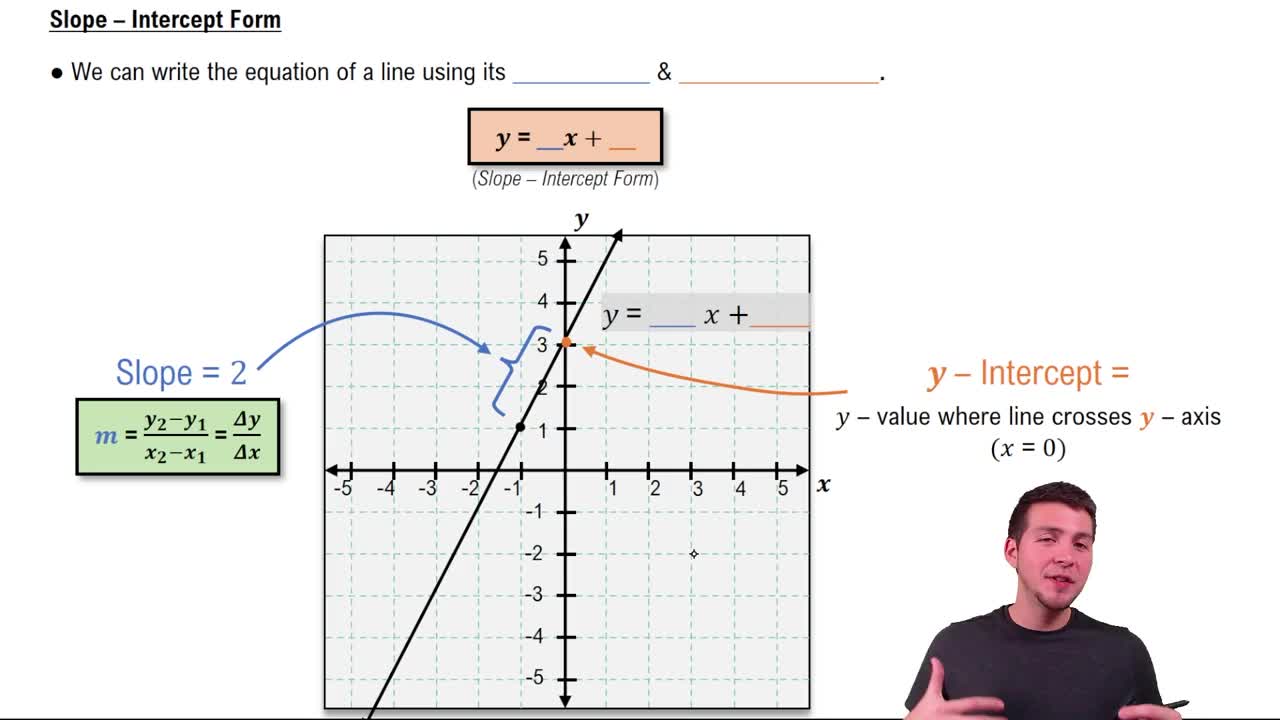
Slope-Intercept Form of a Linear Equation

The slope-intercept form is y = mx + b, where m is the slope and b is the y-intercept. This form clearly shows the slope and where the line crosses the y-axis, making it easy to graph and understand the line's behavior. It is often derived by solving for y in terms of x.
Recommended video:
Guided course
03:56
Slope-Intercept Form