Ch. 2 - Graphs and Functions
Lial - College Algebra 13th Edition
Lial13th EditionCollege AlgebraISBN: 9780136881063Not the one you use?Change textbook
Chapter 3, Problem 49

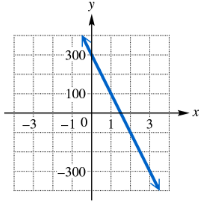
The graph of a linear function f is shown. (a) Identify the slope, y-intercept, and x-intercept. (b) Write an equation that defines f.

Verified step by step guidance
1
Step 1: Identify the y-intercept by finding the point where the line crosses the y-axis. This occurs when x = 0. From the graph, note the y-coordinate of this point.
Step 2: Identify the x-intercept by finding the point where the line crosses the x-axis. This occurs when y = 0. From the graph, note the x-coordinate of this point.
Step 3: Calculate the slope (m) of the line using the formula \(m = \frac{\Delta y}{\Delta x} = \frac{y_2 - y_1}{x_2 - x_1}\), where \((x_1, y_1)\) and \((x_2, y_2)\) are two points on the line. Use the intercepts or any two points clearly visible on the graph.
Step 4: Write the equation of the line in slope-intercept form, which is \(y = mx + b\), where \(m\) is the slope found in Step 3 and \(b\) is the y-intercept found in Step 1.
Step 5: Optionally, verify the equation by plugging in the x-coordinate of the x-intercept and checking that the y-value is zero, confirming the correctness of the equation.

Verified video answer for a similar problem:

This video solution was recommended by our tutors as helpful for the problem above.
Video duration:
7m
Was this helpful?

Key Concepts

Here are the essential concepts you must grasp in order to answer the question correctly.

Slope of a Linear Function

The slope measures the steepness and direction of a line, calculated as the ratio of the vertical change (rise) to the horizontal change (run) between two points. It indicates how much y changes for a unit change in x. A positive slope means the line rises, while a negative slope means it falls.
Recommended video:
06:07
Linear Inequalities

Intercepts of a Linear Function

The y-intercept is the point where the line crosses the y-axis (x=0), representing the function's value when x is zero. The x-intercept is where the line crosses the x-axis (y=0), showing the input value that makes the function zero. Identifying these points helps in graphing and writing the equation.
Recommended video:
06:07
Linear Inequalities

Equation of a Linear Function

A linear function can be expressed as y = mx + b, where m is the slope and b is the y-intercept. Using the slope and y-intercept from the graph, you can write the equation that defines the function. This equation models the relationship between x and y values on the line.
Recommended video:
06:00
Categorizing Linear Equations