Ch. 2 - Graphs and Functions
Lial - College Algebra 13th Edition
Lial13th EditionCollege AlgebraISBN: 9780136881063Not the one you use?Change textbook
Chapter 3, Problem 33

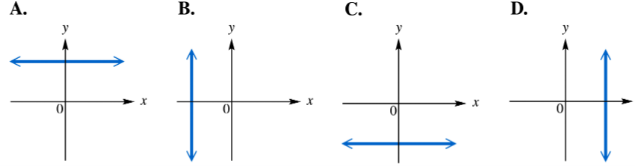
Match each equation with the sketch that most closely resembles its graph. x = 5
Four coordinate plane sketches labeled A to D, each showing a blue line: A horizontal through y-axis, B vertical through y-axis, C horizontal through x-axis, D vertical through x-axis.

Verified step by step guidance
1
Recognize that the equation \(x = 5\) represents a vertical line in the coordinate plane because it states that the x-coordinate is always 5 regardless of the y-coordinate.
Recall that vertical lines have the form \(x = a\), where \(a\) is a constant, and they run parallel to the y-axis.
Understand that the graph of \(x = 5\) will be a straight line crossing the x-axis at the point (5, 0).
Note that this line does not slope or curve; it extends infinitely up and down through all y-values while maintaining \(x = 5\).
When matching the equation to a sketch, look for the graph that shows a vertical line passing through \(x = 5\) on the x-axis.

Verified video answer for a similar problem:

This video solution was recommended by our tutors as helpful for the problem above.
Video duration:
2m
Was this helpful?

Key Concepts

Here are the essential concepts you must grasp in order to answer the question correctly.

Vertical Lines

A vertical line is a line where all points have the same x-coordinate. Its equation is of the form x = a constant, such as x = 5. This line runs parallel to the y-axis and does not depend on y-values.
Recommended video:
Guided course
06:49
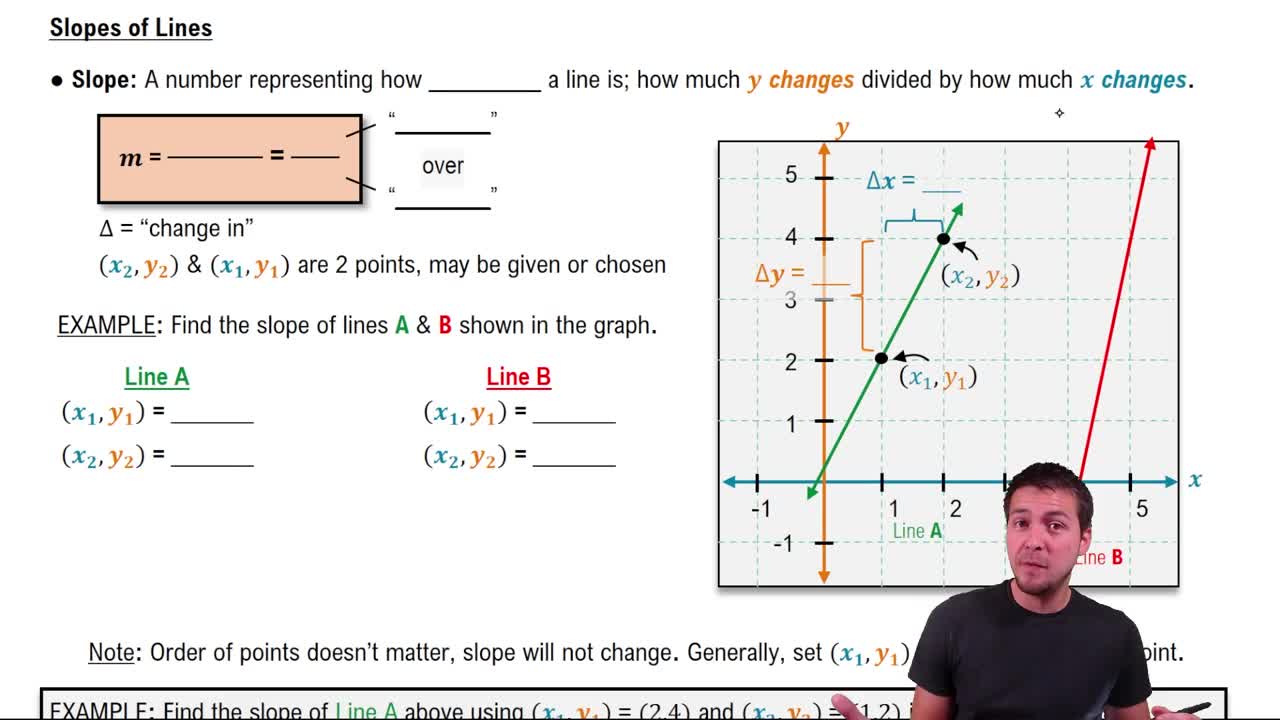
The Slope of a Line

Graphing Linear Equations

Graphing linear equations involves plotting all points (x, y) that satisfy the equation. For equations like x = 5, the graph is a straight line where x is fixed, illustrating the concept of lines with undefined slope.
Recommended video:
06:00
Categorizing Linear Equations

Coordinate Plane and Axes

The coordinate plane consists of the x-axis (horizontal) and y-axis (vertical). Understanding the position of lines relative to these axes helps in matching equations to their graphs, such as recognizing that x = 5 is a vertical line crossing the x-axis at 5.
Recommended video:
Guided course
05:10
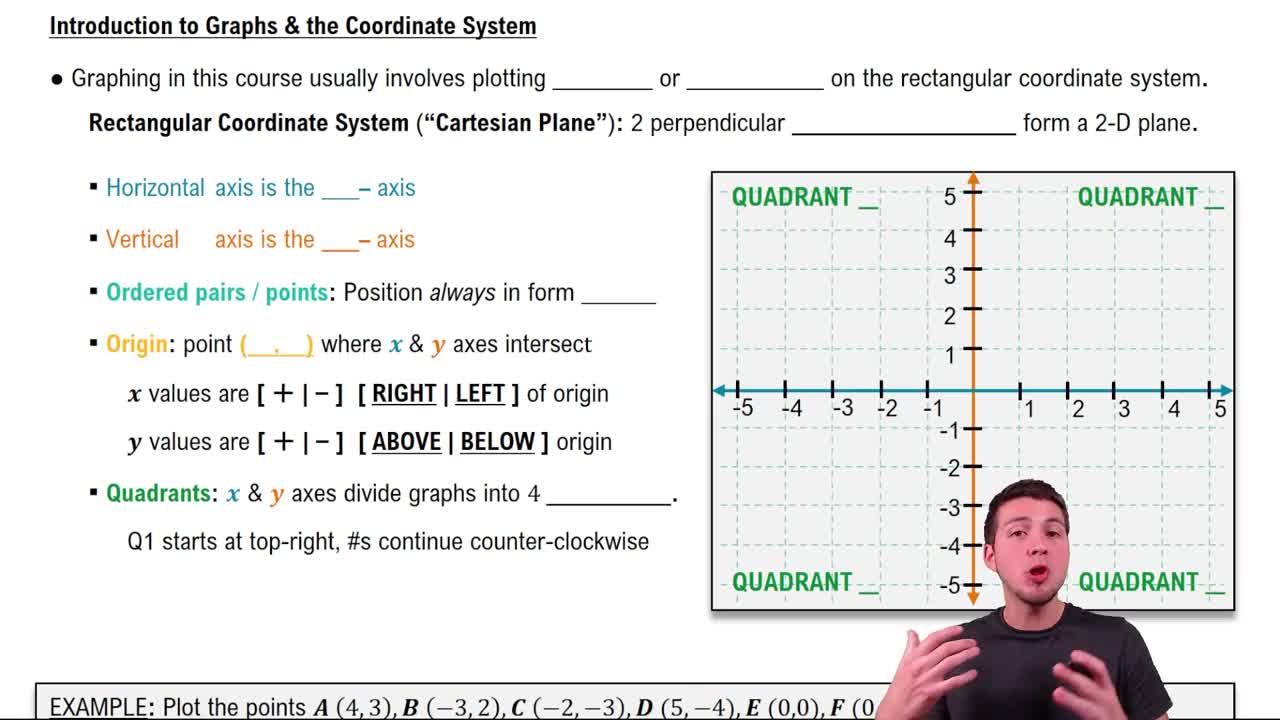
Graphs & the Rectangular Coordinate System