Ch. 2 - Graphs and Functions
Lial - College Algebra 13th Edition
Lial13th EditionCollege AlgebraISBN: 9780136881063Not the one you use?Change textbook
Chapter 3, Problem 55

Let ƒ(x)=-3x+4 and g(x)=-x2+4x+1. Find each of the following. Simplify if necessary. ƒ(1/3)

Verified step by step guidance
1
Identify the function ƒ(x) given as ƒ(x) = -3x + 4.
To find ƒ(1/3), substitute x = \(\frac{1}{3}\) into the function ƒ(x).
Write the substitution explicitly: ƒ\(\left\)(\(\frac{1}{3}\)\(\right\)) = -3 \(\times\) \(\frac{1}{3}\) + 4.
Multiply -3 by \(\frac{1}{3}\) to simplify the expression inside the function.
Add the result of the multiplication to 4 to get the simplified value of ƒ\(\left\)(\(\frac{1}{3}\)\(\right\)).

Verified video answer for a similar problem:

This video solution was recommended by our tutors as helpful for the problem above.
Video duration:
56s
Was this helpful?

Key Concepts

Here are the essential concepts you must grasp in order to answer the question correctly.

Function Evaluation

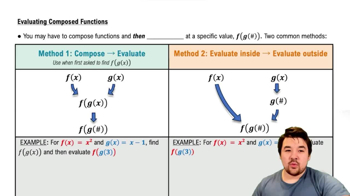
Function evaluation involves substituting a given input value into the function's formula and simplifying to find the output. For example, to find ƒ(1/3), replace x with 1/3 in ƒ(x) and simplify the expression.
Recommended video:
4:26
Evaluating Composed Functions

Linear Functions

A linear function has the form ƒ(x) = mx + b, where m and b are constants. Its graph is a straight line, and evaluating it involves simple arithmetic operations like multiplication and addition.
Recommended video:
06:07
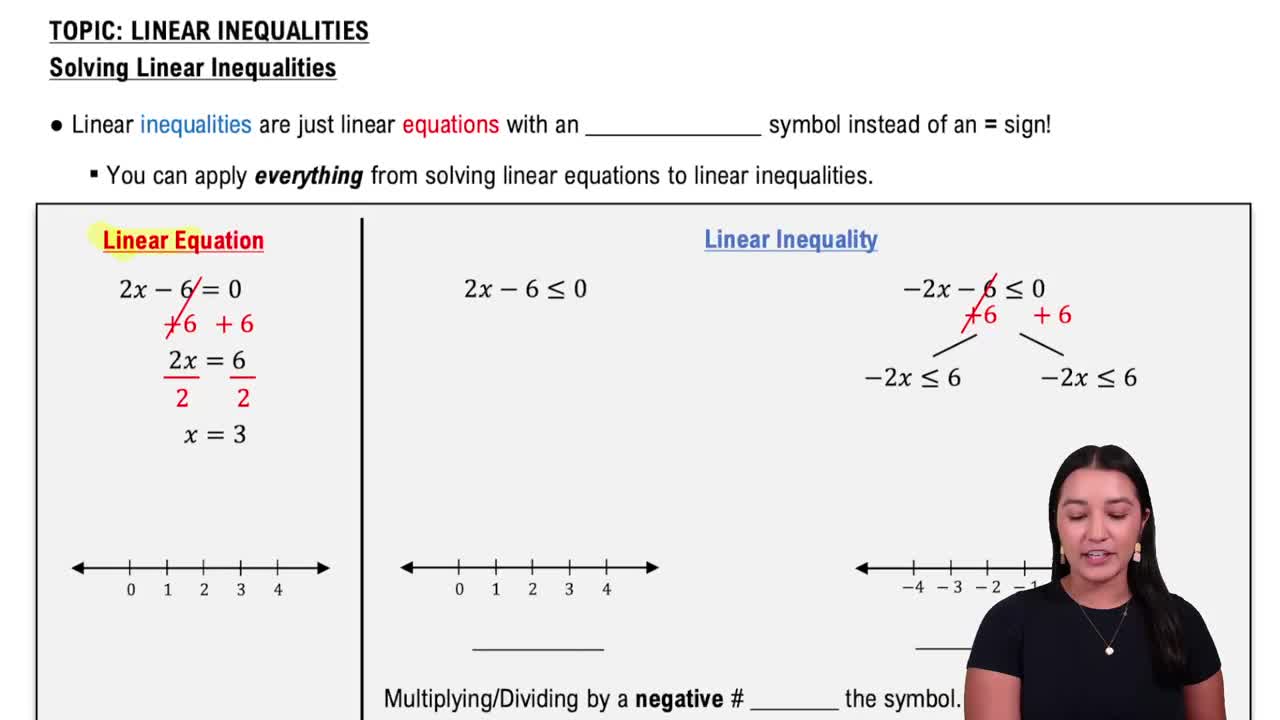
Linear Inequalities

Simplification of Algebraic Expressions

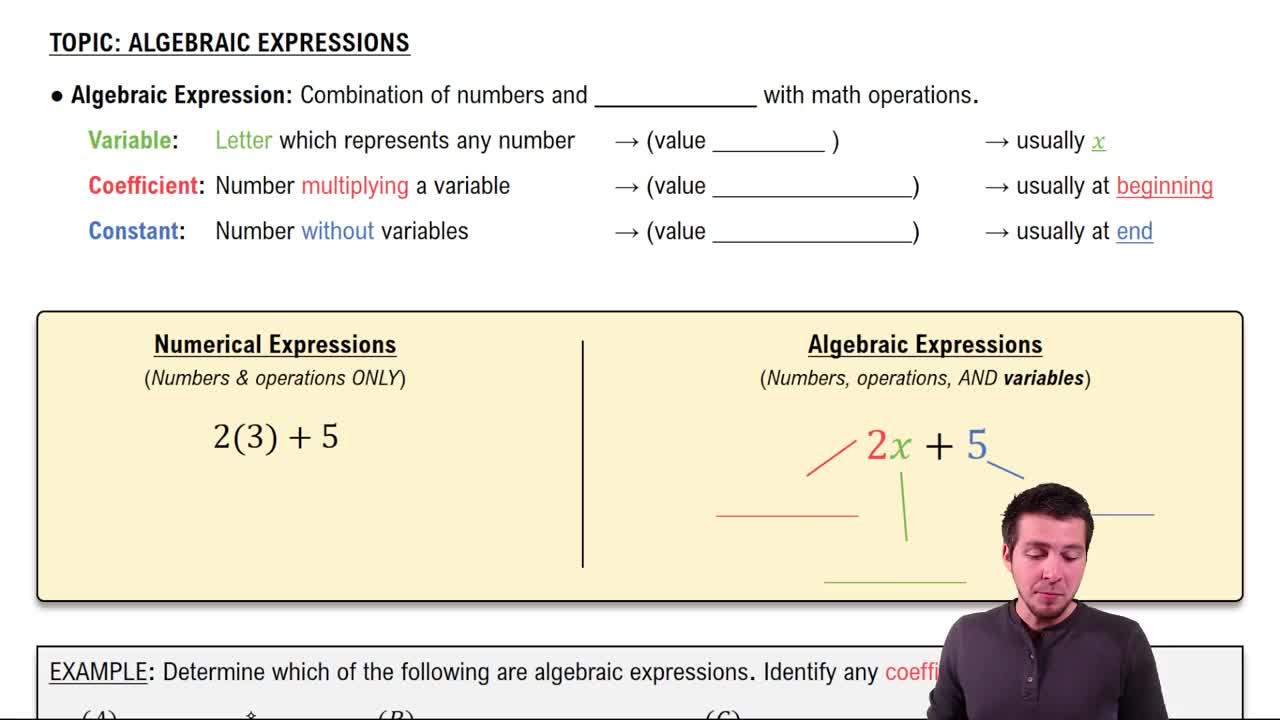
Simplification means reducing an expression to its simplest form by performing arithmetic operations and combining like terms. This step ensures the final answer is clear and concise.
Recommended video:
Guided course
05:09
Introduction to Algebraic Expressions