Ch. 2 - Graphs and Functions
Lial - College Algebra 13th Edition
Lial13th EditionCollege AlgebraISBN: 9780136881063Not the one you use?Change textbook
Chapter 3, Problem 19d

For the pair of functions defined, find (f/g)(x).Give the domain of each. See Example 2.
ƒ(x)=3x+4, g(x)=2x-8

Verified step by step guidance
1
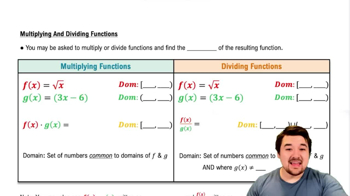
First, recall that the function (f/g)(x) is defined as the quotient of f(x) and g(x), so write it as \( (f/g)(x) = \frac{f(x)}{g(x)} \).
Substitute the given functions into the quotient: \( (f/g)(x) = \frac{3x + 4}{2x - 8} \).
Next, determine the domain of f(x) which is \( f(x) = 3x + 4 \). Since this is a linear function, its domain is all real numbers, or \( (-\infty, \infty) \).
Determine the domain of g(x) which is \( g(x) = 2x - 8 \). This is also a linear function with domain \( (-\infty, \infty) \), but since g(x) is in the denominator of the quotient, we must exclude values where \( g(x) = 0 \).
Solve \( 2x - 8 = 0 \) to find the value to exclude from the domain of (f/g)(x). This gives \( x = 4 \). Therefore, the domain of (f/g)(x) is all real numbers except \( x = 4 \), or \( (-\infty, 4) \cup (4, \infty) \).

Verified video answer for a similar problem:

This video solution was recommended by our tutors as helpful for the problem above.
Video duration:
2m
Was this helpful?

Key Concepts

Here are the essential concepts you must grasp in order to answer the question correctly.

Function Division (f/g)(x)

Dividing two functions f and g means creating a new function (f/g)(x) = f(x) / g(x). This involves substituting the expressions for f(x) and g(x) and simplifying the resulting fraction, ensuring the denominator is not zero.
Recommended video:
7:24
Multiplying & Dividing Functions

Domain of a Function

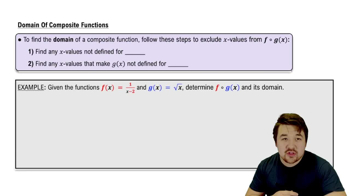
The domain of a function is the set of all input values (x) for which the function is defined. For (f/g)(x), the domain excludes values that make the denominator zero, as division by zero is undefined.
Recommended video:
3:51
Domain Restrictions of Composed Functions

Linear Functions

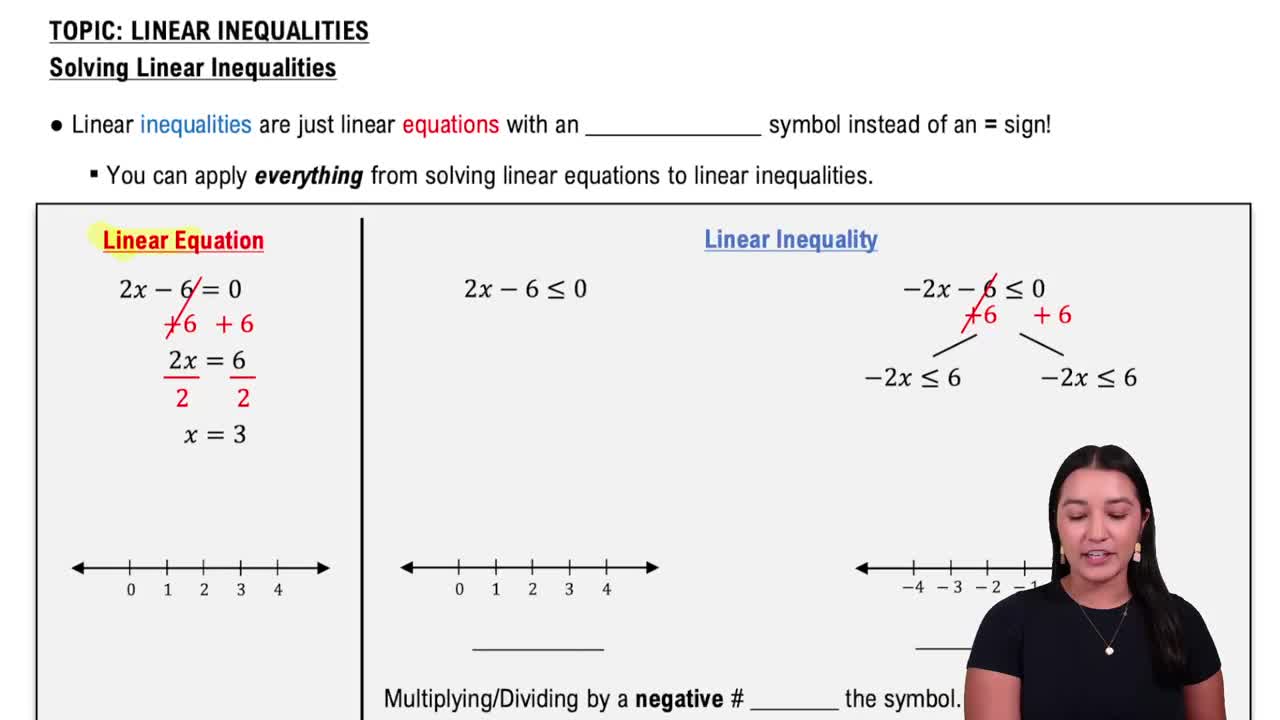
Both f(x) = 3x + 4 and g(x) = 2x - 8 are linear functions, meaning their graphs are straight lines. Understanding their form helps in simplifying (f/g)(x) and determining domain restrictions based on their zero points.
Recommended video:
06:07
Linear Inequalities