Ch. 2 - Graphs and Functions
Lial - College Algebra 13th Edition
Lial13th EditionCollege AlgebraISBN: 9780136881063Not the one you use?Change textbook
Chapter 3, Problem 68

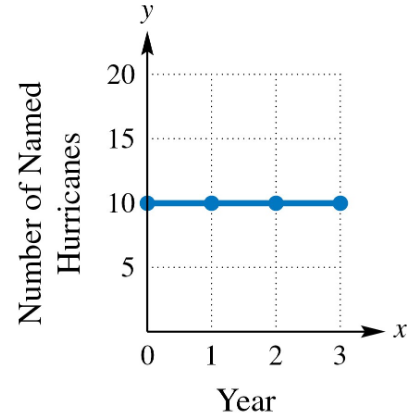
Find and interpret the average rate of change illustrated in each graph.
Graph showing a horizontal line at 10 hurricanes over 3 years, indicating a constant number of hurricanes.

Verified step by step guidance
1
Identify two points on the graph to calculate the average rate of change. For example, use the points (0, 135) and (8, 135).
Recall the formula for the average rate of change between two points \((x_1, y_1)\) and \((x_2, y_2)\): \[\text{Average Rate of Change} = \frac{y_2 - y_1}{x_2 - x_1}\]
Substitute the coordinates of the chosen points into the formula: \[\frac{135 - 135}{8 - 0}\]
Simplify the numerator and denominator separately to find the average rate of change: \[\frac{0}{8}\]
Interpret the result: since the average rate of change is zero, this means the function's value does not change as \(x\) changes, indicating a constant function represented by a horizontal line.

Verified video answer for a similar problem:

This video solution was recommended by our tutors as helpful for the problem above.
Video duration:
3m
Was this helpful?

Key Concepts

Here are the essential concepts you must grasp in order to answer the question correctly.

Average Rate of Change

The average rate of change of a function over an interval measures how much the function's output changes per unit change in input. It is calculated as the change in the y-values divided by the change in the x-values between two points on the graph.
Recommended video:
5:36
Change of Base Property

Interpreting Horizontal Lines

A horizontal line on a graph indicates that the function's output remains constant regardless of changes in the input. This means the average rate of change is zero, as there is no increase or decrease in the y-values over the interval.
Recommended video:
Guided course
06:49
The Slope of a Line

Slope of a Line

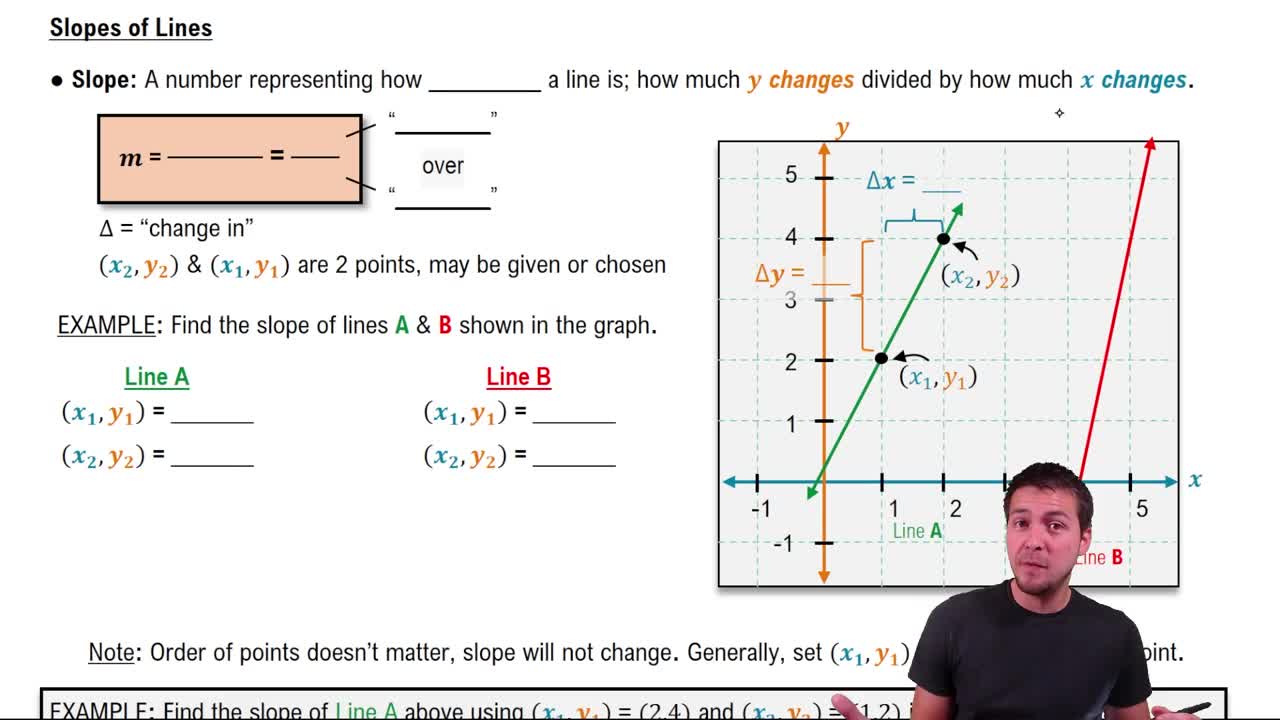
The slope of a line represents the rate at which y changes with respect to x. For a horizontal line, the slope is zero, indicating no change in y-values. Understanding slope helps interpret the average rate of change visually and numerically.
Recommended video:
Guided course
06:49
The Slope of a Line