Ch. 2 - Graphs and Functions
Lial - College Algebra 13th Edition
Lial13th EditionCollege AlgebraISBN: 9780136881063Not the one you use?Change textbook
Chapter 3, Problem 36

Describe the graph of each equation as a circle, a point, or nonexistent. If it is a circle, give the center and radius. If it is a point, give the coordinates. x2+y2+4x-8y+32=0

Verified step by step guidance
1
Start by rewriting the given equation: \(x^2 + y^2 + 4x - 8y + 32 = 0\).
Group the \(x\) terms and \(y\) terms together: \((x^2 + 4x) + (y^2 - 8y) + 32 = 0\).
Complete the square for the \(x\) terms: take half of 4, which is 2, and square it to get 4. Add and subtract 4 inside the equation.
Complete the square for the \(y\) terms: take half of -8, which is -4, and square it to get 16. Add and subtract 16 inside the equation.
Rewrite the equation as \((x^2 + 4x + 4) + (y^2 - 8y + 16) + 32 - 4 - 16 = 0\), then simplify and express it in the form \((x + 2)^2 + (y - 4)^2 = r^2\) to identify the center and radius.

Verified video answer for a similar problem:

This video solution was recommended by our tutors as helpful for the problem above.
Video duration:
3m
Was this helpful?

Key Concepts

Here are the essential concepts you must grasp in order to answer the question correctly.

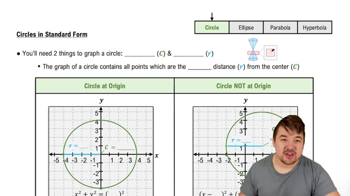
Standard Form of a Circle Equation

The standard form of a circle's equation is (x - h)^2 + (y - k)^2 = r^2, where (h, k) is the center and r is the radius. Converting a general quadratic equation into this form helps identify the circle's properties clearly.
Recommended video:
5:18
Circles in Standard Form

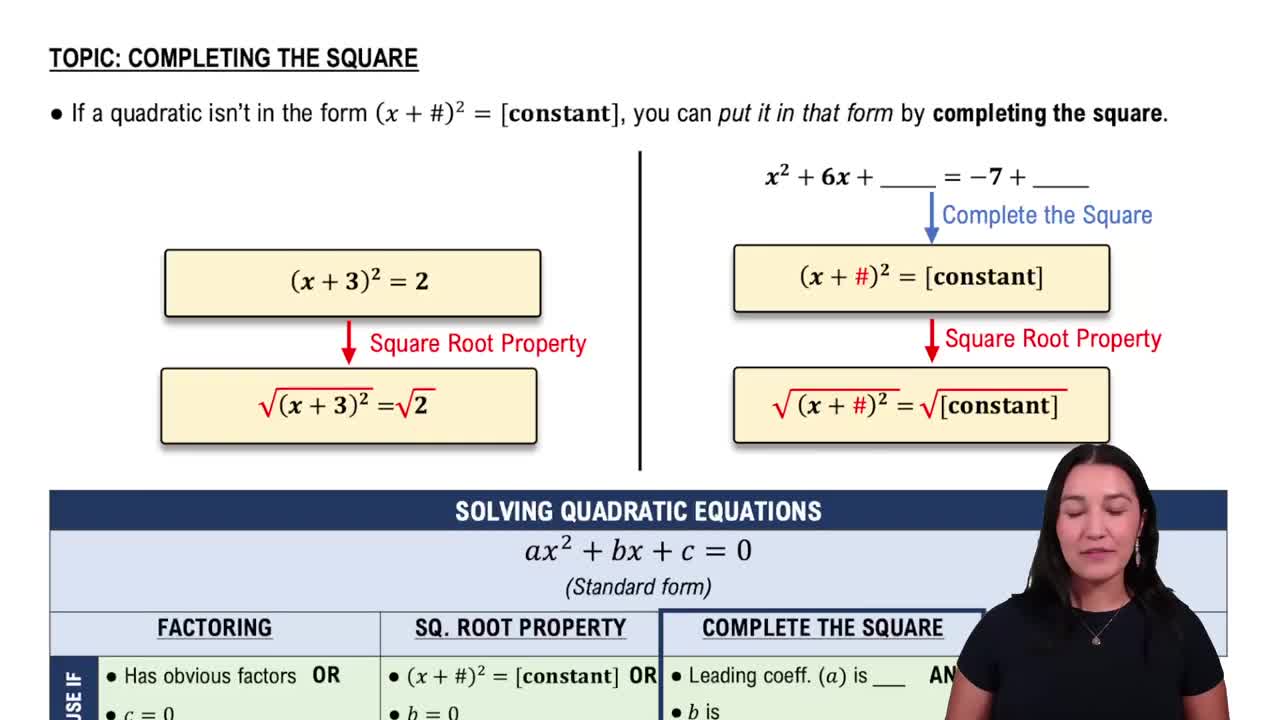
Completing the Square

Completing the square is a method used to rewrite quadratic expressions in the form (x - h)^2 or (y - k)^2. This technique is essential to transform the given equation into the standard form of a circle.
Recommended video:
06:24
Solving Quadratic Equations by Completing the Square

Determining the Nature of the Graph

After rewriting the equation, the radius squared (r^2) determines the graph's nature: if r^2 > 0, it's a circle; if r^2 = 0, it's a point; if r^2 < 0, the graph does not exist in the real plane.
Recommended video:
2:51
The Natural Log