Ch. 2 - Graphs and Functions
Lial - College Algebra 13th Edition
Lial13th EditionCollege AlgebraISBN: 9780136881063Not the one you use?Change textbook
Chapter 3, Problem 39

Describe the graph of each equation as a circle, a point, or nonexistent. If it is a circle, give the center and radius. If it is a point, give the coordinates. x2+y2-2x+12y-12=0

Verified step by step guidance
1
Start by rewriting the given equation: \(x^2 + y^2 - 2x + 12y - 12 = 0\).
Group the \(x\) terms and \(y\) terms together: \((x^2 - 2x) + (y^2 + 12y) = 12\) (move the constant to the right side).
Complete the square for the \(x\) terms: take half of \(-2\), which is \(-1\), and square it to get \(1\). Add \(1\) inside the \(x\) group.
Complete the square for the \(y\) terms: take half of \(12\), which is \(6\), and square it to get \(36\). Add \(36\) inside the \(y\) group.
Since you added \(1\) and \(36\) to the left side, add \(1 + 36 = 37\) to the right side as well to keep the equation balanced. Then rewrite the equation as \((x - 1)^2 + (y + 6)^2 = 12 + 37\).

Verified video answer for a similar problem:

This video solution was recommended by our tutors as helpful for the problem above.
Video duration:
6m
Was this helpful?

Key Concepts

Here are the essential concepts you must grasp in order to answer the question correctly.

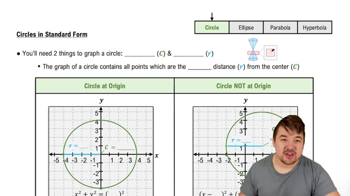
Standard Form of a Circle Equation

The standard form of a circle's equation is (x - h)^2 + (y - k)^2 = r^2, where (h, k) is the center and r is the radius. Converting a general quadratic equation into this form helps identify the circle's properties.
Recommended video:
5:18
Circles in Standard Form

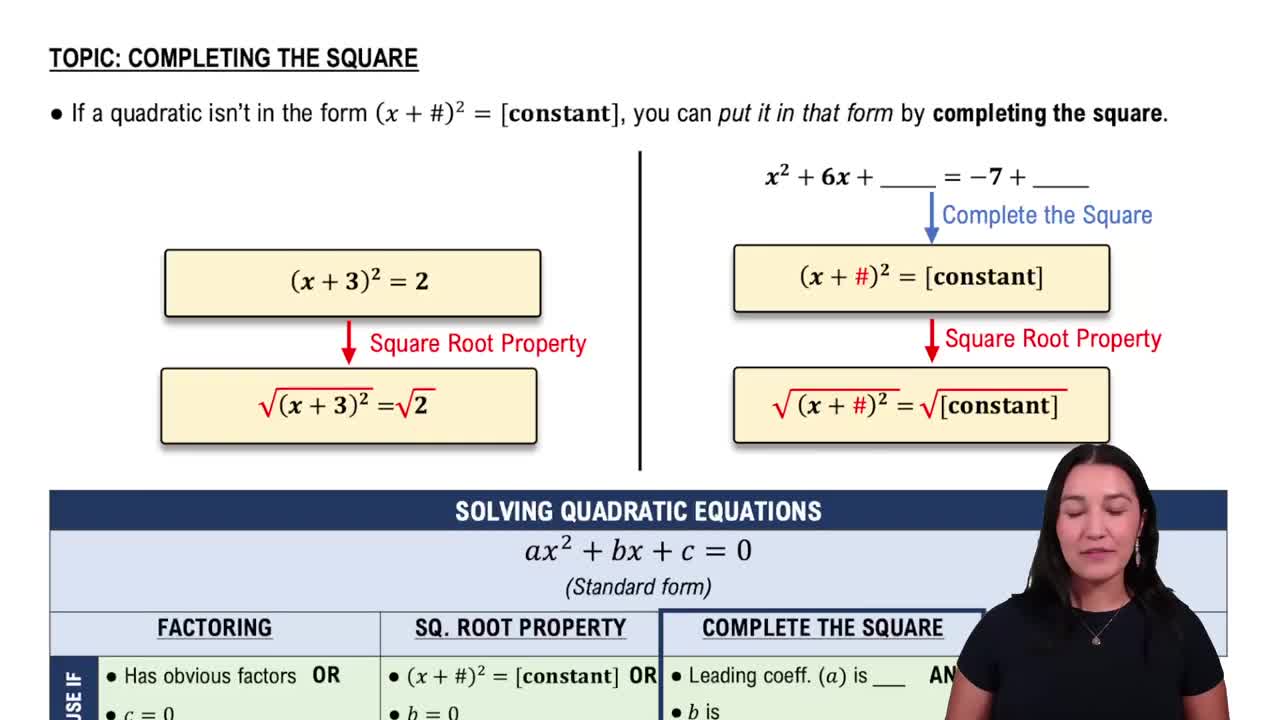
Completing the Square

Completing the square is a method used to rewrite quadratic expressions as perfect square trinomials. This technique is essential to transform the given equation into the standard form of a circle.
Recommended video:
06:24
Solving Quadratic Equations by Completing the Square

Determining the Nature of the Graph

After rewriting the equation, the value of r^2 determines the graph's nature: if r^2 > 0, it's a circle; if r^2 = 0, it's a single point; if r^2 < 0, the graph does not exist in the real plane.
Recommended video:
2:51
The Natural Log