Solve each problem. See Examples 5 and 6. Formaldehyde is an indoor air pollutant formerly found in plywood, foam insulation, and carpeting. When concentrations in the air reach 33 micrograms per cubic foot (μg/ft3), eye irritation can occur. One square foot of new plywood could emit 140 μg per hr. (Data from A. Hines, Indoor Air Quality & Control.) A room has 100 ft2 of new plywood flooring. Find a linear equation F that computes the amount of formaldehyde, in micrograms, emitted in x hours.
Ch. 1 - Equations and Inequalities

Chapter 2, Problem 43a
Write each number in standard form a+bi. 10+ √-200 / 5
Verified step by step guidance1
Identify the expression given: \(\frac{10 + \sqrt{-200}}{5}\). Our goal is to write it in the form \(a + bi\), where \(a\) and \(b\) are real numbers.
Simplify the square root of the negative number: \(\sqrt{-200} = \sqrt{200} \cdot \sqrt{-1} = \sqrt{200}i\). Recall that \(\sqrt{-1} = i\).
Simplify \(\sqrt{200}\) by factoring it into perfect squares: \(\sqrt{200} = \sqrt{100 \times 2} = \sqrt{100} \times \sqrt{2} = 10\sqrt{2}\).
Rewrite the numerator using the simplification: \(10 + 10\sqrt{2}i\). Now the expression is \(\frac{10 + 10\sqrt{2}i}{5}\).
Divide both terms in the numerator by 5 separately: \(\frac{10}{5} + \frac{10\sqrt{2}i}{5} = 2 + 2\sqrt{2}i\). This is the standard form \(a + bi\).

Verified video answer for a similar problem:
This video solution was recommended by our tutors as helpful for the problem above.
Video duration:
3mWas this helpful?
Key Concepts
Here are the essential concepts you must grasp in order to answer the question correctly.
Complex Numbers and Standard Form
Complex numbers are expressed in the form a + bi, where a is the real part and b is the imaginary part. The imaginary unit i is defined as √-1. Writing a number in standard form means separating it into its real and imaginary components.
Recommended video:
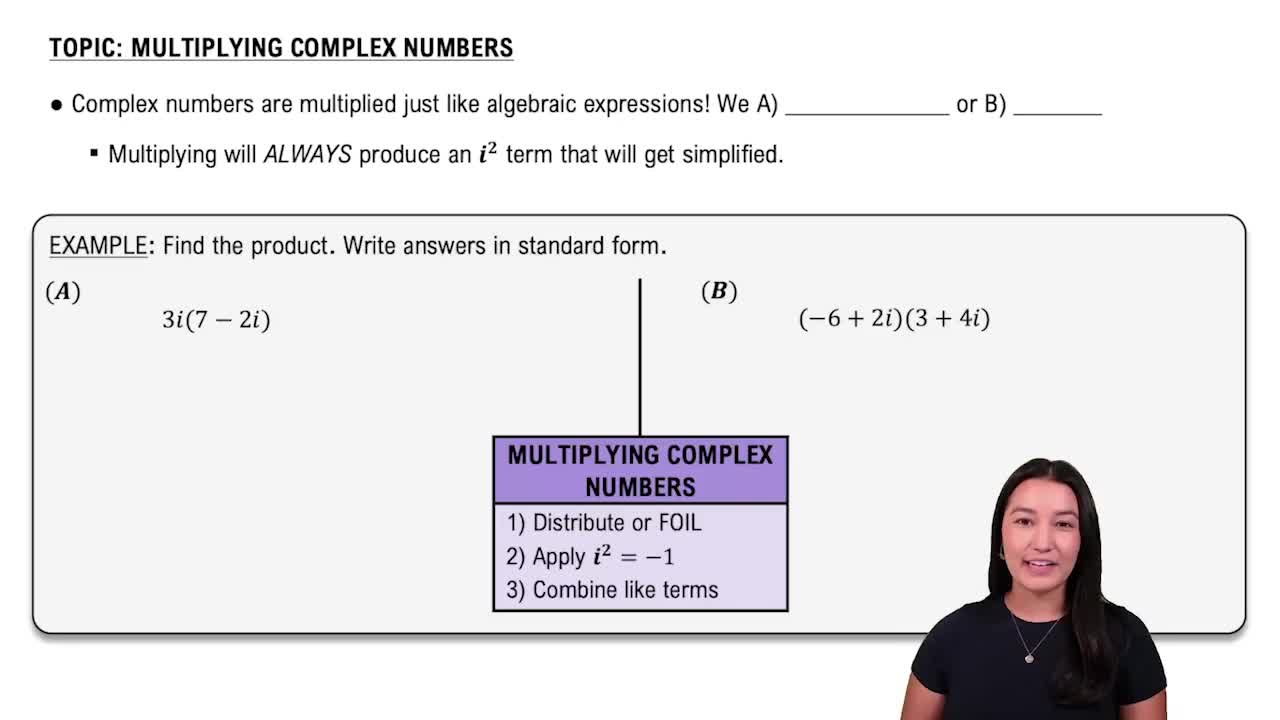
Multiplying Complex Numbers
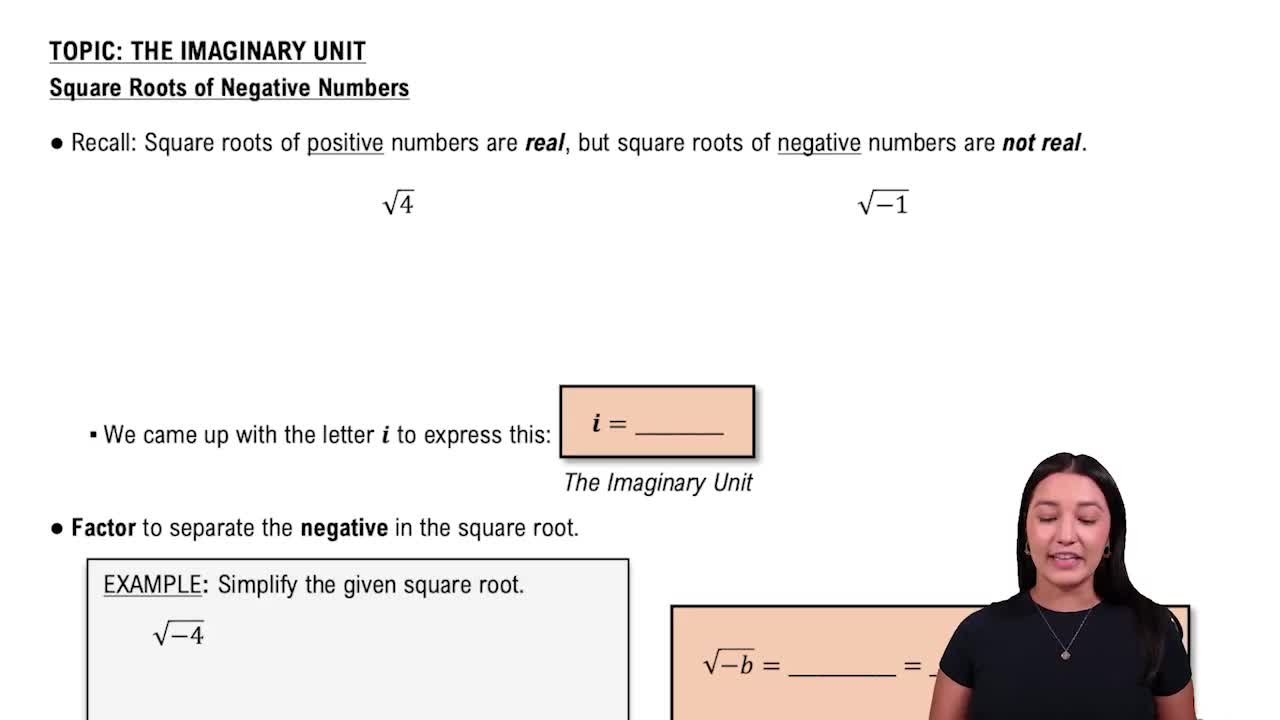
Simplifying Square Roots of Negative Numbers
To simplify the square root of a negative number, factor out √-1 as i and simplify the remaining positive square root. For example, √-200 = √(200) * i = 10√2 * i. This step is essential to rewrite expressions involving imaginary numbers.
Recommended video:
Square Roots of Negative Numbers
Operations with Complex Numbers
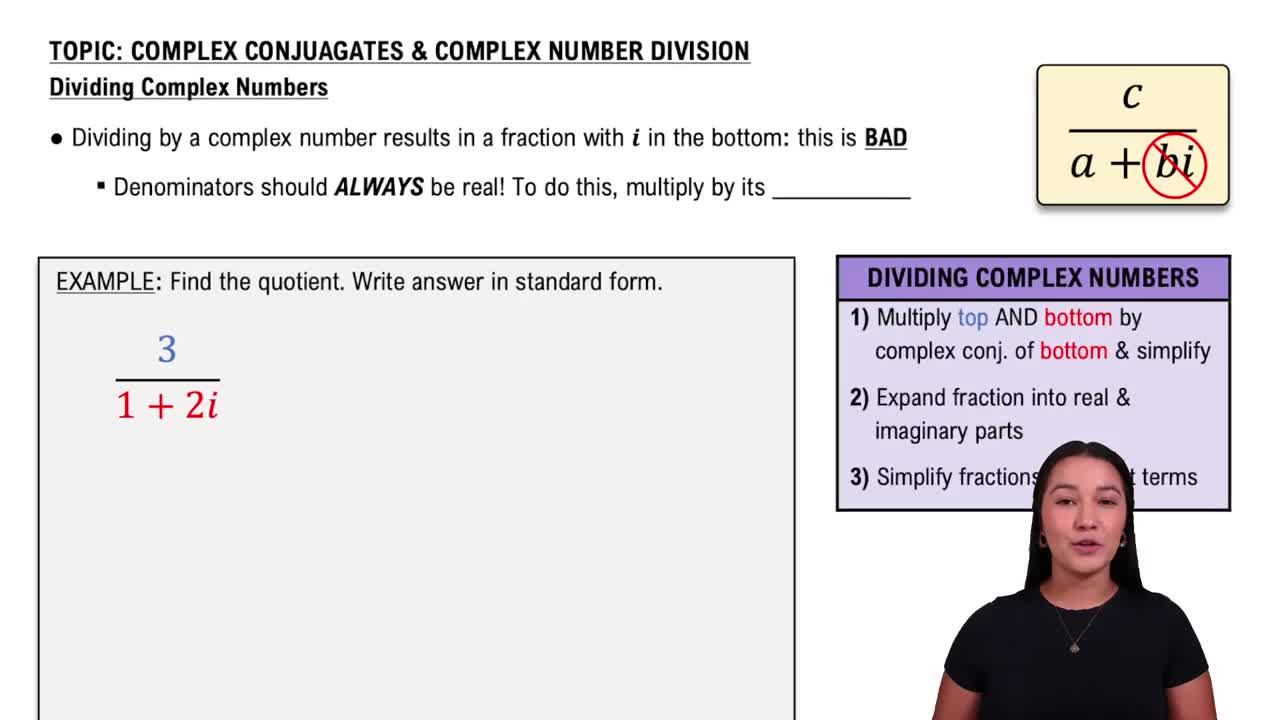
When performing arithmetic with complex numbers, apply algebraic rules carefully, including distributing division across terms and combining like terms. Simplify fractions and separate real and imaginary parts to express the result in standard form a + bi.
Recommended video:
Dividing Complex Numbers
Related Practice
Textbook Question
1
views
Textbook Question
Solve each problem. See Examples 5 and 6. Formaldehyde is an indoor air pollutant formerly found in plywood, foam insulation, and carpeting. When concentrations in the air reach 33 micrograms per cubic foot (μg/ft^3), eye irritation can occur. One square foot of new plywood could emit 140 μg per hr. (Data from A. Hines, Indoor Air Quality & Control.) The room contains 800 ft^3 of air and has no ventilation. Determine how long it would take for concentrations to reach 33 μg/ft^3. (Round to the nearest tenth.)
2
views
Textbook Question
Solve each quadratic inequality. Give the solution set in interval notation. 2x2-9x≤18
Textbook Question
Solve each equation or inequality. |4x + 3| - 2 = -1
3
views
Textbook Question
Solve each equation. (2x+1)(x-4) = x
1
views
Textbook Question
Solve each equation or inequality. |8 - 3x| - 3 = -2
