Ch. 1 - Equations and Inequalities
Lial - College Algebra 13th Edition
Lial13th EditionCollege AlgebraISBN: 9780136881063Not the one you use?Change textbook
Chapter 2, Problem 55

Which inequality has solution set (-∞, ∞)?
A. (x-3)2≥0
B. (5x-6)2≤0
C. (6x+4)2>0
D. (8x+7)2<0

Verified step by step guidance
1
Recall that for any real number expression squared, such as \(a^2\), the value is always greater than or equal to zero, i.e., \(a^2 \geq 0\) for all real \(a\).
Analyze each inequality option to determine the set of \(x\) values that satisfy it:
Option A: \((x-3)^2 \geq 0\) means the square of \((x-3)\) is greater than or equal to zero. Since squares are never negative, this inequality holds for all real \(x\).
Option B: \((5x-6)^2 \leq 0\) means the square of \((5x-6)\) is less than or equal to zero. Since squares are always nonnegative, the only way this is true is when \((5x-6)^2 = 0\), which happens at a single value of \(x\).
Options C and D involve strict inequalities with squares: \((6x+4)^2 > 0\) and \((8x+7)^2 < 0\). Since squares are never negative, \((8x+7)^2 < 0\) has no solution, and \((6x+4)^2 > 0\) is true for all \(x\) except where the expression inside the square is zero.

Verified video answer for a similar problem:

This video solution was recommended by our tutors as helpful for the problem above.
Video duration:
3m
Was this helpful?

Key Concepts

Here are the essential concepts you must grasp in order to answer the question correctly.

Properties of Squares of Real Numbers

The square of any real number is always non-negative, meaning it is either zero or positive. This property is fundamental when analyzing inequalities involving squared expressions, as it restricts the possible values the expression can take.
Recommended video:
02:20
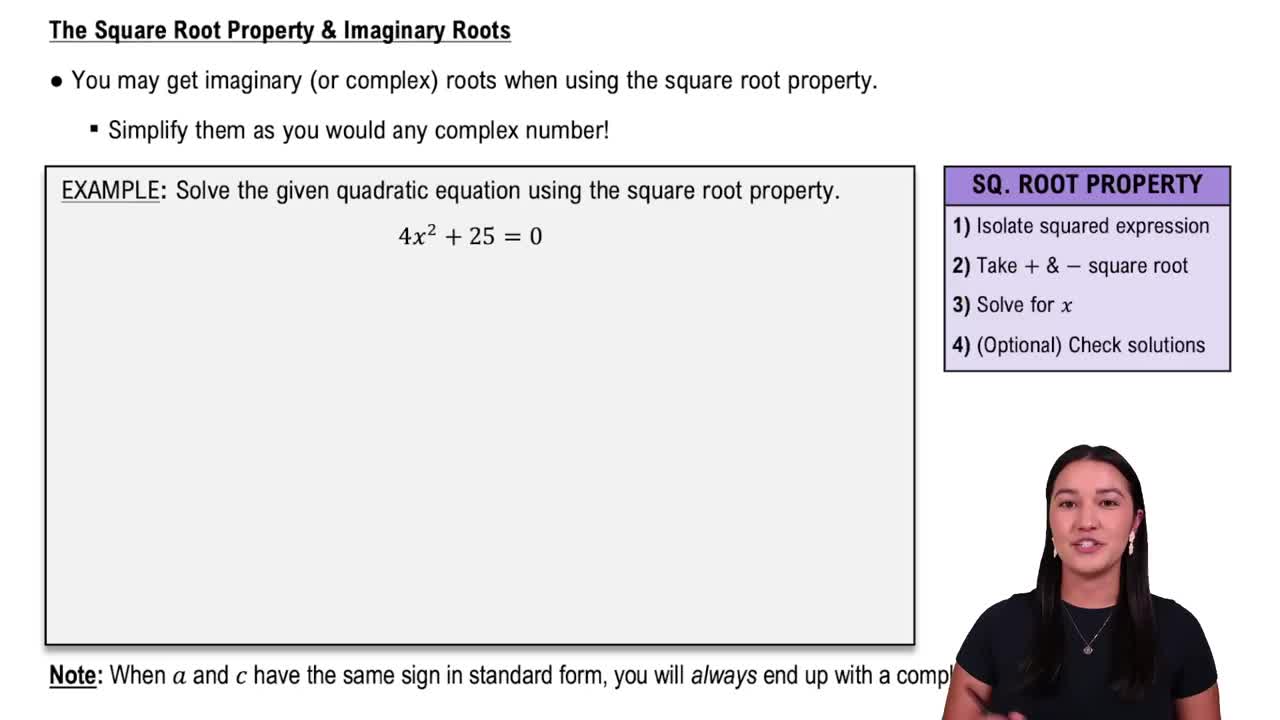
Imaginary Roots with the Square Root Property

Solving Inequalities Involving Squares

Inequalities with squared terms often require understanding when the expression equals zero or is positive/negative. Since squares are never negative, inequalities like (expression) < 0 have no real solutions, while (expression) ≥ 0 are true for all real numbers.
Recommended video:
06:24
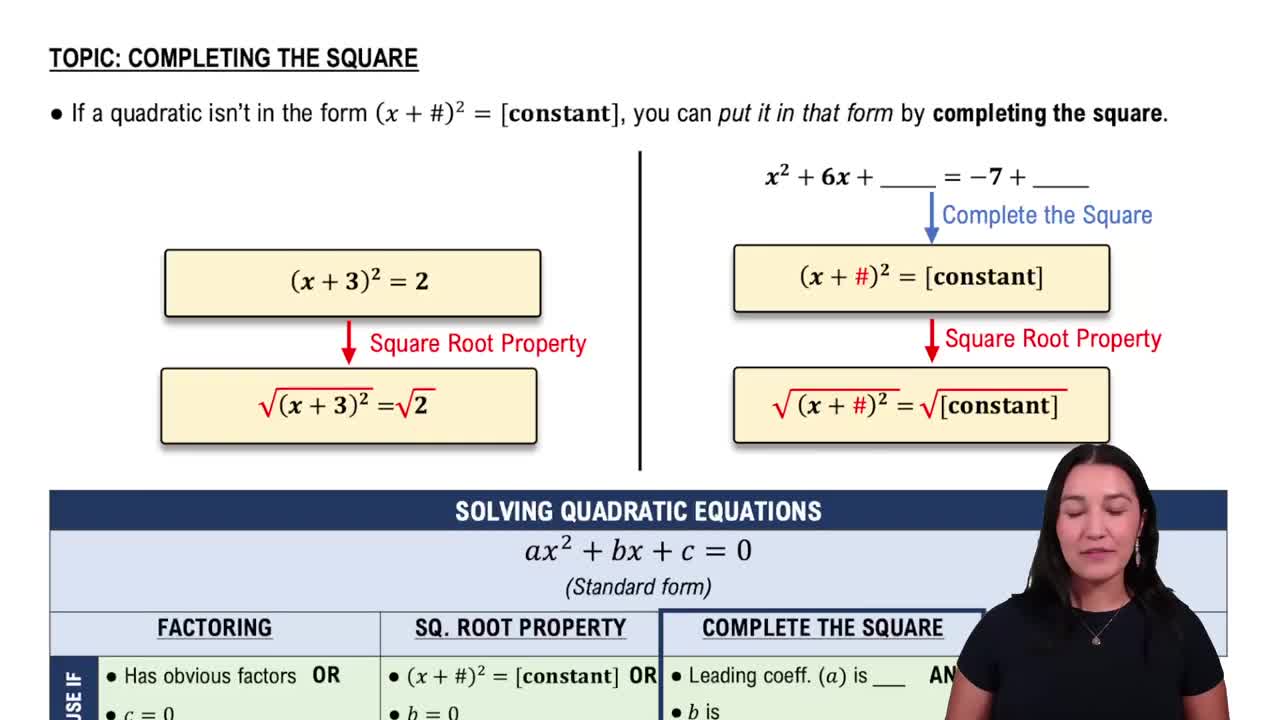
Solving Quadratic Equations by Completing the Square

Solution Sets and Interval Notation

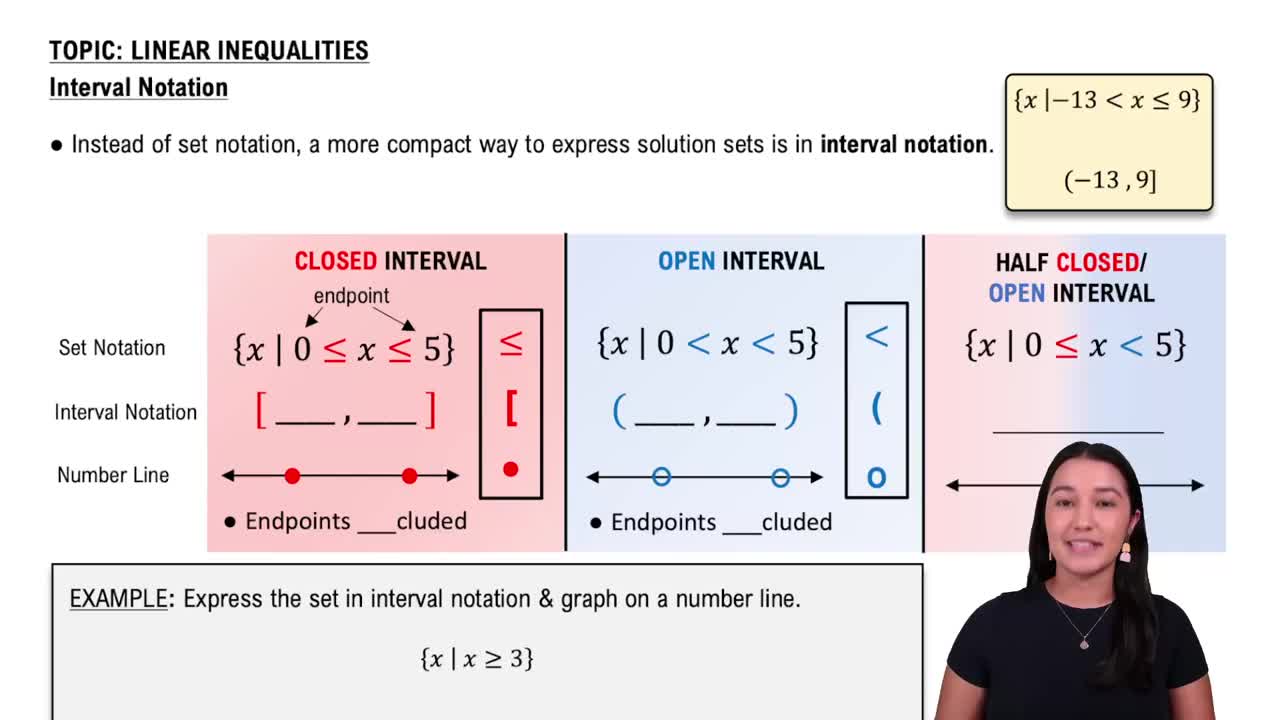
The solution set of an inequality is the set of all values that satisfy it, often expressed in interval notation. For example, (-∞, ∞) means all real numbers satisfy the inequality, which occurs when the inequality is always true regardless of x.
Recommended video:
05:18
Interval Notation