Ch. 1 - Equations and Inequalities
Lial - College Algebra 13th Edition
Lial13th EditionCollege AlgebraISBN: 9780136881063Not the one you use?Change textbook
Chapter 2, Problem 74

Solve each rational inequality. Give the solution set in interval notation. 4/(3+x)≤3/(3+x)

Verified step by step guidance
1
Start by writing down the inequality: \(\frac{4}{3+x} \leq \frac{3}{3+x}\).
Identify the domain restrictions by finding values that make the denominator zero. Set \(3 + x = 0\) which gives \(x = -3\). So, \(x \neq -3\) because the expression is undefined there.
Since the denominators on both sides are the same and nonzero (except at \(x = -3\)), multiply both sides of the inequality by \((3+x)^2\) (which is always positive except at \(x = -3\)) to eliminate the denominators safely without reversing the inequality sign. This gives: \(4(3+x) \leq 3(3+x)\).
Simplify the inequality: \(4(3+x) \leq 3(3+x)\) becomes \(12 + 4x \leq 9 + 3x\). Then, subtract \(9\) and \$3x\( from both sides to isolate \)x$: \(12 - 9 + 4x - 3x \leq 0\) which simplifies to \(3 + x \leq 0\).
Solve the simplified inequality \(3 + x \leq 0\) to get \(x \leq -3\). Remember to exclude \(x = -3\) from the solution set because it makes the original expression undefined. Finally, express the solution in interval notation considering the domain restriction.

Verified video answer for a similar problem:

This video solution was recommended by our tutors as helpful for the problem above.
Video duration:
6m
Was this helpful?

Key Concepts

Here are the essential concepts you must grasp in order to answer the question correctly.

Rational Inequalities

Rational inequalities involve expressions where variables appear in the denominator. Solving them requires finding values that satisfy the inequality while ensuring the denominator is not zero, as division by zero is undefined.
Recommended video:
Guided course
3:21
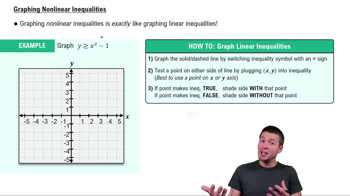
Nonlinear Inequalities

Domain Restrictions

When solving rational inequalities, it is crucial to identify values that make the denominator zero and exclude them from the solution set. These restrictions define the domain and prevent invalid solutions.
Recommended video:
3:51
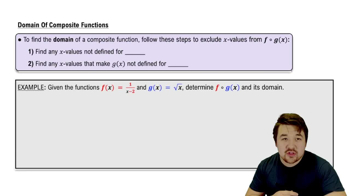
Domain Restrictions of Composed Functions

Solving Inequalities by Multiplying or Subtracting

To solve rational inequalities, one often subtracts one side from the other to form a single rational expression and then analyzes the sign of the numerator and denominator separately. Multiplying both sides by an expression requires careful attention to its sign to avoid reversing the inequality.
Recommended video:
06:07
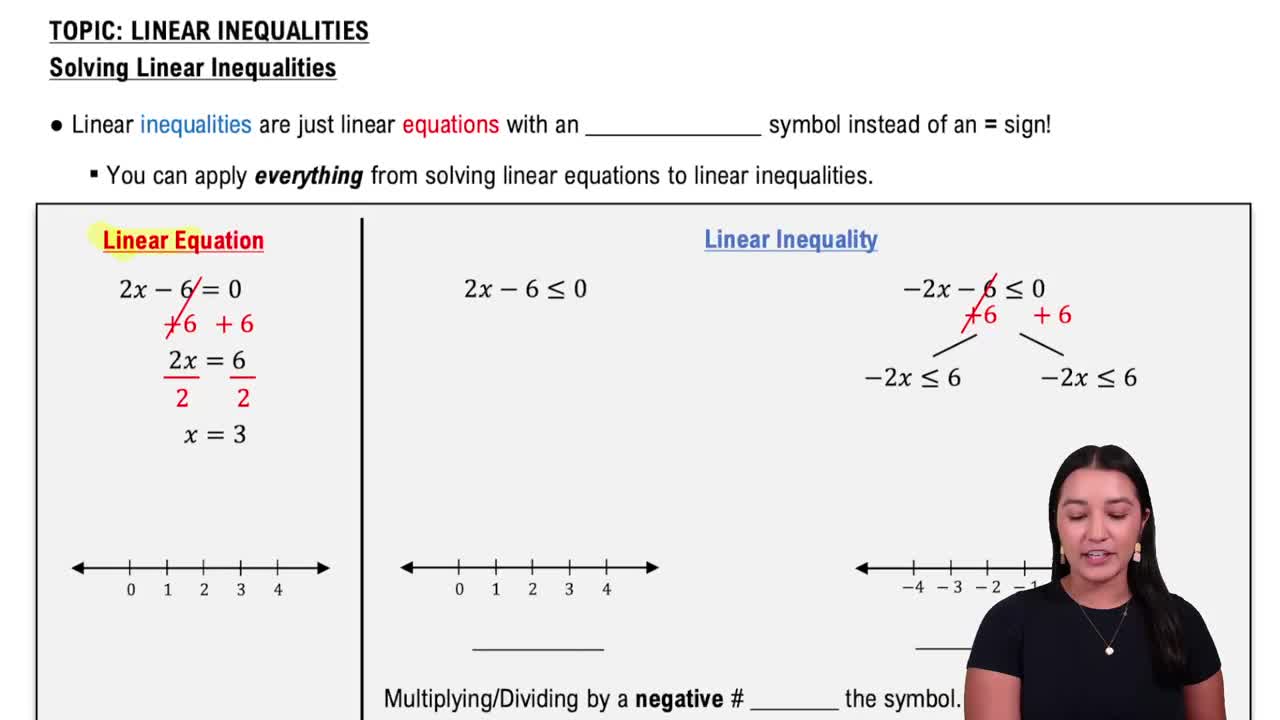
Linear Inequalities