Ch. 1 - Equations and Inequalities
Lial - College Algebra 13th Edition
Lial13th EditionCollege AlgebraISBN: 9780136881063Not the one you use?Change textbook
Chapter 2, Problem 33

Solve each problem. See Example 3. How much water should be added to 8 mL of 6% saline solution to reduce the concentration to 4%?

Verified step by step guidance
1
Identify the known quantities: the initial volume of the saline solution is 8 mL, and its concentration is 6%. The final concentration after adding water should be 4%. Let the volume of water to be added be \( x \) mL.
Set up the equation based on the fact that the amount of salt (solute) remains constant before and after dilution. The amount of salt initially is \( 8 \times 0.06 \). After adding water, the total volume is \( 8 + x \) mL, and the concentration is 4%, so the amount of salt is \( (8 + x) \times 0.04 \).
Write the equation representing the conservation of salt: \( 8 \times 0.06 = (8 + x) \times 0.04 \).
Solve the equation for \( x \) by first expanding the right side: \( 0.48 = 0.04 \times 8 + 0.04x \), then isolate \( x \) by subtracting \( 0.32 \) from both sides and dividing by \( 0.04 \).
Interpret the solution for \( x \) as the volume of water in milliliters that must be added to reduce the saline concentration from 6% to 4%.

Verified video answer for a similar problem:

This video solution was recommended by our tutors as helpful for the problem above.
Video duration:
5m
Was this helpful?

Key Concepts

Here are the essential concepts you must grasp in order to answer the question correctly.

Concentration and Percentage Solutions

Concentration refers to the amount of solute present in a given volume of solution, often expressed as a percentage. In this problem, the percentage indicates how much saline (solute) is in the total solution volume. Understanding this helps relate the amount of solute before and after dilution.
Recommended video:
06:00
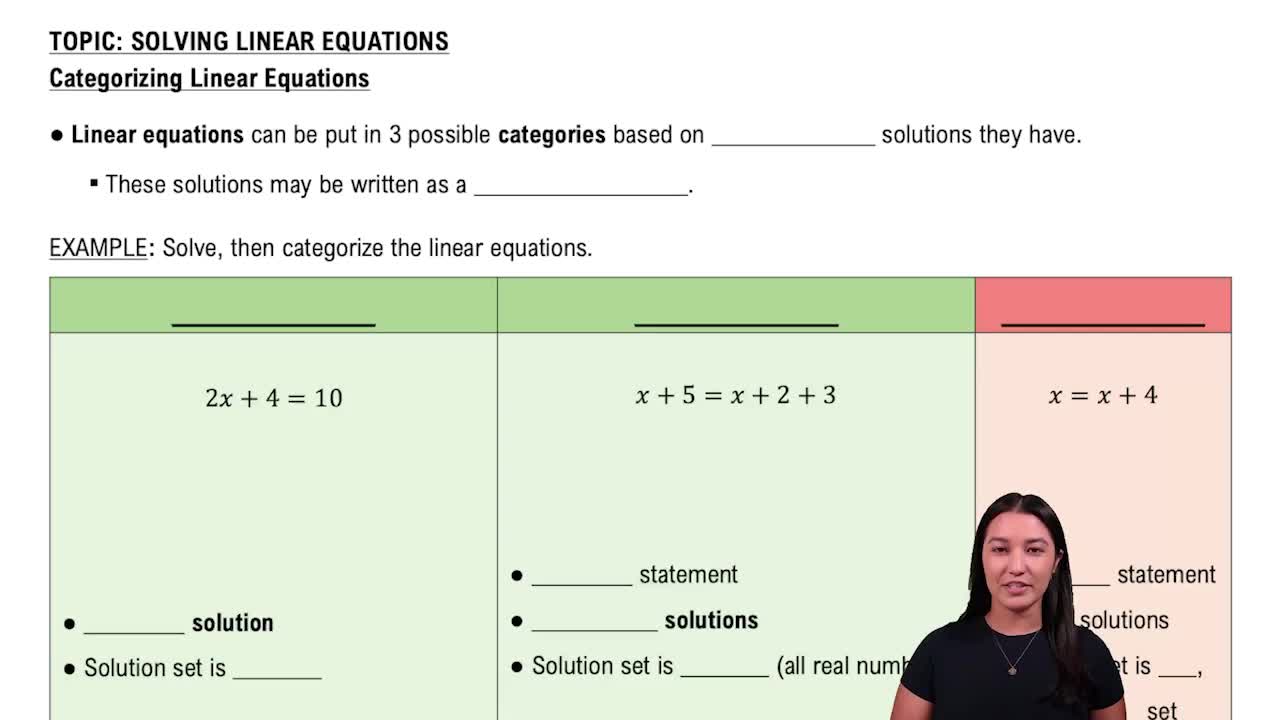
Categorizing Linear Equations

Dilution Principle

Dilution involves adding solvent (water) to a solution to decrease its concentration without changing the amount of solute. The key idea is that the amount of solute remains constant before and after dilution, allowing the use of the formula C1V1 = C2V2 to find the unknown volume.
Recommended video:
4:04
Fundamental Counting Principle

Setting Up and Solving Equations

Solving the problem requires translating the word problem into an algebraic equation using the dilution formula. This involves defining variables, substituting known values, and solving for the unknown volume of water to be added, reinforcing skills in equation manipulation.
Recommended video:
5:02
Solving Logarithmic Equations