Ch. 1 - Equations and Inequalities
Lial - College Algebra 13th Edition
Lial13th EditionCollege AlgebraISBN: 9780136881063Not the one you use?Change textbook
Chapter 2, Problem 115

Solve each equation or inequality.
7x3>4|7x-3| > 4

Verified step by step guidance
1
Recognize that the inequality involves an absolute value expression: \(|7x - 3| > 4\). Recall that for any expression \(A\), the inequality \(|A| > c\) (where \(c > 0\)) means \(A > c\) or \(A < -c\).
Set up two separate inequalities based on the definition of absolute value inequalities: 1) \(7x - 3 > 4\) 2) \(7x - 3 < -4\)
Solve the first inequality \(7x - 3 > 4\) by adding 3 to both sides: \(7x > 7\) Then divide both sides by 7: \(x > 1\)
Solve the second inequality \(7x - 3 < -4\) by adding 3 to both sides: \(7x < -1\) Then divide both sides by 7: \(x < -\frac{1}{7}\)
Combine the two solution sets to express the final solution: \(x < -\frac{1}{7}\) or \(x > 1\)

Verified video answer for a similar problem:

This video solution was recommended by our tutors as helpful for the problem above.
Video duration:
2m

Key Concepts

Here are the essential concepts you must grasp in order to answer the question correctly.

Absolute Value Inequalities

Absolute value inequalities involve expressions where the distance of a number from zero is compared to another value. For |A| > B, the solution splits into two cases: A > B or A < -B, because the absolute value measures magnitude regardless of sign.
Recommended video:
06:07
Linear Inequalities

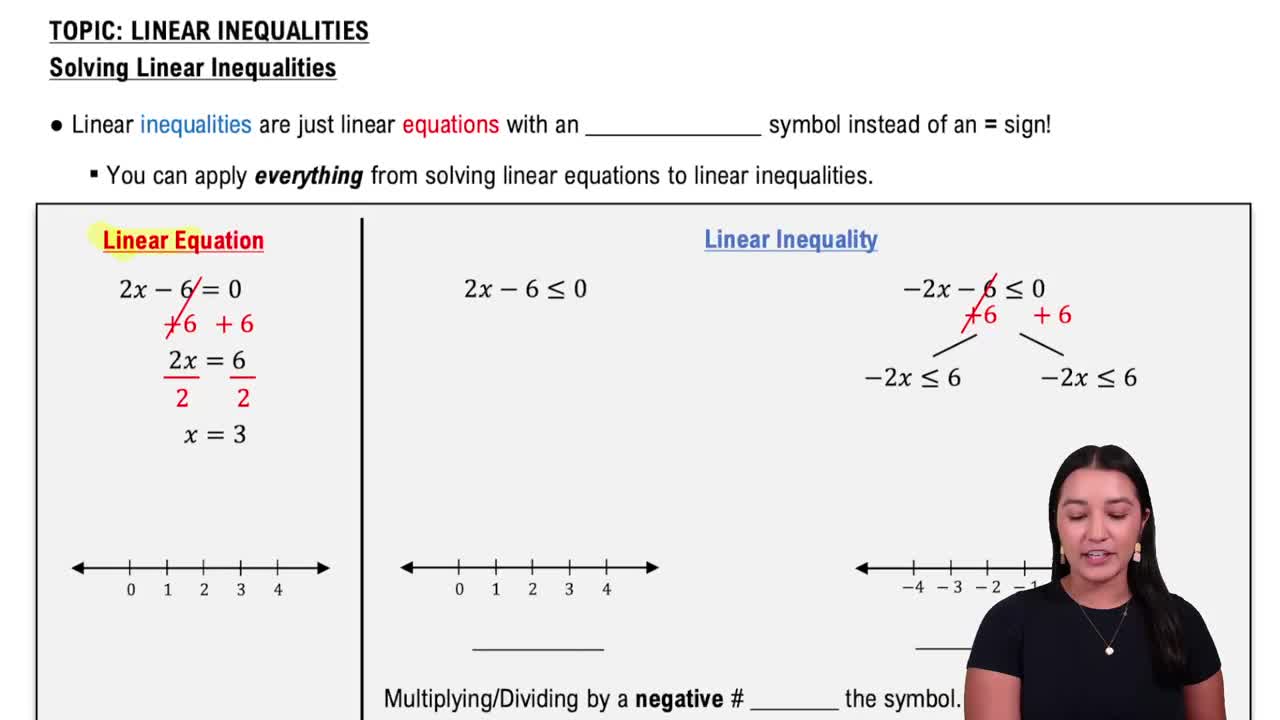
Solving Linear Inequalities

Solving linear inequalities requires isolating the variable on one side while maintaining the inequality's direction. When multiplying or dividing by a negative number, the inequality sign reverses. Solutions are often expressed as intervals or compound inequalities.
Recommended video:
06:07
Linear Inequalities

Compound Inequalities

Compound inequalities combine two inequalities connected by 'and' or 'or'. For absolute value inequalities like |7x - 3| > 4, the solution is a union of two inequalities, representing values that satisfy either condition, reflecting the distance concept.
Recommended video:
06:07
Linear Inequalities