Solve each equation. (x-4)2/5 = 9
Ch. 1 - Equations and Inequalities

Chapter 2, Problem 66
Solve each equation or inequality.
Verified step by step guidance1
Identify the inequality to solve: \(|4x + 3| > 0\).
Recall that the absolute value \(|A|\) represents the distance of \(A\) from zero on the number line, so \(|A| > 0\) means \(A\) is not equal to zero.
Set the expression inside the absolute value not equal to zero: \(4x + 3 \neq 0\).
Solve the equation \(4x + 3 = 0\) to find the value that \(x\) cannot be: subtract 3 from both sides to get \(4x = -3\), then divide both sides by 4 to get \(x = -\frac{3}{4}\).
Conclude that the solution to the inequality \(|4x + 3| > 0\) is all real numbers except \(x = -\frac{3}{4}\).

Verified video answer for a similar problem:
This video solution was recommended by our tutors as helpful for the problem above.
Video duration:
2mKey Concepts
Here are the essential concepts you must grasp in order to answer the question correctly.
Absolute Value Inequalities
Absolute value inequalities involve expressions within absolute value bars and require understanding how to interpret them. For |A| > 0, the expression inside the absolute value, A, must be any number except zero, since absolute value measures distance from zero. This concept helps determine the solution set for inequalities involving absolute values.
Recommended video:
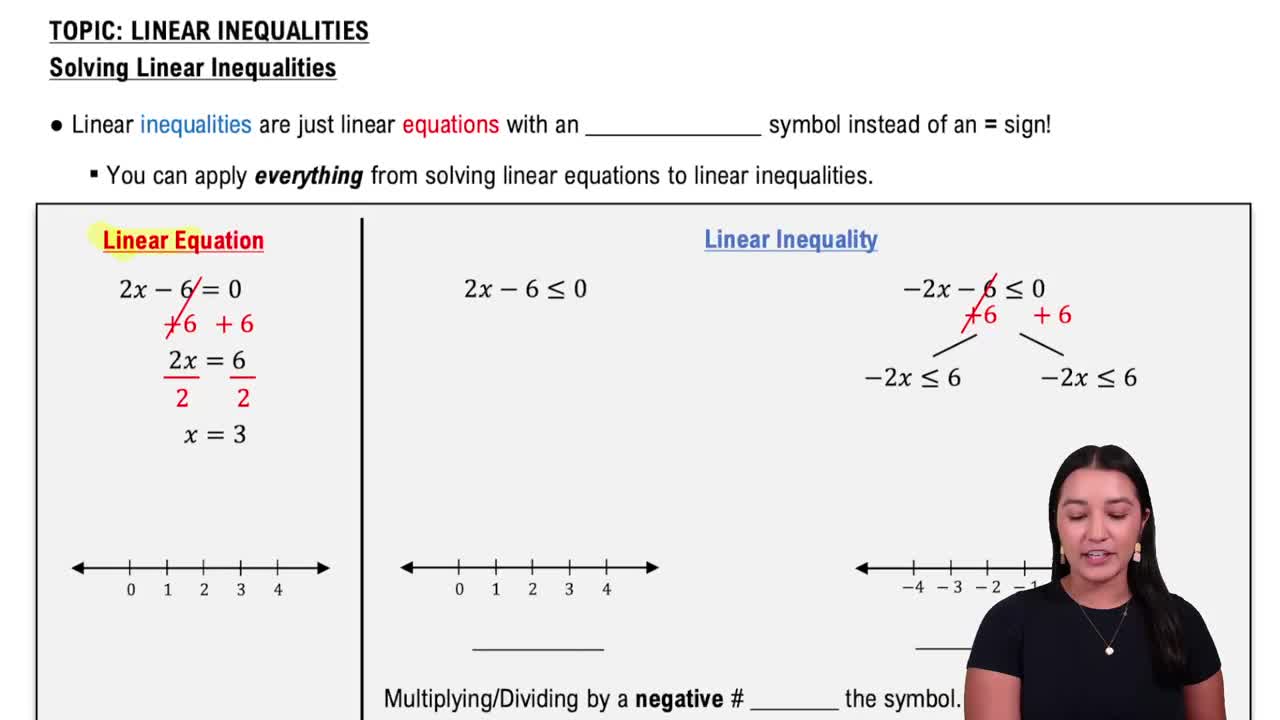
Linear Inequalities
Properties of Absolute Value
The absolute value of a number is always non-negative and equals zero only when the number itself is zero. This property means |x| > 0 holds true for all x except x = 0. Recognizing this helps simplify and solve inequalities by focusing on when the inside expression equals zero.
Recommended video:
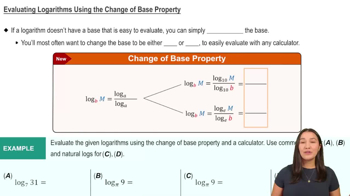
Change of Base Property
Solving Linear Equations
Solving linear equations involves isolating the variable to find its value. In this problem, setting the inside of the absolute value equal to zero (4x + 3 = 0) identifies critical points that affect the inequality's solution. Understanding how to solve such equations is essential for determining boundary values.
Recommended video:
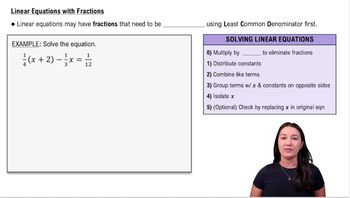
Solving Linear Equations with Fractions
Related Practice
Textbook Question
2
views
Textbook Question
Solve each equation. (√x)+2=√(4+7√x)
1
views
Textbook Question
Solve each rational inequality. Give the solution set in interval notation. -4/(1-x)<5
1
views
Textbook Question
In the metric system of weights and measures, temperature is measured in degrees Celsius (°C) instead of degrees Fahrenheit (°F). To convert between the two systems, we use the equations. C =5/9 (F-32) and F = 9/5C+32. In each exercise, convert to the other system. Round answers to the nearest tenth of a degree if necessary. 100°F
Textbook Question
Solve each equation. 10/(4x-4) = 1 /(1-x)
1
views
Textbook Question
Work each problem. Round to the nearest tenth of a degree if necessary. Temperature of VenusVenus is the hottest planet, with a surface temperature of 867°F. What is this temperature in degrees Celsius? (Data from The World Almanac and Book of Facts.)
1
views