Height of a Projected Ball An astronaut on the moon throws a baseball upward. The astronaut is 6 ft, 6 in. tall, and the initial velocity of the ball is 30 ft per sec. The height s of the ball in feet is given by the equations=-2.7t2+30t+6.5,where t is the number of seconds after the ball was thrown. (a) After how many seconds is the ball 12 ft above the moon's surface? Round to the nearest hundredth. (b) How many seconds will it take for the ball to hit the moon's surface? Round to the nearest hundredth.
Ch. 1 - Equations and Inequalities

Chapter 2, Problem 47
Solve each equation or inequality. | 3x + 1 | - 1 < 2
Verified step by step guidance1
Start by isolating the absolute value expression on one side of the inequality. Add 1 to both sides to get: \(| 3x + 1 | < 3\).
Recall that the inequality \(|A| < B\) means that \(-B < A < B\). Apply this to the inequality: \(-3 < 3x + 1 < 3\).
Break the compound inequality into two separate inequalities: \(-3 < 3x + 1\) and \(3x + 1 < 3\).
Solve each inequality for \(x\). For \(-3 < 3x + 1\), subtract 1 from both sides to get \(-4 < 3x\), then divide by 3 to get \(\frac{-4}{3} < x\). For \(3x + 1 < 3\), subtract 1 from both sides to get \(3x < 2\), then divide by 3 to get \(x < \frac{2}{3}\).
Combine the two inequalities to write the solution as an interval: \(\frac{-4}{3} < x < \frac{2}{3}\).

Verified video answer for a similar problem:
This video solution was recommended by our tutors as helpful for the problem above.
Video duration:
2mKey Concepts
Here are the essential concepts you must grasp in order to answer the question correctly.
Absolute Value Inequalities
Absolute value inequalities involve expressions where the absolute value of a variable or expression is compared to a number. To solve them, you consider the definition of absolute value as distance from zero, leading to two cases: one positive and one negative. For example, |A| < B means -B < A < B.
Recommended video:
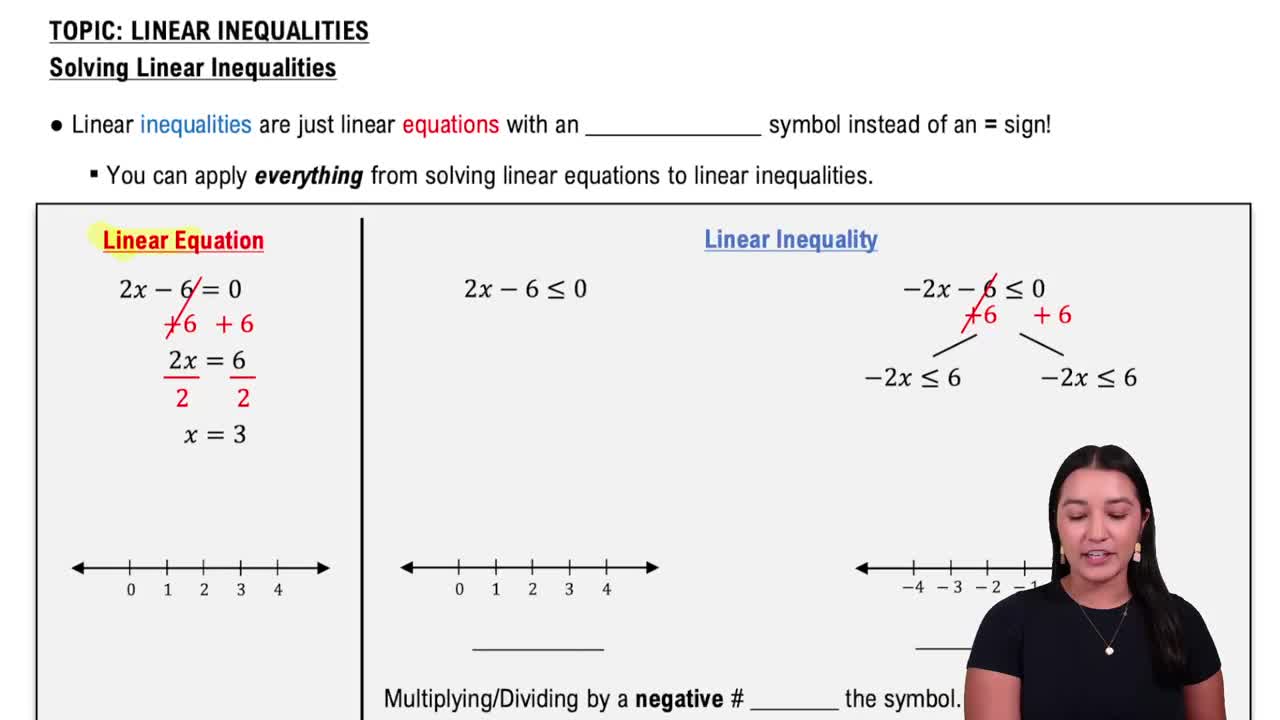
Linear Inequalities
Isolating the Absolute Value Expression
Before solving an absolute value inequality, isolate the absolute value term on one side of the inequality. This often involves adding or subtracting constants and dividing by coefficients. Proper isolation ensures the inequality can be correctly interpreted and split into two linear inequalities.
Recommended video:
Introduction to Algebraic Expressions
Solving Compound Inequalities
When an absolute value inequality is less than a positive number, it translates into a compound inequality combining two inequalities with 'and'. Solving these requires handling both inequalities simultaneously to find the range of values satisfying the original inequality.
Recommended video:
Linear Inequalities
Related Practice
Textbook Question
Textbook Question
Solve each quadratic inequality. Give the solution set in interval notation. x(x-1)≤6
Textbook Question
Solve each equation. (x+4)(x+2) = 2x
3
views
Textbook Question
Solve each formula for the specified variable. Assume that the denominator is not 0 if variables appear in the denominator. s = 1/2gt², for g (distance traveled by a falling object)
1
views
Textbook Question
Solve each equation. √(3x+7) = 3x+5
Textbook Question
Solve each equation or inequality. | 4 - 4x | + 2 = 4
3
views
