Solve each equation using the zero-factor property. x2 - 5x + 6 = 0
Ch. 1 - Equations and Inequalities

Chapter 2, Problem 13
Solve each equation. 6(3x-1)= 8 - (10x-14)
Verified step by step guidance1
Start by expanding both sides of the equation: on the left side, distribute 6 to both terms inside the parentheses, and on the right side, simplify the expression by distributing the negative sign across the parentheses. This gives you: \(6 \times 3x - 6 \times 1 = 8 - 10x + 14\).
Simplify both sides by performing the multiplications and combining like terms: the left side becomes \(18x - 6\), and the right side becomes \(8 + 14 - 10x\).
Combine the constants on the right side: \(8 + 14\) to get \(22\), so the equation now is \(18x - 6 = 22 - 10x\).
Next, get all the variable terms on one side and constants on the other side. You can do this by adding \$10x$ to both sides and adding \(6\) to both sides, resulting in \(18x + 10x = 22 + 6\).
Combine like terms on both sides: \(28x = 28\). Finally, solve for \(x\) by dividing both sides by 28, which gives \(x = \frac{28}{28}\).

Verified video answer for a similar problem:
This video solution was recommended by our tutors as helpful for the problem above.
Video duration:
2mWas this helpful?
Key Concepts
Here are the essential concepts you must grasp in order to answer the question correctly.
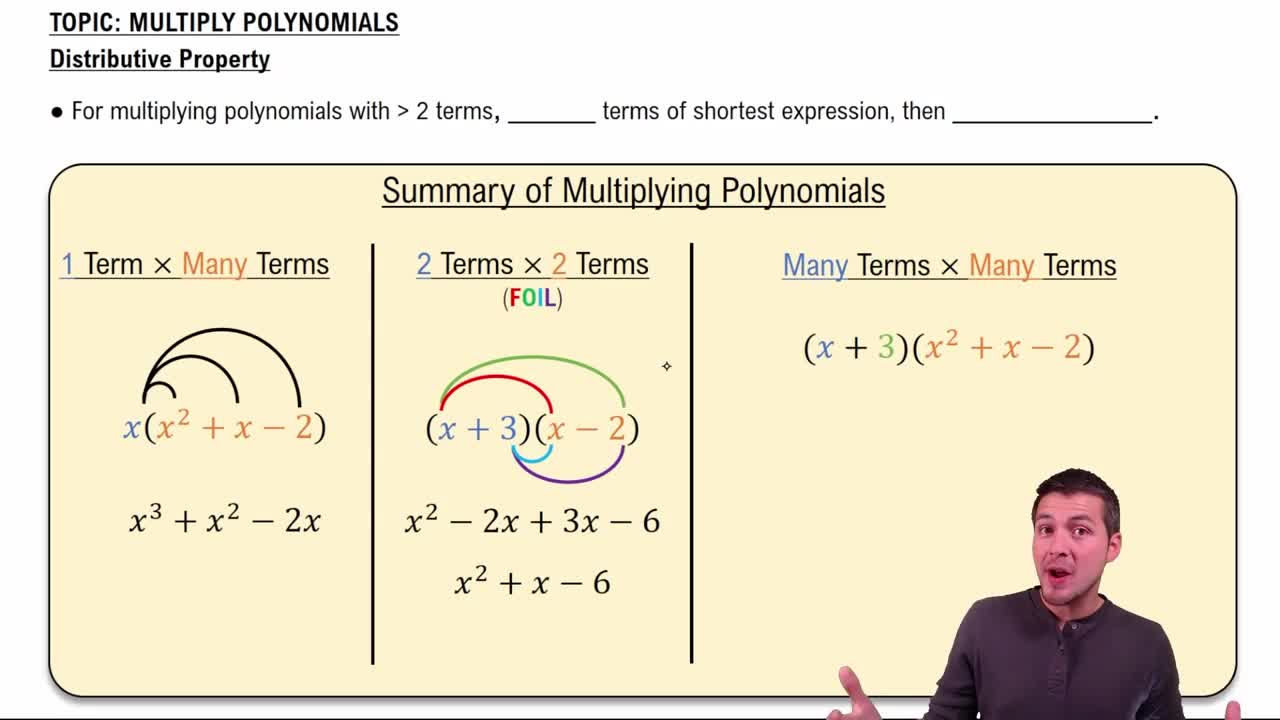
Distributive Property
The distributive property allows you to multiply a single term by each term inside parentheses. For example, a(b + c) = ab + ac. This is essential for simplifying expressions like 6(3x - 1) by multiplying 6 with both 3x and -1.
Recommended video:
Guided course
Multiply Polynomials Using the Distributive Property
Combining Like Terms
Combining like terms involves adding or subtracting terms that have the same variable raised to the same power. This simplifies expressions and makes solving equations easier, such as combining terms with x on one side of the equation.
Recommended video:
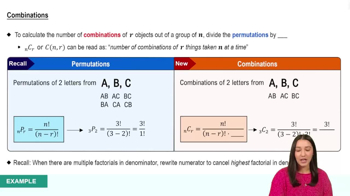
Combinations
Solving Linear Equations
Solving linear equations means finding the value of the variable that makes the equation true. This involves isolating the variable by performing inverse operations like addition, subtraction, multiplication, or division on both sides of the equation.
Recommended video:
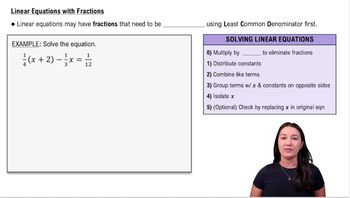
Solving Linear Equations with Fractions
Related Practice
Textbook Question
Textbook Question
Solve each equation. | (x - 4)/ 2| = 5
2
views
Textbook Question
Solve each equation using the zero-factor property. x2 + 2x - 8 = 0
1
views
Textbook Question
Determine the values of the variable that cannot possibly be solutions of each equation. Do not solve. 3/(x-2) + 1/(x+1) = 3/(x2-x-2)
Textbook Question
Solve each problem. See Example 1. The length of a rectangular label is 2.5 cm less than twice the width. The perimeter is 40.6 cm. Find the width.
5
views
Textbook Question
Use the following facts. If x represents an integer, then x+1 represents the next consecutive integer. If x represents an even integer, then x+2 represents the next consecutive even integer. If x represents an odd integer, then x+2 represents the next consecutive odd integer. Find two consecutive odd integers whose product is 143.