Ch. 1 - Equations and Inequalities
Lial - College Algebra 13th Edition
Lial13th EditionCollege AlgebraISBN: 9780136881063Not the one you use?Change textbook
Chapter 2, Problem 2

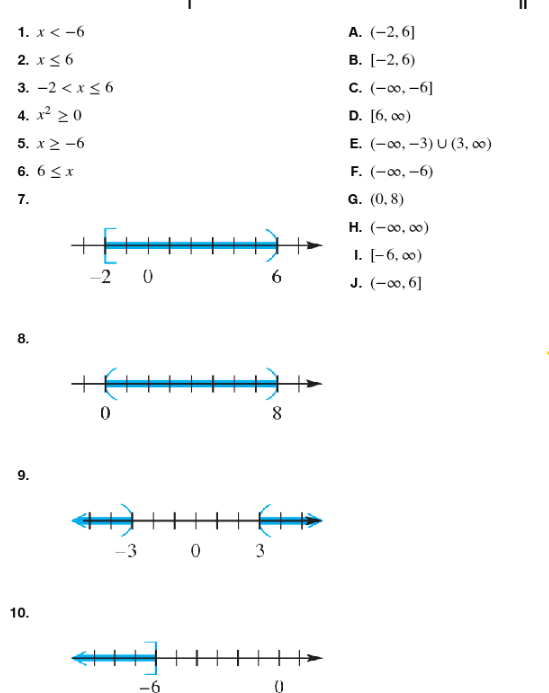
Match the inequality in each exercise in Column I with its equivalent interval notation in Column II. x≤6
Matching exercise with inequalities and interval notations alongside number lines illustrating solution sets.

Verified step by step guidance
1
Identify the inequality given: \(x \leq 6\) means that \(x\) can be any number less than or equal to 6.
Recall that interval notation expresses the set of all numbers that satisfy the inequality using brackets and parentheses.
Since \(x\) can be any number less than or equal to 6, the interval extends from negative infinity up to 6, including 6.
Use a parenthesis for infinity because infinity is not a number and cannot be included, and use a bracket for 6 because it is included: \((-\infty, 6]\).
Match the inequality \(x \leq 6\) with the interval notation \((-\infty, 6]\).

Verified video answer for a similar problem:

This video solution was recommended by our tutors as helpful for the problem above.
Video duration:
1m
Was this helpful?

Key Concepts

Here are the essential concepts you must grasp in order to answer the question correctly.

Inequalities

Inequalities express a relationship where one quantity is less than, greater than, or equal to another. In this case, x ≤ 6 means all values of x are less than or equal to 6. Understanding how to interpret and manipulate inequalities is essential for solving and representing them.
Recommended video:
06:07
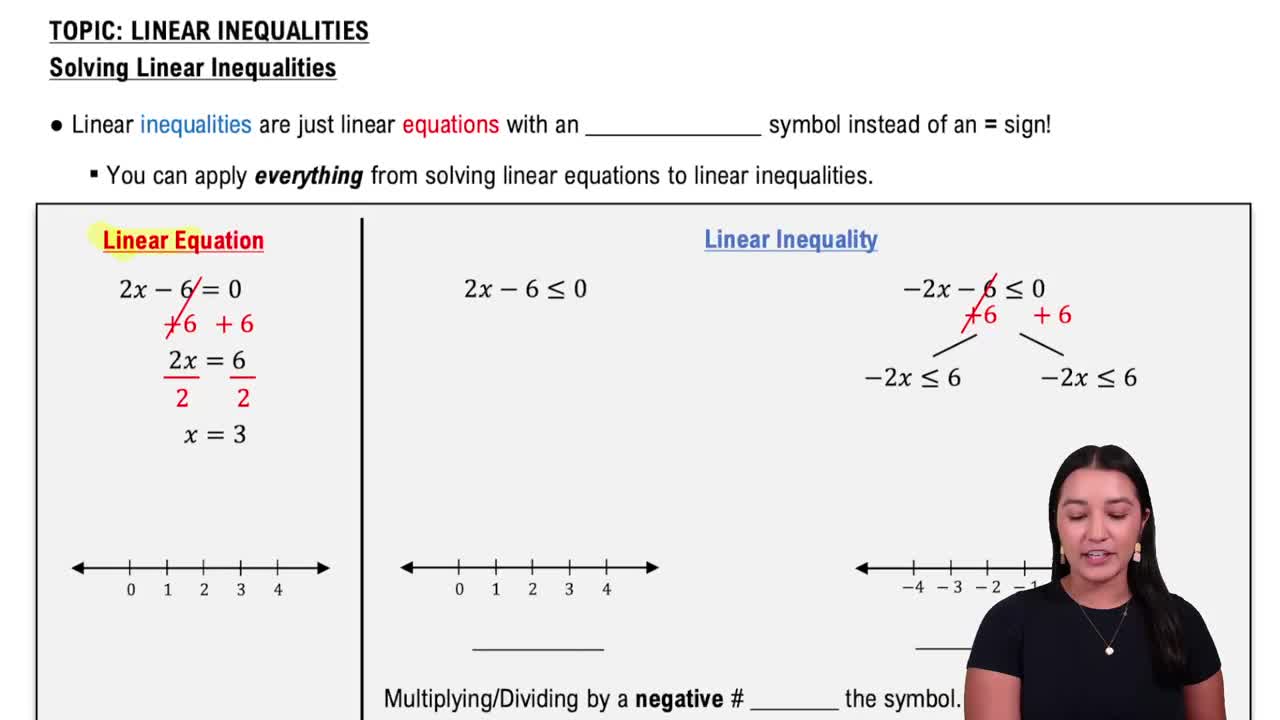
Linear Inequalities

Interval Notation

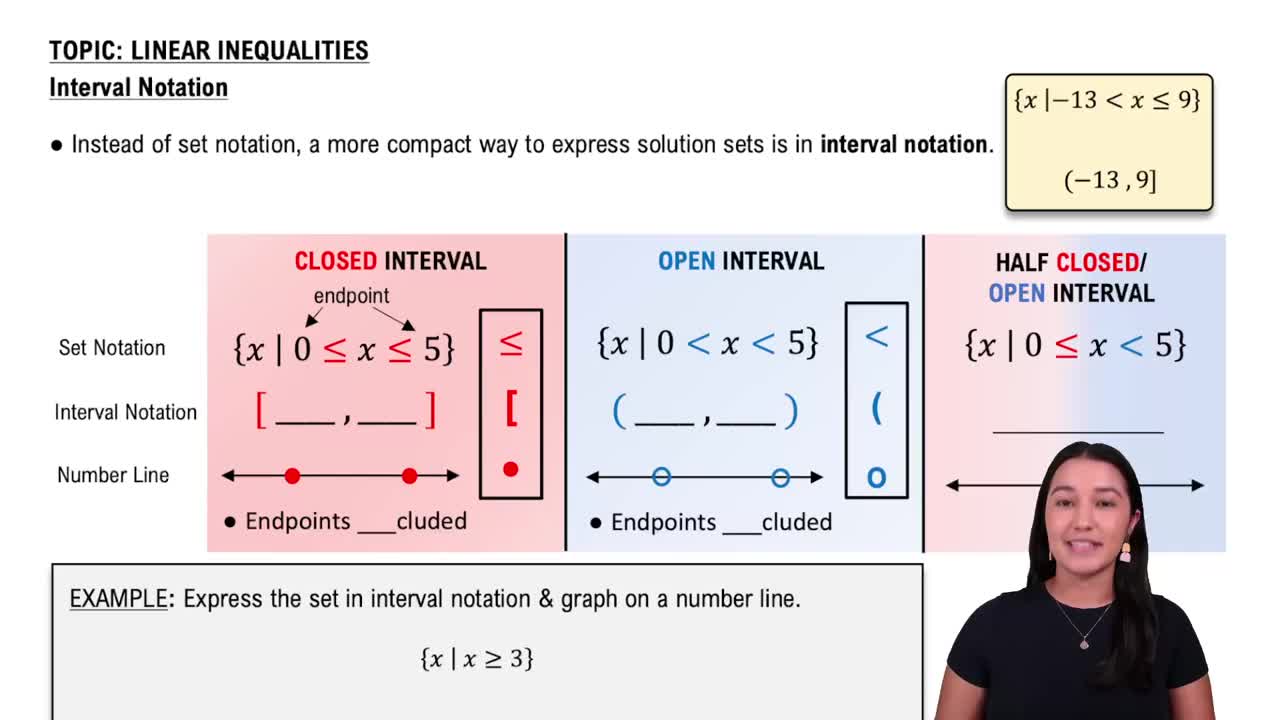
Interval notation is a concise way to represent sets of numbers on the number line. For inequalities like x ≤ 6, the interval includes all numbers up to 6, often written as (-∞, 6]. The square bracket indicates inclusion of the endpoint, while a parenthesis indicates exclusion.
Recommended video:
05:18
Interval Notation

Set Representation of Solutions

Solutions to inequalities can be expressed as sets, showing all possible values that satisfy the inequality. Recognizing how to convert between inequality notation and set or interval notation helps in understanding the solution's scope and communicating it clearly.
Recommended video:
06:00
Categorizing Linear Equations