Ch. 1 - Equations and Inequalities
Lial - College Algebra 13th Edition
Lial13th EditionCollege AlgebraISBN: 9780136881063Not the one you use?Change textbook
Chapter 2, Problem 1

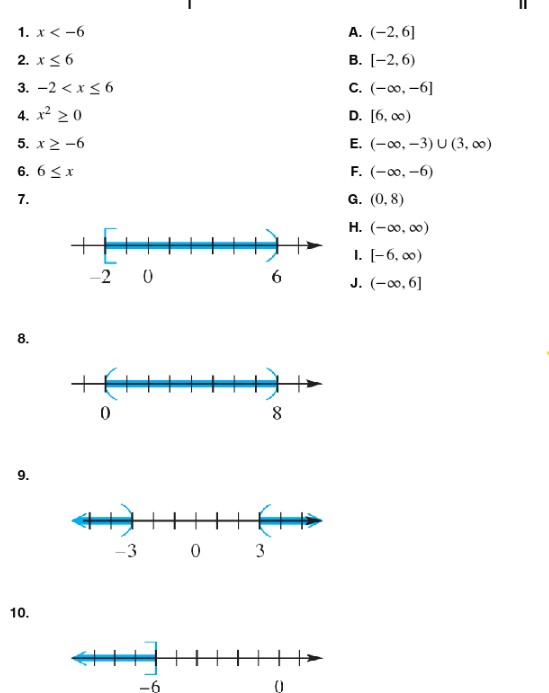
Match the inequality in each exercise in Column I with its equivalent interval notation in Column II. x<-6
Matching exercise pairs inequalities with their equivalent interval notations and number line graphs for practice.

Verified step by step guidance
1
Identify the inequality given: \(x < -6\). This means all values of \(x\) are less than \(-6\).
Recall that interval notation expresses the set of all numbers satisfying the inequality using parentheses and brackets.
Since \(x\) is less than \(-6\) but does not include \(-6\), use a parenthesis to indicate that \(-6\) is not included: \((-\infty, -6)\).
The interval starts from negative infinity because there is no lower bound to the values \(x\) can take, and extends up to but not including \(-6\).
Therefore, the inequality \(x < -6\) corresponds to the interval notation \((-\infty, -6)\).

Verified video answer for a similar problem:

This video solution was recommended by our tutors as helpful for the problem above.
Video duration:
1m
Was this helpful?

Key Concepts

Here are the essential concepts you must grasp in order to answer the question correctly.

Inequalities

Inequalities express a relationship where one quantity is less than or greater than another. In this case, x < -6 means all values of x are less than -6. Understanding how to interpret and manipulate inequalities is essential for solving and representing them.
Recommended video:
06:07
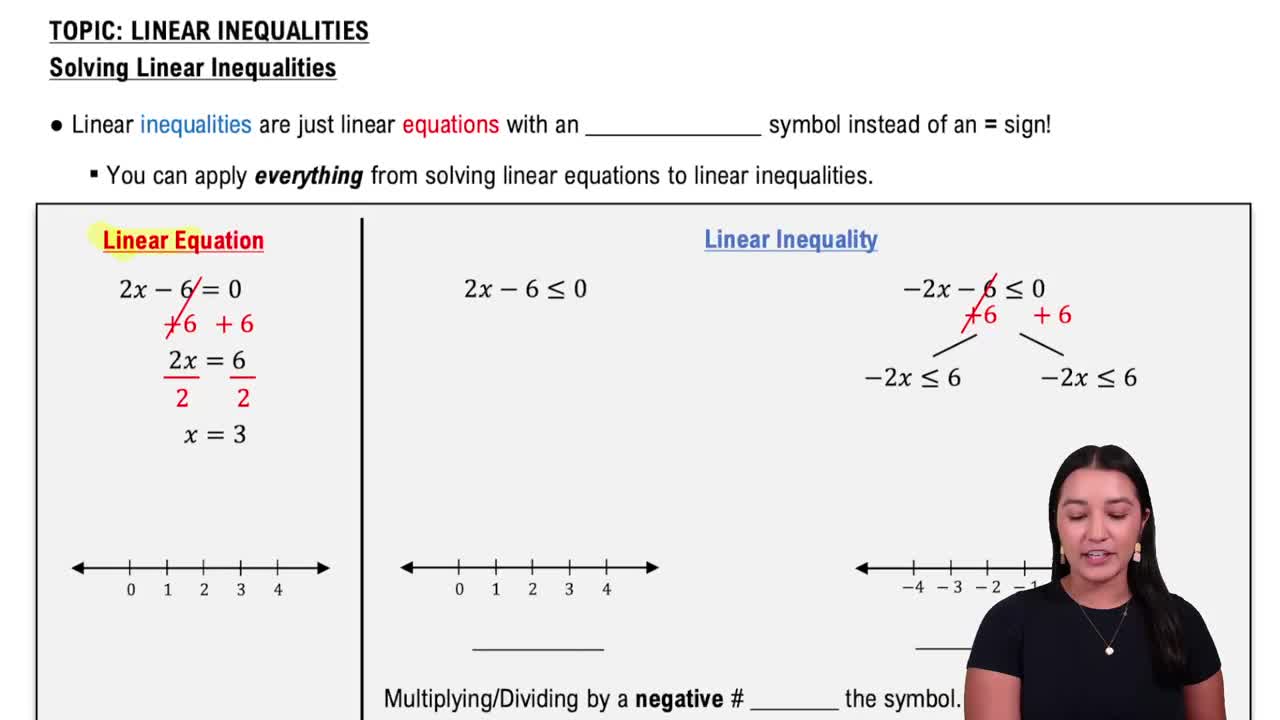
Linear Inequalities

Interval Notation

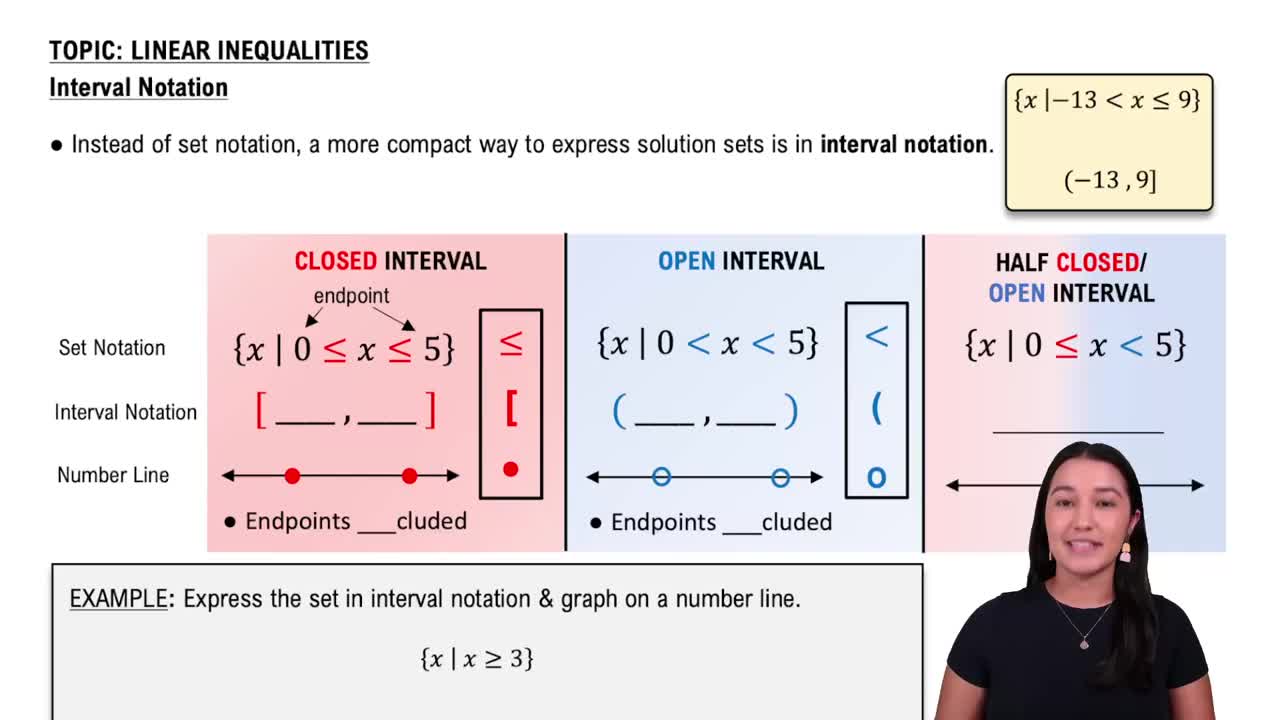
Interval notation is a concise way to represent sets of numbers between two endpoints. For inequalities like x < -6, the interval notation uses parentheses to indicate that -6 is not included, written as (-∞, -6). This notation helps clearly describe solution sets.
Recommended video:
05:18
Interval Notation

Matching Inequalities to Interval Notation

Matching involves translating an inequality into its equivalent interval form. Recognizing symbols like '<' or '≤' and knowing how they affect interval endpoints (open or closed) is crucial. This skill connects algebraic expressions with their set representations.
Recommended video:
05:18
Interval Notation