Ch. 1 - Equations and Inequalities
Lial - College Algebra 13th Edition
Lial13th EditionCollege AlgebraISBN: 9780136881063Not the one you use?Change textbook
Chapter 2, Problem 77a

Find each quotient. Write answers in standard form. (1-3i) / (1+i)

Verified step by step guidance
1
Identify the problem as dividing two complex numbers: \(\frac{1 - 3i}{1 + i}\).
To simplify, multiply the numerator and denominator by the conjugate of the denominator. The conjugate of \(1 + i\) is \(1 - i\), so multiply both numerator and denominator by \(1 - i\):
\[\frac{1 - 3i}{1 + i} \times \frac{1 - i}{1 - i}\]
Use the distributive property (FOIL) to expand both numerator and denominator:
Numerator: \((1 - 3i)(1 - i) = 1 \cdot 1 - 1 \cdot i - 3i \cdot 1 + (-3i)(-i)\)
Denominator: \((1 + i)(1 - i) = 1 \cdot 1 - 1 \cdot i + i \cdot 1 - i \cdot i\)
Simplify both expressions by combining like terms and using \(i^2 = -1\).
Finally, write the result in standard form \(a + bi\) by separating the real and imaginary parts.

Verified video answer for a similar problem:

This video solution was recommended by our tutors as helpful for the problem above.
Video duration:
4m
Was this helpful?

Key Concepts

Here are the essential concepts you must grasp in order to answer the question correctly.

Complex Numbers and Standard Form

Complex numbers are expressed in the form a + bi, where a is the real part and b is the imaginary part. Writing answers in standard form means presenting the result explicitly as a sum of a real number and an imaginary number, such as x + yi.
Recommended video:
05:02
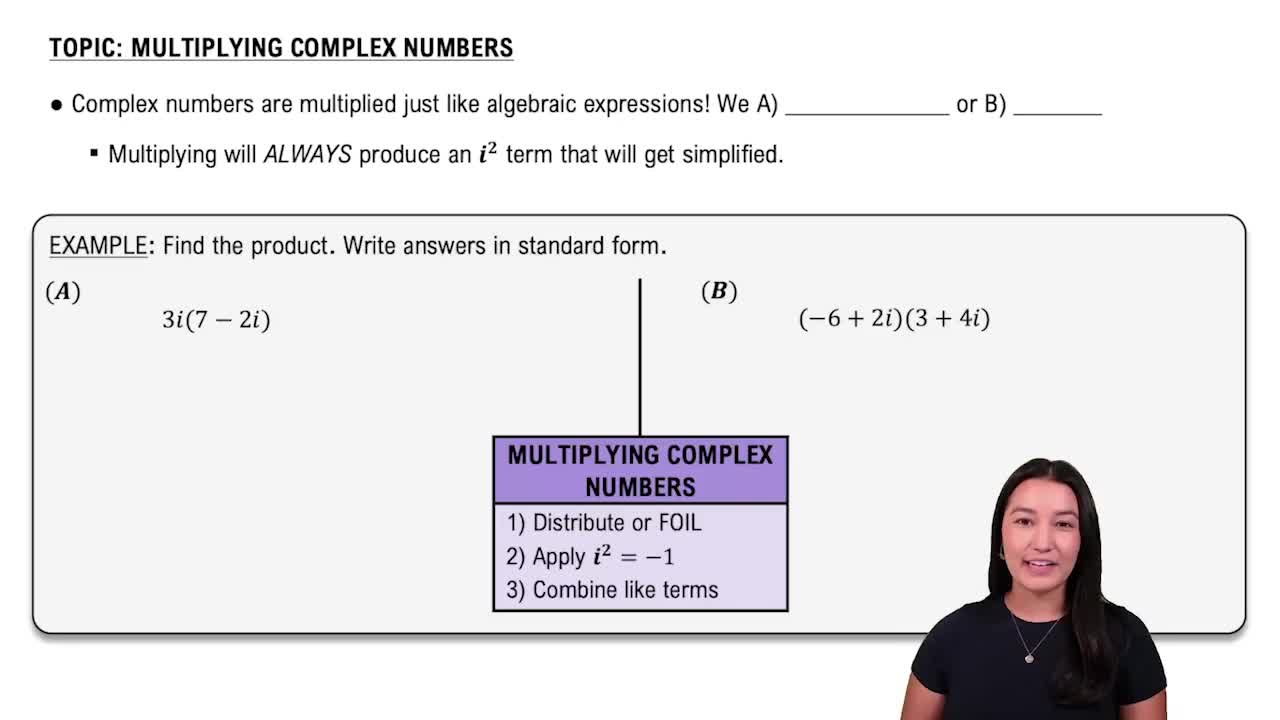
Multiplying Complex Numbers

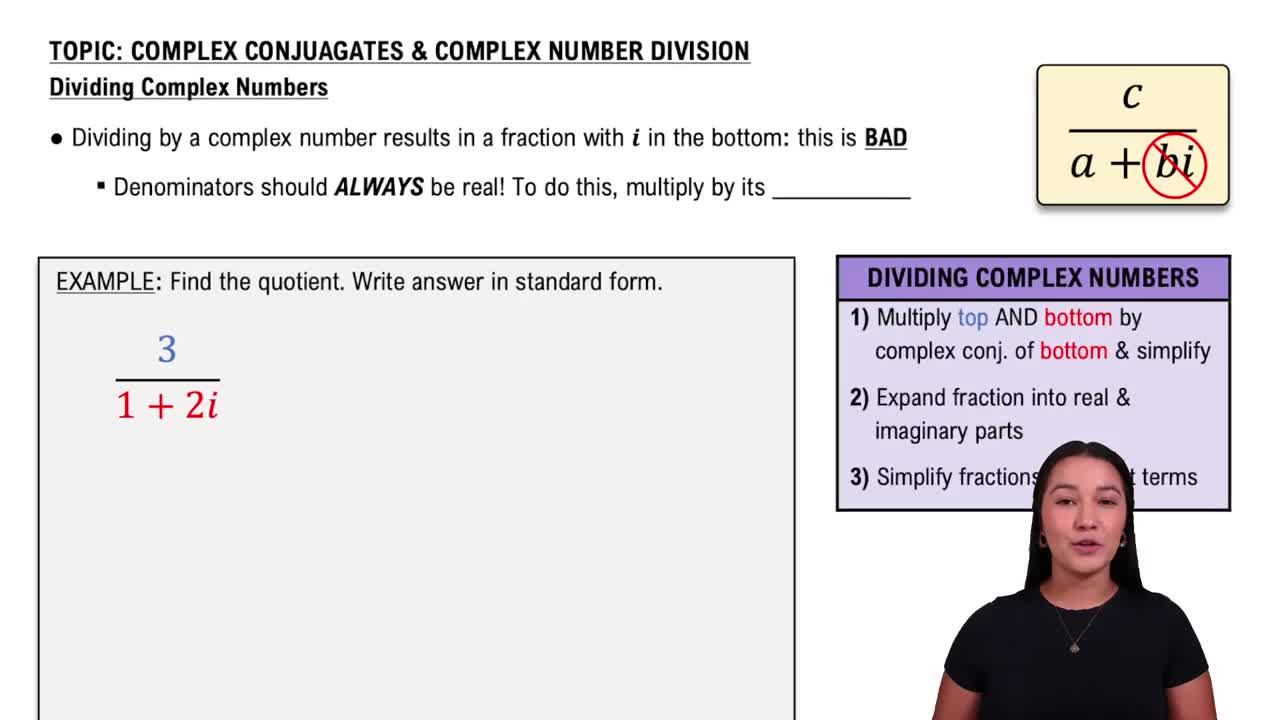
Division of Complex Numbers

Dividing complex numbers involves multiplying the numerator and denominator by the conjugate of the denominator to eliminate the imaginary part in the denominator. This process simplifies the expression to standard form.
Recommended video:
04:22
Dividing Complex Numbers

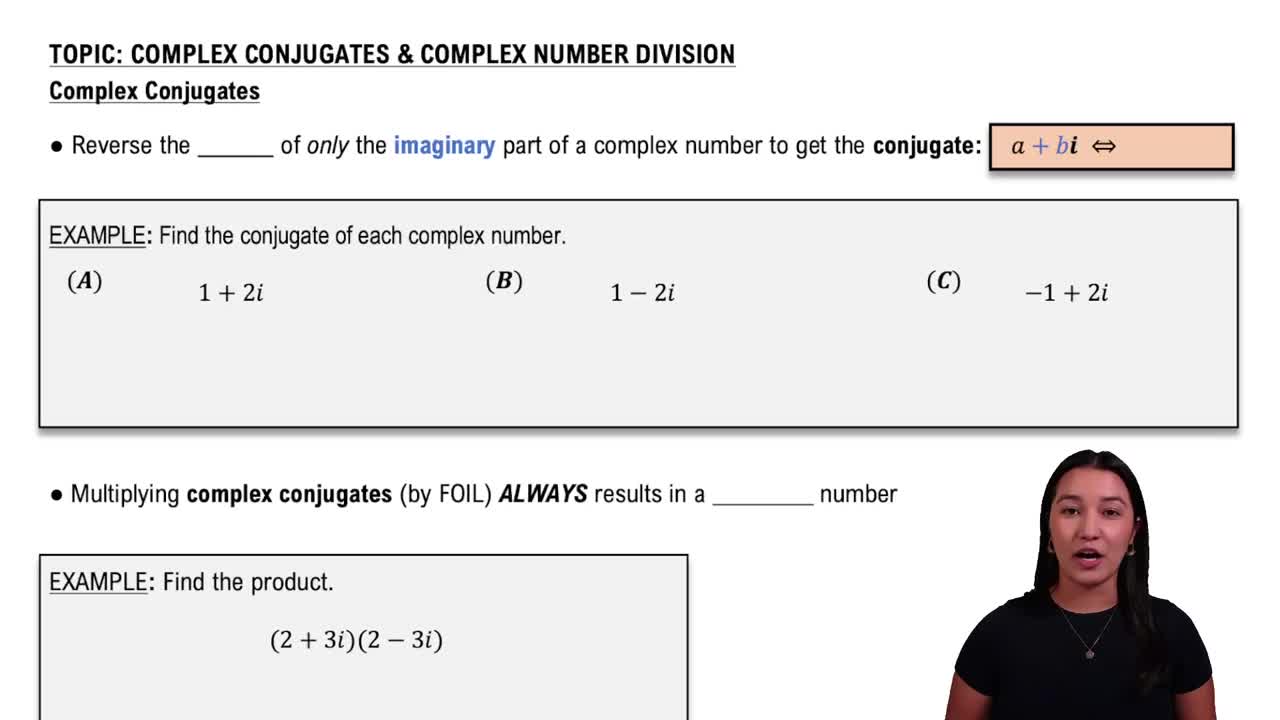
Complex Conjugate

The complex conjugate of a number a + bi is a - bi. Multiplying by the conjugate removes the imaginary part in the denominator because (a + bi)(a - bi) equals a² + b², a real number, facilitating division.
Recommended video:
05:33
Complex Conjugates